Betel nut palm
Areca Catechu
Betel nut palm in Motion
The Essence
"The Betel nut palm (Areca catechu) is a slender, solitary tropical palm best known as the world's primary source of the areca or betel nut, chewed by hundreds of millions of people across Asia and the Pacific as a mild stimulant. Despite that fame, it is also a handsome ornamental landscape palm, growing straight to about 20 m tall on a green trunk that ages to grey, marked with prominent white ringed leaf scars and crowned by pinnate leaves up to 2 m long. Fragrant cream flowers give way to smooth ovoid fruits, ripening from green to orange-yellow or red, each holding a single hard seed. The species is native to the Philippines but has been carried by people since at least around 1500 BCE, during the Austronesian migrations and trade, and is now cultivated or naturalized throughout the tropics. It is frost-tender and thrives only in warm, humid, frost-free climates (roughly USDA zone 10b to 11), making it a plant for true tropical and subtropical gardens."
The genus name Areca derives from a vernacular name for the plant used on the Malabar Coast of South India (rendered as 'areek'), Latinized by Linnaeus as the genus name; the underlying word is related to the Dravidian terms for the nut (e.g. Malayalam 'adakka', Tamil 'adaikkay'). The species epithet catechu comes from the Malay name 'cachu' (kachu) for the astringent extract, a word itself of ultimately Dravidian origin.
Areca catechu has travelled with people since at least around 1500 BCE, carried along the routes of the Austronesian migrations and trade, which spread it far beyond its native Philippines across the tropical world.
Natural Habitat
Areca catechu is native to the Philippines, where it occurs across provinces from Batanes and Cagayan in the north to Palawan, Sulu and Zamboanga del Sur in the south. Carried by people since at least around 1500 BCE, it is now cultivated or naturalized throughout tropical Asia, Taiwan, southern China, Madagascar and East Africa, the Pacific Islands and the West Indies. It grows primarily in the wet tropical biome, favouring humid tropical forest with high rainfall, from sea level up to around 1,000 m.
Curated Specimens
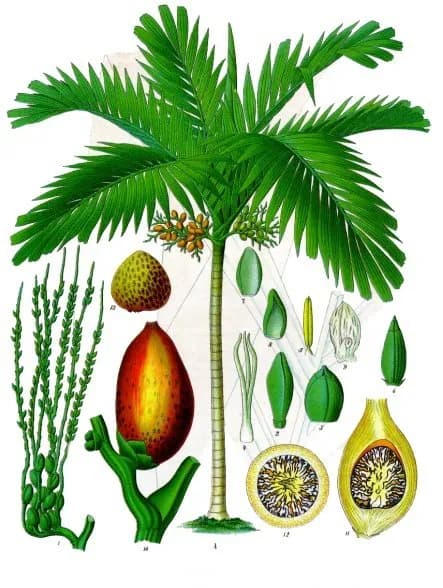
Botanical specimen of Areca Catechu.
Biology & Morphology
"A medium-sized, monoecious solitary palm growing straight to about 20 m tall on a slender trunk (greening when young, ageing to grey with prominent white ringed leaf scars), topped by pinnate leaves roughly 1.5 to 2 m long. Fragrant cream flowers are borne on branched inflorescences and ripen into smooth ovoid orange-yellow to red fibrous drupes about 4 to 6 cm long, each holding a single hard betel nut."
Morphology
Multi-stemmed clumping architecture with slender, clustering canes exhibiting high tensile strength.
Adventitious root system spreading radially to maximize hydraulic intake in competitive soil matrices.
Distinctive solitary/clumping habit and medium stature providing a unique architectural profile.
Foliage
Vibrant green canopy featuring feather-like pinnate fronds with reinforced midribs and high surface-area leaflets.
Specialized green tissues exhibiting moderate metabolic expansion rates.
Reproduction
Complex inflorescence branching typical of the Areca clade, exhibiting seasonal reproductive synchrony.
Nutrient-dense drupes encased in a fibrous pericarp, optimized for protection and dispersal.
Dormant embryonic tissues with high endosperm density, characteristic of resilient Areca specimens.
Ecology
Active rhizosphere communication with mycorrhizal fungal networks, enhancing phosphorus and micronutrient uptake.
Interlocked with local entomological vectors, primarily Meliponini bees or specialized coleoptera.
Gravity-mediated and animal-vectored dispersal mechanisms ensuring regional genetic distribution.
Germination & Propagation
Germination Timeline
Hydration soak.
Incubation in moist media.
Sprout emergence.
Use fresh seed for best results. These figures come from a single secondary botanical source and should be treated as approximate.
Cultivation & Care
Light
Juvenile plants prefer partial shade, while mature plants prefer (and need) full sun.
Water
Demands high, constant humidity in both air and soil along with abundant water; it is associated with humid tropics receiving annual rainfall above roughly 2,000 mm spread throughout the year.
Soil
Tolerant of a wide range of soils provided they are well-drained, with a preference for acidic to neutral soils rich in organic matter.
This is a frost-tender palm that is not frost-hardy. It thrives only where temperatures stay above about 10 C (50 F), corresponding roughly to USDA zone 10b to 11. (Hardiness figures come from horticultural sources rather than primary botanical authorities, so treat them as approximate.)
Pests, Diseases & Care
Pests
Oryctes rhinoceros (Asiatic Rhinoceros Beetle)
HIGHSevere damage to young spear leaves and apical bud.
Pheromone lures and integration of viral control (Oryctes nudivirus).
Chrysomphalus aonidum (Florida Red Scale)
MODERATEYellow spotting and premature leaf drop in high-humidity zones.
Introduction of Aphytis holoxanthus (parasitic wasp).
Diseases
Thielaviopsis punctulata (Black Scorch)
HIGHBlackening and dwarfing of newly emerging fronds.
Wound protection and application of thiophanate-methyl.
Phytophthora palmivora (Bud Rot)
CRITICALNecrosis of the spear leaf and decay of the meristem.
Fosetyl-Al application and optimizing canopy ventilation.
Nutritional Deficiencies
Interveinal chlorosis (Younger fronds)
Chelated Fe-EDDHA Soil Pulse
Marginal chlorosis (Older fronds)
Mg-Sulfate (Kieserite) saturation
Frizzletop / Distorted spear
Systemic Mn-Sulfate application
Care Tips
Biosurveillance pulse synchronized for Asia regional vectors.
Apply prophylactic fungicidal drench in the nocturnal phase.
Improve canopy ventilation to disrupt fungal sporulation cycles.
Sources & Conservation
Curated- Areca catechu L. | Plants of the World Online (POWO) | Kew Science · accessed 2026-06
- Areca catechu - Wikipedia · accessed 2026-06
- Areca catechu (Betel Nut Palm) - IUCN Red List (assessed 2022, Least Concern; ID 67530457) · accessed 2026-06
- Areca catechu - Monaco Nature Encyclopedia · accessed 2026-06
- Areca catechu: Systematics, Etymology, Habitat, Cultivation - Antropocene.it · accessed 2026-06