Black basselinia
Basselinia Pancheri • Me Ori basselinia
Black basselinia in Motion
The Essence
"Basselinia pancheri is a slender New Caledonian palm, often regarded as one of the most attractive of the island's palms for its crownshaft, which ranges from brown through dark red to purplish black outside and is brilliant orange within. Solitary and rarely clustering, it reaches 10-15 m on a trunk only 2-10 cm thick, sometimes with adventitious roots at the base, and carries a small crown of 5-8 stiff, nearly entire, erect leaves. It grows in the forest subcanopy or as an emergent, and is dominant in disturbed areas. In a genus of twelve species confined to New Caledonia, it is described as one of the most adaptable and does well in most tropical and subtropical climates, though it remains slow and fastidious in cultivation: a Californian account records it grown there on multiple occasions but with no adult specimens as of 2015. Its seeds are sold into the international horticultural trade, and a distinctive very compact-crowned form from high altitude on Me Ori is offered separately. Synonyms include Kentia pancheri, Cyphokentia pancheri, Clinostigma pancheri, Microkentia pancheri and Nephrocarpus schlechteri."
The genus name Basselinia honours the French poet Olivier Basselin (1400-1450); the epithet pancheri honours the French botanist Jean Armand Isidore Pancher (1814-1877), who collected in New Caledonia.
First described as Kentia pancheri by Brongniart and Gris in Bulletin de la Societe Botanique de France 11: 316 (1864); the current combination was published by Eugene Vieillard (1819-1896) in Bulletin de la Societe Linneenne de Normandie, ser. 2, 6: 232 (1873).
Natural Habitat
Endemic to New Caledonia, occurring throughout Grande Terre and more common in the south, with an estimated extent of occurrence of 12,413 km2; Kew's checklist summarises the range as western and southern New Caledonia, and other accounts give rainforest in the south, west and north-west. It grows in dense humid forest and shrubland on serpentine (ultramafic) soils at 96-1,100 m, in rainforest undergrowth on shallow or deep ground or on scree, and also persists in disturbed habitats and open, exposed situations. Some subpopulations are affected by mining and fires; the species is legally protected in Province Nord and occurs in protected areas including Mont Panie and Blue River Provincial Park.
Curated Specimens
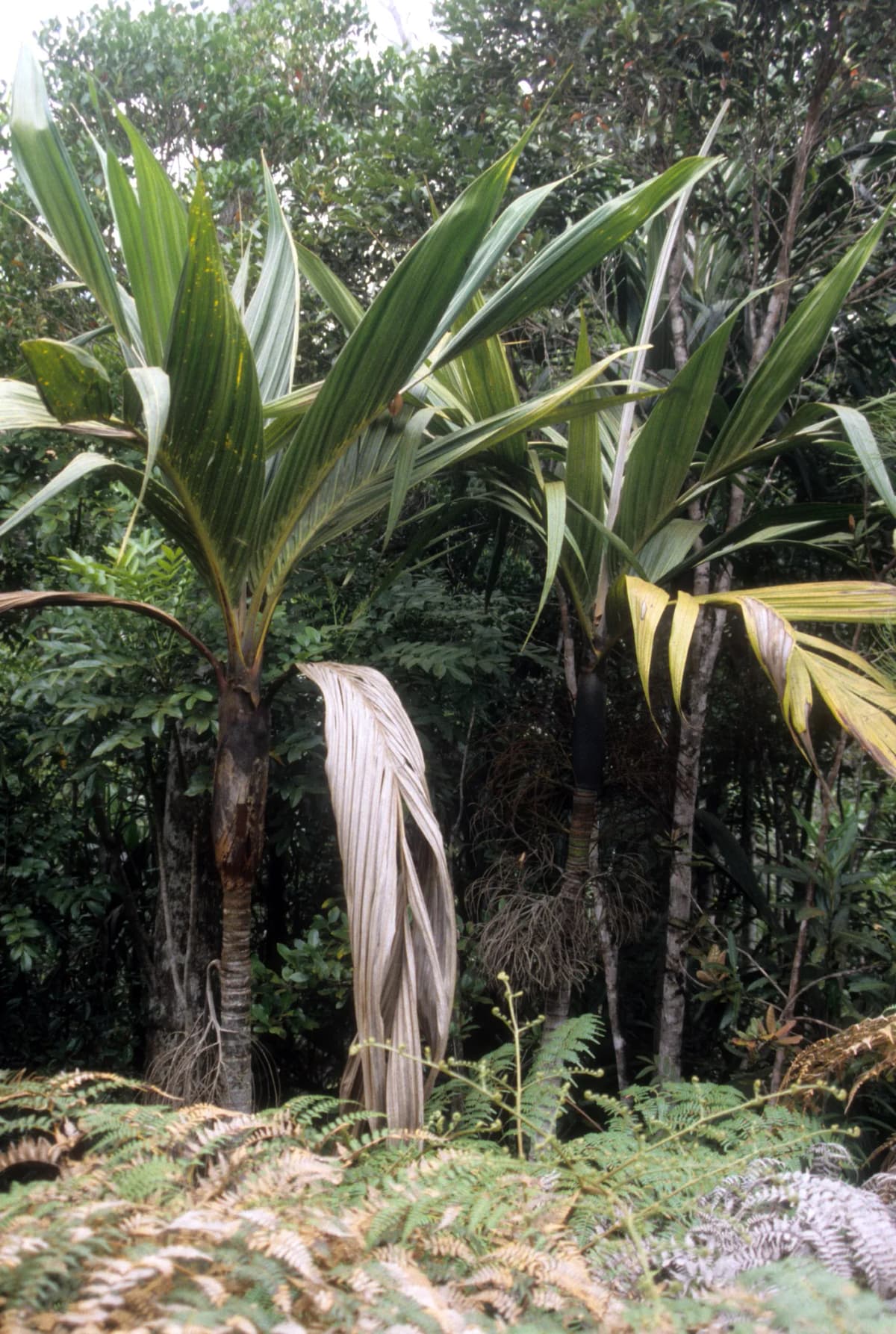
Botanical specimen of Basselinia Pancheri.
Biology & Morphology
"A solitary, rarely clustering, monoecious palm of 10-15 m with a slender green or grey trunk 2-10 cm in diameter, 5-8 stiff erect leaves 0.30-1.30 m long bearing 6-20 rigid, strongly ridged pinnae per side that are bright green above and brownish-scaly beneath, a prominent brown to purplish-black crownshaft with a brilliant orange interior, inflorescences branched one to three times below the leaves, and bilobed to kidney-shaped fruit 6-8 x 6-9 mm ripening shiny black."
Morphology
Symmetrical columnar trunk with characteristic leaf-scar patterning and lignified outer cortex.
Adventitious root system spreading radially to maximize hydraulic intake in competitive soil matrices.
Distinctive unknown habit and medium stature providing a unique architectural profile.
Foliage
Vibrant green canopy featuring characteristic frond architecture optimized for photon interception and transpiration efficiency.
Specialized green tissues exhibiting moderate metabolic expansion rates.
Reproduction
Complex inflorescence branching typical of the Basselinia clade, exhibiting seasonal reproductive synchrony.
Nutrient-dense drupes encased in a fibrous pericarp, optimized for protection and dispersal.
Dormant embryonic tissues with high endosperm density, characteristic of resilient Basselinia specimens.
Ecology
Active rhizosphere communication with mycorrhizal fungal networks, enhancing phosphorus and micronutrient uptake.
Interlocked with Pacific avian and entomological vectors adapted to island ecosystems.
Gravity-mediated and animal-vectored dispersal mechanisms ensuring regional genetic distribution.
Germination & Propagation
Germination Timeline
Hydration soak.
Incubation in moist media.
Sprout emergence.
A commercial seed supplier rates germination 2.0 out of 5 on a difficult-to-easy scale, and germination time 4.0 out of 5 on a years-to-days scale. No species-specific pre-treatment or temperature data was found in the sources consulted.
Cultivation & Care
Light
Light shade to full sun when mature. A commercial seed supplier lists light shade in all climates and in dry, hot climates, with deep shade when young and in dry, hot climates. In marginal conditions such as California it is grown in shade to filtered light.
Water
High water requirements. Keep the soil consistently moist to wet; drought tolerance is low.
Soil
Moist, acidic, well-draining soil in cultivation. In the wild it grows on ultramafic (serpentine) substrates; ten of the twelve species of Basselinia are restricted to either serpentine or schistose soils.
Frost-tender: frost tolerance is rated as light and a minimum temperature of about 0 C (32 F) is listed, along with a need for a very warm, relatively windless, frost-free and somewhat humid climate. It does well in most tropical and subtropical climates. Growth is slow to very slow and it is described as a touchy plant. No quantified deep-frost tolerance is published.
Pests, Diseases & Care
Pests
Promecotheca caerulipennis (Fiji Leafminer)
MODERATEBlistering of leaflets leading to significant photosynthetic loss.
Augmentation of native hymenopteran parasitoids.
Brontispa longissima (Coconut Leaf Beetle)
HIGHBrowning and drying of young fronds; high impact on tropical palms.
Biological control using parasitic wasps (Tetrastichus brontispae).
Diseases
Thielaviopsis punctulata (Black Scorch)
HIGHBlackening and dwarfing of newly emerging fronds.
Wound protection and application of thiophanate-methyl.
Colletotrichum spp. (Anthracnose)
MODERATEBlack necrotic spots on leaflets under high humidity.
Copper-based fungicides and reduction of overhead irrigation.
Nutritional Deficiencies
Interveinal chlorosis (Younger fronds)
Chelated Fe-EDDHA Soil Pulse
Marginal chlorosis (Older fronds)
Mg-Sulfate (Kieserite) saturation
Frizzletop / Distorted spear
Systemic Mn-Sulfate application
Care Tips
Biosurveillance pulse synchronized for Oceania regional vectors.
Apply prophylactic fungicidal drench in the nocturnal phase.
Improve canopy ventilation to disrupt fungal sporulation cycles.
Sources & Conservation
Curated- Plants of the World Online (Kew) – Basselinia pancheri · accessed 2026-09
- International Plant Names Index (IPNI) – Basselinia pancheri · accessed 2026-09
- Wikipedia – Basselinia pancheri · accessed 2026-09
- IUCN Red List – Basselinia pancheri (LC, assessed 2016) · accessed 2026-09
- Palmpedia – Basselinia pancheri · accessed 2026-09
- PACSOA Wiki – Basselinia pancheri · accessed 2026-09
- Palmweb – genus Basselinia · accessed 2026-09
- Palms For California – Basselinia pancheri (Geoff Stein) · accessed 2026-09
- Rare Palm Seeds – Basselinia pancheri (Black Basselinia) · accessed 2026-09
- GBIF – Basselinia pancheri (Brongn. & Gris) Vieill. · accessed 2026-09
- Wikipedia (Spanish) – Basselinia pancheri (etymology) · accessed 2026-09