Brilliant Palm
Cyphokentia Macrostachya
The Essence
"Cyphokentia macrostachya is one of only two species in Cyphokentia, a genus endemic to New Caledonia whose closest relative is Clinosperma — together the sole genera of subtribe Clinospermatinae. It grows only on the main island, Grande Terre, in rain forest on free-draining ground: POWO records it from central and southern New Caledonia and Rare Palm Seeds from the south and centre, while Palmpedia describes a wide but disjunct range taking in the far south, the centre and the northeast coast. Trunks reach roughly 15 m, carrying a crownshaft 0.5–1 m long that Palmpedia describes as light green, entirely covered in a whitish waxy coating and pale pinkish-white inside. Heavily branched inflorescences about 90 × 70 cm emerge below the crownshaft, reddish when young and later greenish, and ripen single-seeded fruit 10–20 mm long, red or black. Brongniart published the name in 1873, and the IUCN assessed the species as Least Concern in 2016, publishing the assessment in 2017. It is exceedingly rare in cultivation: the grower Geoff Stein notes its dark reddish crownshaft under a thick coating of white powder and its "very regular, evenly spaced, perfectly recurved pinnate leaves", but seed is nearly impossible to come by, reputedly difficult to germinate and very slow to grow."
Wikipedia states that the genus name Cyphokentia is formed from two Greek words meaning 'tumor' and 'Kentia', a former palm genus. The sources retrieved do not explain the meaning of the epithet macrostachya.
Brongniart published the name in Comptes Rendus Hebd. Séances Acad. Sci. 77: 399 (1873). POWO lists six synonyms, among them Cyphokentia robusta, Dolichokentia robusta, Clinostigma macrostachyum and Kentia macrostachya. POWO and the GBIF backbone give the authorship as Brongn., while Wikipedia's genus page and the IUCN taxonomy give Pancher ex Brongn. Palmpedia's gallery documents cultivated specimens at Floribunda in Hawaii and in the Mt Warning caldera, New South Wales, Australia.
Natural Habitat
New Caledonian rain forest on the main island, Grande Terre. The IUCN records the habitat system as terrestrial and the habitat type simply as forest, with the palm known from 1–20 locations between a lower elevation limit of 170 m and an upper limit of 800 m; Wikipedia gives sea level to 900 m, and Rare Palm Seeds describes montane rainforest between 50 and 900 m. Palmpedia's habitat photographs come from Rivière Bleue, Yaté, Amoa, Tyé, Povila and Mont Aoupinié. Substrate is free-draining — schistose soil according to Wikipedia, and primarily deep ultramafic as well as volcano-sedimentary substrate according to Palmpedia. Plants grow in filtered light or shade until they reach the top of the canopy in later life.
Curated Specimens
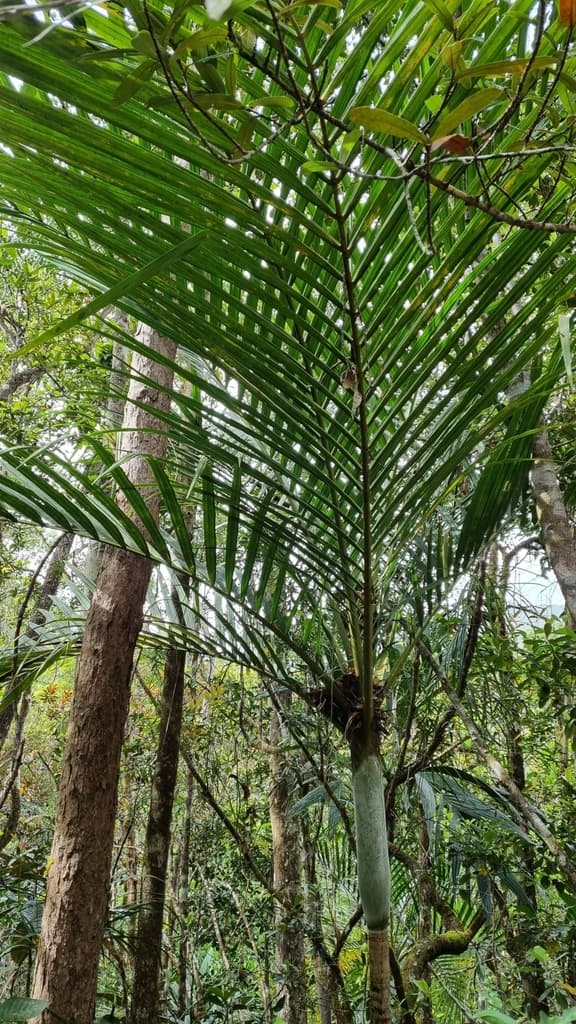
Botanical specimen of Cyphokentia Macrostachya.
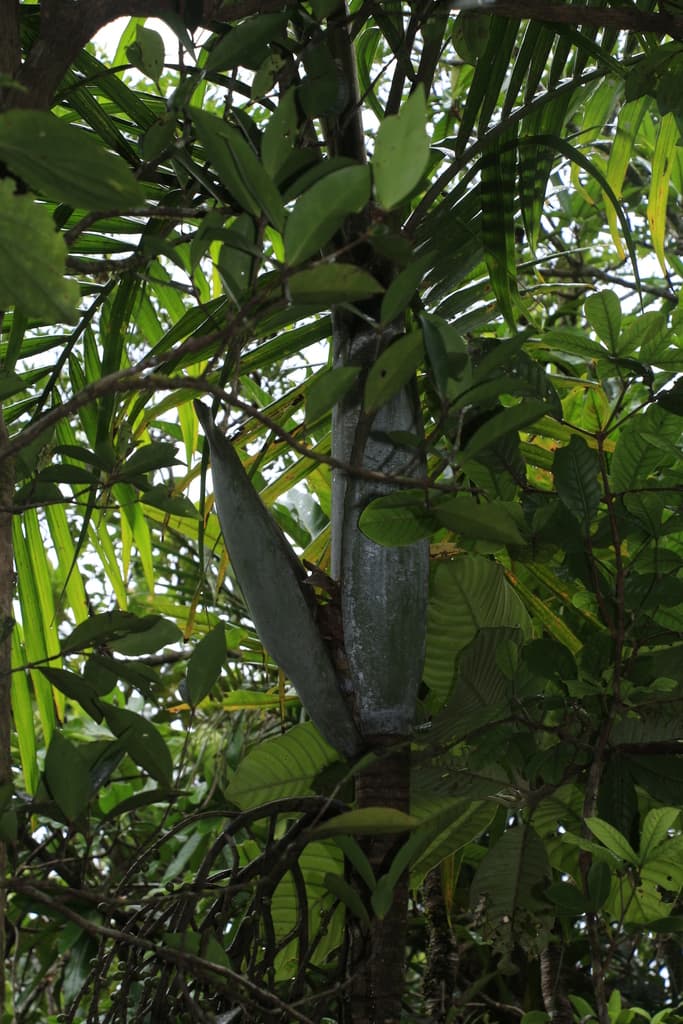
Botanical specimen of Cyphokentia Macrostachya.
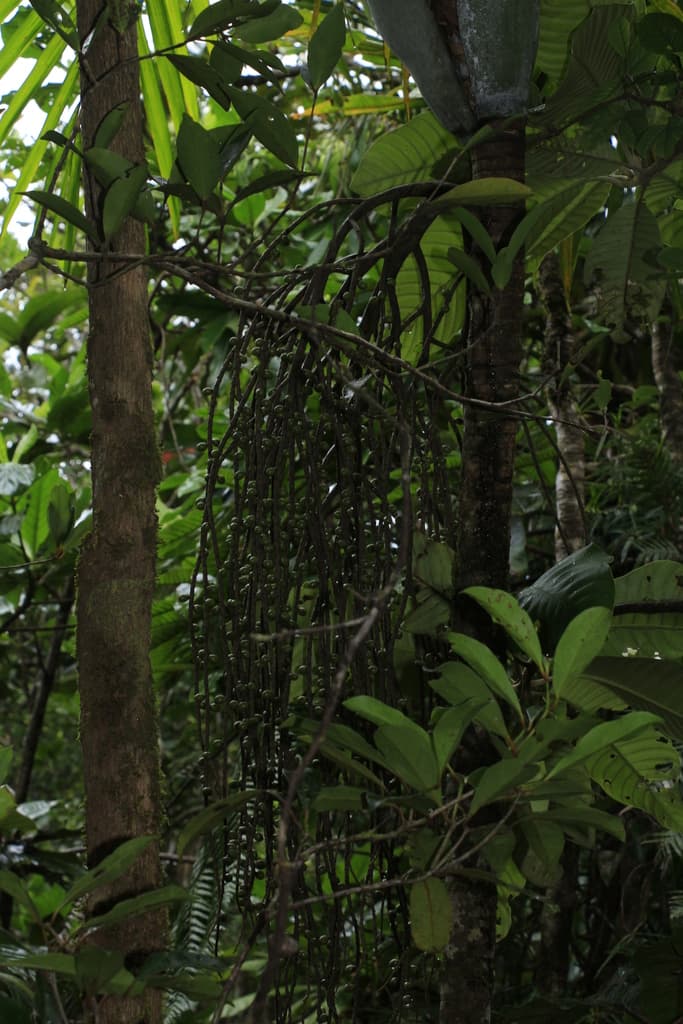
Botanical specimen of Cyphokentia Macrostachya.
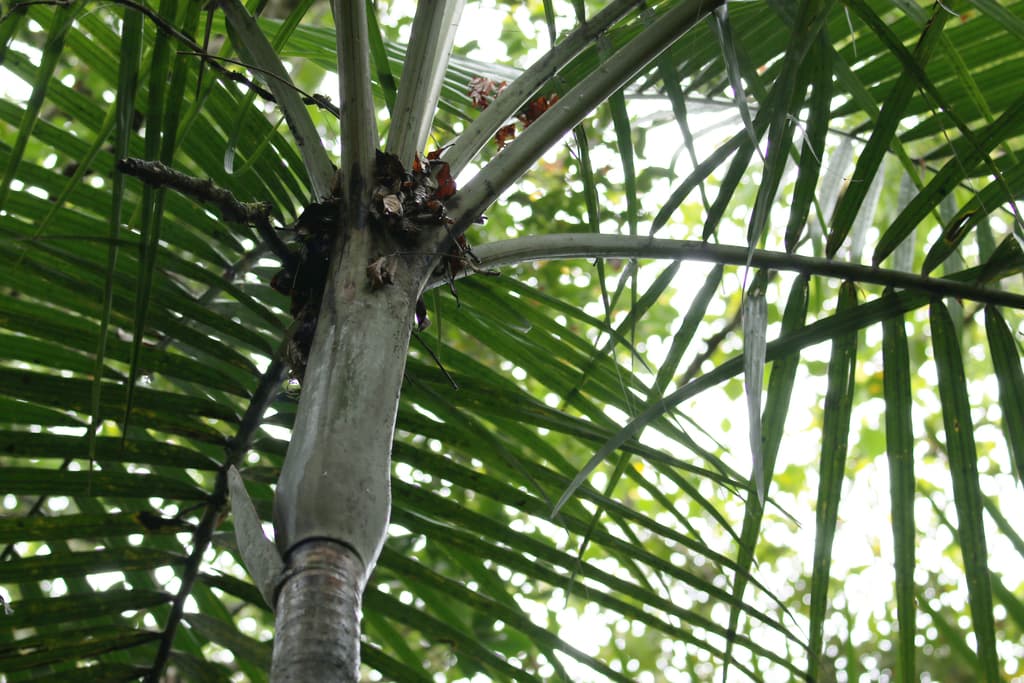
Botanical specimen of Cyphokentia Macrostachya.
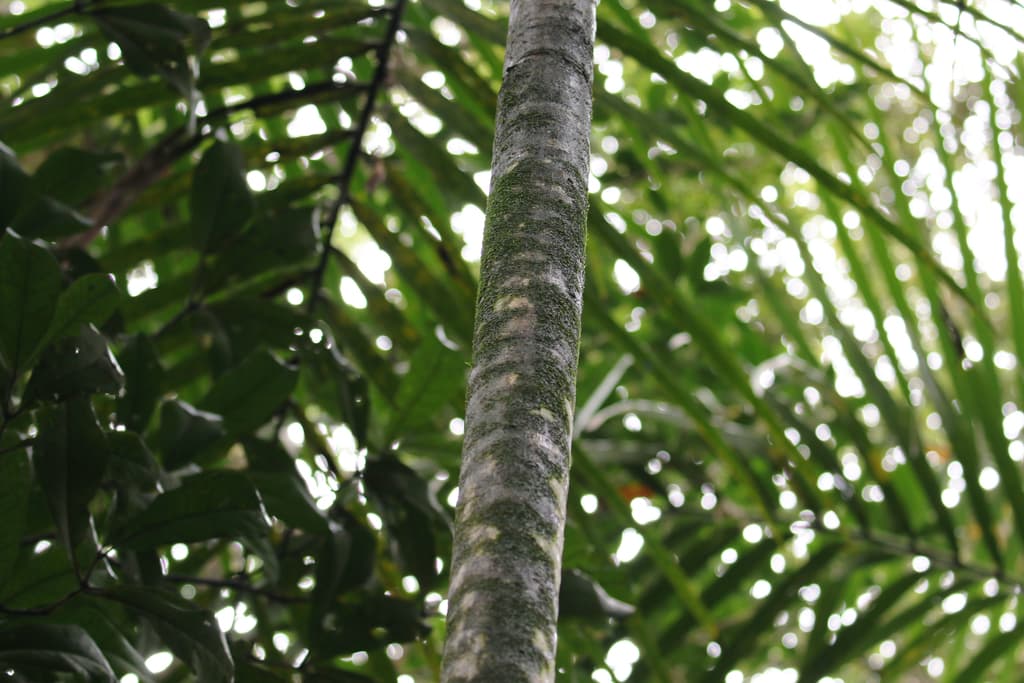
Botanical specimen of Cyphokentia Macrostachya.
Biology & Morphology
"Solitary pinnate-leaved crownshaft palm with a trunk to about 15 m and 10–15 cm in diameter (Wikipedia gives over 15 m at 20 cm, slightly bulging at the base), a crownshaft 0.5–1 m long — light green under a whitish waxy coating per Palmpedia, though Wikipedia instead describes it as covered in tomentum and scales and brown to gray to white — a crown of 8–15 recurving leaves more than 2 m long (to about 3 m), branched spreading inflorescences below the crownshaft, and ellipsoid to globose fruit 10–20 × 7–11 mm ripening red or black with a single seed about 10 × 6 mm."
Morphology
Symmetrical columnar trunk with characteristic leaf-scar patterning and lignified outer cortex.
Adventitious root system spreading radially to maximize hydraulic intake in competitive soil matrices.
Distinctive unknown habit and medium stature providing a unique architectural profile.
Foliage
Vibrant green canopy featuring characteristic frond architecture optimized for photon interception and transpiration efficiency.
Specialized green tissues exhibiting moderate metabolic expansion rates.
Reproduction
Complex inflorescence branching typical of the Cyphokentia clade, exhibiting seasonal reproductive synchrony.
Nutrient-dense drupes encased in a fibrous pericarp, optimized for protection and dispersal.
Dormant embryonic tissues with high endosperm density, characteristic of resilient Cyphokentia specimens.
Ecology
Active rhizosphere communication with mycorrhizal fungal networks, enhancing phosphorus and micronutrient uptake.
Interlocked with Pacific avian and entomological vectors adapted to island ecosystems.
Gravity-mediated and animal-vectored dispersal mechanisms ensuring regional genetic distribution.
Germination & Propagation
Germination Timeline
Hydration soak.
Incubation in moist media.
Sprout emergence.
Reputed to be difficult to germinate and very slow growing (Rare Palm Seeds); Palmpedia likewise calls it slow growing. No detailed germination protocol was found in the sources, and Rare Palm Seeds notes that seed is nearly impossible to come by.
Cultivation & Care
Light
Filtered light or shade until the palm reaches the top of the canopy in later life (Wikipedia); Rare Palm Seeds advises light shade when young.
Water
Rare Palm Seeds rates its water requirements as high and its wind tolerance as low.
Soil
No explicit horticultural soil guidance was found in the sources. In habitat it grows on free-draining soils — schistose soil per Wikipedia, and primarily deep ultramafic and volcano-sedimentary substrates per Palmpedia — which points to a need for free drainage.
Palmpedia rates it USDA zone 10a and calls it slow growing, though faster than Cyphokentia cerifera. Wikipedia says plants are not tolerant of frost; Rare Palm Seeds lists frost tolerance as 'light' and growth rate as very slow, and reports that it does well in most warm temperate and tropical climates.
Pests, Diseases & Care
Pests
Brontispa longissima (Coconut Leaf Beetle)
HIGHBrowning and drying of young fronds; high impact on tropical palms.
Biological control using parasitic wasps (Tetrastichus brontispae).
Promecotheca caerulipennis (Fiji Leafminer)
MODERATEBlistering of leaflets leading to significant photosynthetic loss.
Augmentation of native hymenopteran parasitoids.
Diseases
Colletotrichum spp. (Anthracnose)
MODERATEBlack necrotic spots on leaflets under high humidity.
Copper-based fungicides and reduction of overhead irrigation.
Phytophthora palmivora (Bud Rot)
CRITICALNecrosis of the spear leaf and decay of the meristem.
Fosetyl-Al application and optimizing canopy ventilation.
Nutritional Deficiencies
Interveinal chlorosis (Younger fronds)
Chelated Fe-EDDHA Soil Pulse
Marginal chlorosis (Older fronds)
Mg-Sulfate (Kieserite) saturation
Frizzletop / Distorted spear
Systemic Mn-Sulfate application
Care Tips
Biosurveillance pulse synchronized for Oceania regional vectors.
Apply prophylactic fungicidal drench in the nocturnal phase.
Improve canopy ventilation to disrupt fungal sporulation cycles.
Sources & Conservation
Curated- Plants of the World Online (POWO), Kew — Cyphokentia macrostachya Brongn. · accessed 2026-09
- IUCN Red List — Cyphokentia macrostachya (e.T38500A115773526, assessed 2016, published 2017) · accessed 2026-09
- Wikipedia — Cyphokentia macrostachya · accessed 2026-09
- Wikipedia — Cyphokentia (genus) · accessed 2026-09
- Palmpedia — Cyphokentia macrostachya · accessed 2026-09
- GBIF — Cyphokentia macrostachya Brongn. (taxon 2739213, confirmed via api.gbif.org) · accessed 2026-09
- Rare Palm Seeds — Cyphokentia macrostachya (Brilliant Palm) · accessed 2026-09