Elegant kentia palm
Cyphophoenix Elegans
The Essence
"Cyphophoenix elegans is a solitary, pinnate-leaved palm found only in north-eastern New Caledonia, where it grows in rain forest on slopes of Grande Terre at 200–550 m, over soils derived from schist and deep shale. It was described in 1864 as Kentia elegans by Brongniart and Gris and moved to Cyphophoenix in 1884 — a history remembered in its trade name, elegant kentia palm. The genus holds just four species, three on New Caledonia's main island and one in the Loyalty Islands. Reaching 8–10 m, the palm carries a slender trunk ringed by leaf scars, an olive-green crownshaft covered in greyish tomentum, and a crown of 7–10 markedly upright leaves about 2 m long, arched towards the tip — a distinctive silhouette. The ovoid fruits, about 2 cm long, ripen red. In the wild the species is Endangered: it is known from only two locations, its habitat quality is declining, it faces frequent bushfires and introduced animals — rats that eat its seeds, deer that destroy seedlings, pigs that damage its habitat — and it occurs in no protected area, with no ex-situ conservation programme. Its seeds nonetheless enter the international horticultural trade, where it is a prized but very slow collector's palm — surprisingly hardy in southern California, standing brief frosts to about -3 °C, yet far too slow for commercial landscaping."
Cyphophoenix combines the Greek kyphos, meaning bent or humped, with phoenix, a general Greek name for a palm — perhaps a reference to the prominent terminal stigmatic remains on the fruit. The Latin epithet elegans means elegant or graceful.
Described in 1864 as Kentia elegans by Brongniart and Gris in the Bulletin de la Société Botanique de France, the species was transferred to Cyphophoenix by H. Wendland ex Salomon in Gartenflora in 1884; the old genus name survives in its trade name, elegant kentia palm. First red-listed as Vulnerable in 1998, it was assessed by Amice and colleagues in 2016 and is listed as Endangered (published 2017, amended 2020). In cultivation it has long been a rarity: a 2007 grower report knew of only 3–4 trunked specimens in southern California.
Natural Habitat
Wet, often low, shrubby mountain forest on soils derived from schist at 200–550 m in north-eastern Grande Terre, growing in rain forest on slopes and in gallery forest, chiefly over deep shale, on acidic rocky soils close to streams. Habitat area and quality are in continuing decline. The three known subpopulations lie north of Ouégoa, at Haute Mayavetch, Col d'Amos and Rivière Parari.
Curated Specimens
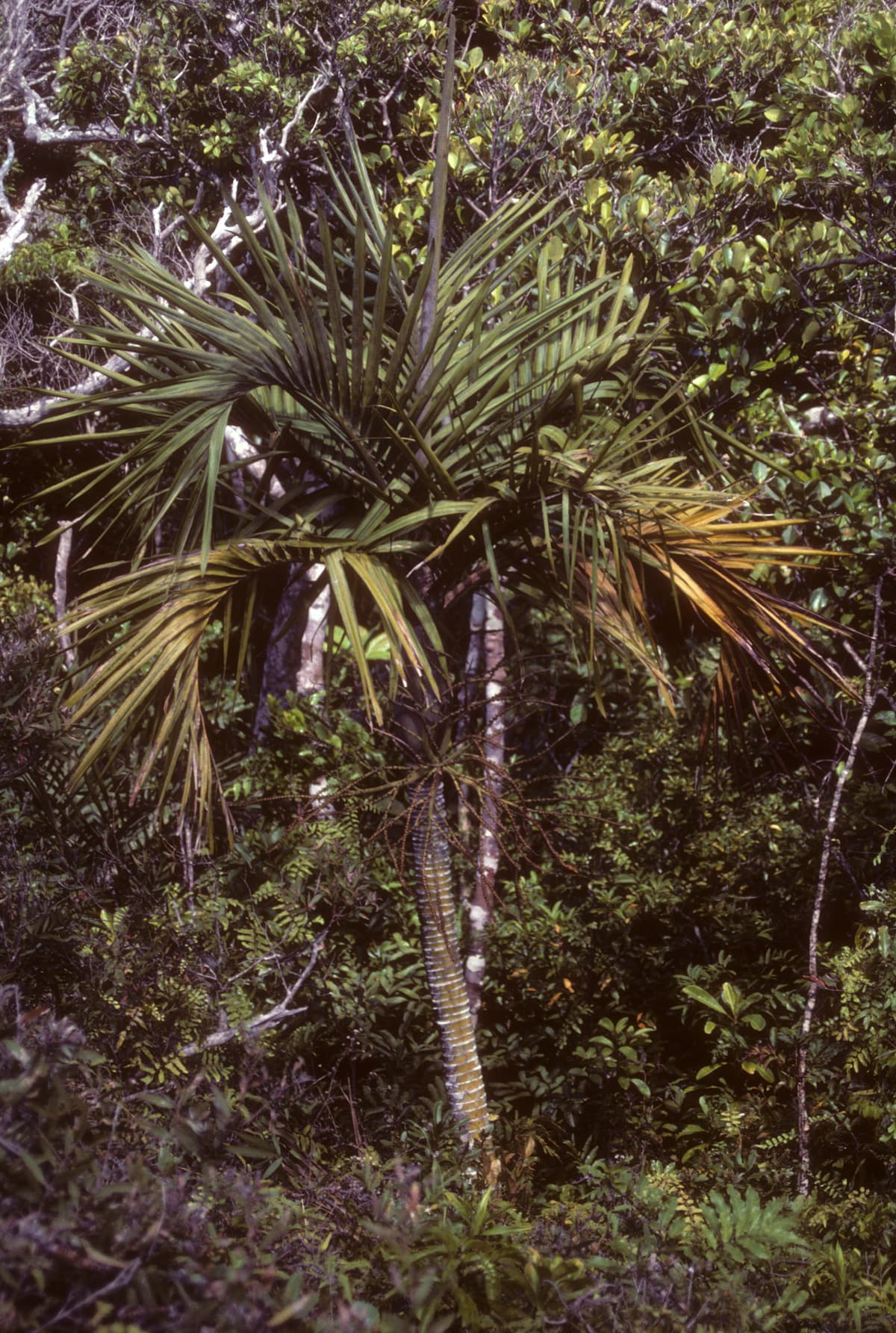
Botanical specimen of Cyphophoenix Elegans.
Biology & Morphology
"Solitary pinnate palm 8–10 m tall with a leaf-scar-ringed trunk 10–18 cm in diameter, an olive-green crownshaft 50–90 cm long covered in greyish tomentum, 7–10 markedly upright leaves about 2 m long with linear leaflets held in an upward V, infrafoliar inflorescences 60–70 cm long, and ovoid single-seeded fruits 19–20 × 13–14 mm that ripen red with apical stigmatic remains."
Morphology
Symmetrical columnar trunk with characteristic leaf-scar patterning and lignified outer cortex.
Adventitious root system spreading radially to maximize hydraulic intake in competitive soil matrices.
Distinctive unknown habit and medium stature providing a unique architectural profile.
Foliage
Vibrant green canopy featuring characteristic frond architecture optimized for photon interception and transpiration efficiency.
Specialized green tissues exhibiting moderate metabolic expansion rates.
Reproduction
Complex inflorescence branching typical of the Cyphophoenix clade, exhibiting seasonal reproductive synchrony.
Nutrient-dense drupes encased in a fibrous pericarp, optimized for protection and dispersal.
Dormant embryonic tissues with high endosperm density, characteristic of resilient Cyphophoenix specimens.
Ecology
Active rhizosphere communication with mycorrhizal fungal networks, enhancing phosphorus and micronutrient uptake.
Interlocked with Pacific avian and entomological vectors adapted to island ecosystems.
Gravity-mediated and animal-vectored dispersal mechanisms ensuring regional genetic distribution.
Germination & Propagation
Germination Timeline
Hydration soak.
Incubation in moist media.
Sprout emergence.
Considered fairly easy for a New Caledonian palm, with reasonably fast subsequent seedling growth; sow in free-draining acidic loam kept humid.
Cultivation & Care
Light
Prefers shade; give some shade inland and light shade when young, adapting with time to full sun — in southern California even seedlings have taken full hot inland sun.
Water
Keep moist, with abundant water in dry weather; given plenty of water it does not even brown-tip. Appreciates high atmospheric and soil humidity and adapts to short dry periods.
Soil
Rich, moist but well-drained soil; acidic soil rich in organic matter is ideal, though it adapts to slightly alkaline soils. In habitat it grows over deep shale and schist-derived soils.
Hardy to about USDA zone 9b, standing brief frosts to about -3 °C. Southern California growers report it as surprisingly hardy, sun- and wind-tolerant, but very slow-growing — too slow for commercial landscaping use.
Pests, Diseases & Care
Pests
Brontispa longissima (Coconut Leaf Beetle)
HIGHBrowning and drying of young fronds; high impact on tropical palms.
Biological control using parasitic wasps (Tetrastichus brontispae).
Promecotheca caerulipennis (Fiji Leafminer)
MODERATEBlistering of leaflets leading to significant photosynthetic loss.
Augmentation of native hymenopteran parasitoids.
Diseases
Phytophthora palmivora (Bud Rot)
CRITICALNecrosis of the spear leaf and decay of the meristem.
Fosetyl-Al application and optimizing canopy ventilation.
Colletotrichum spp. (Anthracnose)
MODERATEBlack necrotic spots on leaflets under high humidity.
Copper-based fungicides and reduction of overhead irrigation.
Nutritional Deficiencies
Interveinal chlorosis (Younger fronds)
Chelated Fe-EDDHA Soil Pulse
Marginal chlorosis (Older fronds)
Mg-Sulfate (Kieserite) saturation
Frizzletop / Distorted spear
Systemic Mn-Sulfate application
Care Tips
Biosurveillance pulse synchronized for Oceania regional vectors.
Apply prophylactic fungicidal drench in the nocturnal phase.
Improve canopy ventilation to disrupt fungal sporulation cycles.
Sources & Conservation
Curated- Cyphophoenix elegans (Brongn. & Gris) H.Wendl. ex Salomon — Plants of the World Online, Kew · accessed 2026-09
- Cyphophoenix elegans (Brongn. & Gris) H.Wendl. ex Salomon, Gartenflora 33: 272 (1884) — International Plant Names Index · accessed 2026-09
- Cyphophoenix elegans (amended version of 2017 assessment, published 2020) — IUCN Red List of Threatened Species · accessed 2026-09
- Cyphophoenix elegans — Palmpedia, Palm Grower's Guide · accessed 2026-09
- Cyphophoenix H.Wendl. ex Hook.f. — PALMweb · accessed 2026-09
- Cyphophoenix elegans — Monaco Nature Encyclopedia · accessed 2026-09
- Cyphophoenix elegans — Wikipedia · accessed 2026-09
- Cyphophoenix elegans — GBIF Backbone Taxonomy (taxon key 2739097) · accessed 2026-09
- Cyphophoenix elegans – Elegant Kentia Palm — rarepalmseeds.com · accessed 2026-09