Little mountain palm
Lepidorrhachis Mooreana • Moorei palm
Little mountain palm in Motion
The Essence
"Lepidorrhachis mooreana is the only species of its genus — one of three palm genera endemic to Lord Howe Island, alongside Howea and Hedyscepe — and has been called perhaps the least known of the island's four palm species. It grows only on the summits of the island's two southern mountains, Mt Gower (875 m) and Mt Lidgbird (777 m), above about 750 m, in the dwarf Gnarled Mossy Cloud Forest kept alive by semi-permanent cloud — a plant community itself listed as critically endangered in New South Wales. It is a short, stocky palm, rarely more than about 2 m tall, with stiff, arching pinnate leaves and no crownshaft. The bushy inflorescences, borne below the leaves, each carry flowers of one sex only — unusual within subfamily Arecoideae — with male and female inflorescences on the same plant, and the marble-sized fruits ripen red and are dispersed by Lord Howe currawongs. Everything about its life is slow: seeds lie on the soil surface for about two years before germinating, sexual maturity plausibly takes 30–60 years, and individuals likely live more than a century. The NSW listing estimated 16,000–47,000 mature palms on Mt Gower's 27-hectare summit plateau if palms occupy roughly half of it, but introduced black rats — on the island since a 1918 shipwreck — eat the fruit so thoroughly that recruitment is eliminated wherever they occur: over 90% of the habitat is rat-impacted, and seedlings recruit only in the roughly 7% of the summit that is baited. Australia lists the palm as Critically Endangered under both the federal EPBC Act (2015) and in New South Wales (2011), although it has not been evaluated on the global IUCN Red List. Climate change is considered an insidious further threat: confined to mountain summits with no bioclimatic zone left to retreat to, the palm could face catastrophe from even a small rise in the cloud base. Despite its remoteness it is grown by a few collectors in cool climates, with documented plants in coastal California, Tasmania and New Zealand."
Lepidorrhachis combines Greek words meaning 'scale' and 'rachis', a reference to the scaly leaves, petioles and rachises; the epithet mooreana honours Charles Moore, first director of the Sydney Botanical Gardens. Ferdinand von Mueller described the species as Kentia mooreana in 1870 (Fragm. 7: 101), and O.F. Cook published the combination Lepidorrhachis mooreana in the Journal of Heredity in 1927.
Black rats reached Lord Howe Island after a shipwreck in 1918, and their consumption of the palm's fruit now eliminates recruitment across most of its range. Formal listing is recent: New South Wales determined the species Critically Endangered in April 2011 — the same year its Gnarled Mossy Cloud Forest habitat was listed as a critically endangered ecological community — and the Australian Government listed it as Critically Endangered under the EPBC Act in June 2015. The palm's entire range lies within a permanent park preserve that forms part of the Lord Howe Island World Heritage property.
Natural Habitat
Restricted to dwarf 'gnarled mossy' cloud forest on the two southern summits of Lord Howe Island, above about 750 m, where semi-permanent cloud cover maintains a cool, constantly moist climate. Less than 0.5 km² of the island's roughly 12 km² lies that high, so suitable habitat is extremely limited: the 2015 Conservation Advice records a single population on the Mt Gower summit plateau (reported from Mt Lidgbird but not seen in a recent survey), with extent of occurrence and area of occupancy each estimated at under 4 km². The palm grows on the ridges of the summit plateau rather than in the gullies, and although intact vegetation continues downslope it appears unable to survive in lower-elevation forest types.
Curated Specimens
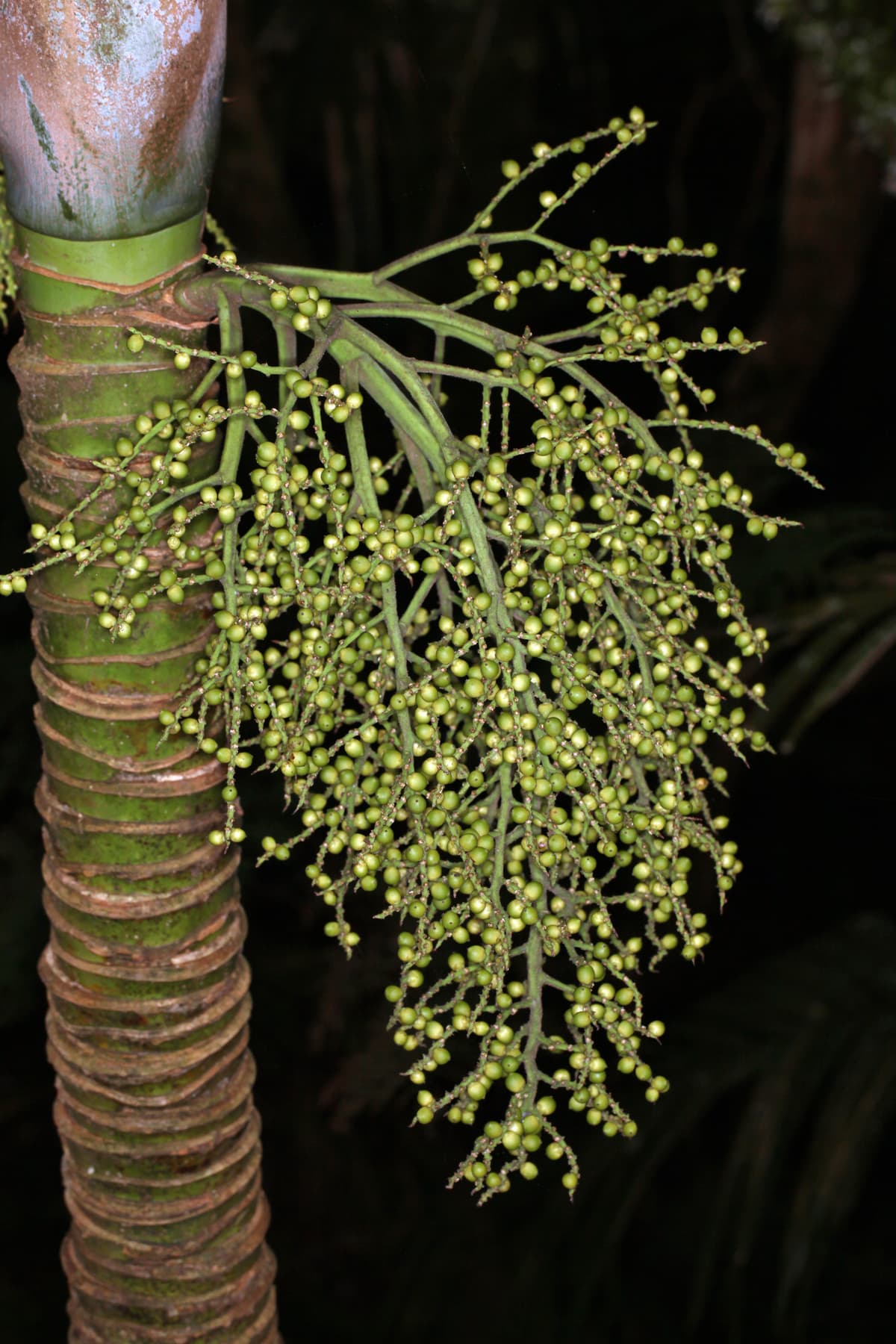
Botanical specimen of Lepidorrhachis Mooreana.
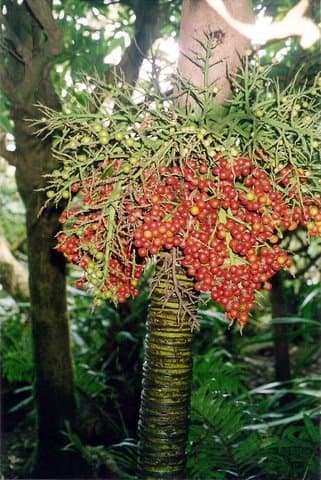
Botanical specimen of Lepidorrhachis Mooreana.
Sources & Conservation
Curated- Lepidorrhachis mooreana (F.Muell.) O.F.Cook — Plants of the World Online, Kew · accessed 2026-09
- Lepidorrhachis — Wikipedia · accessed 2026-09
- Lepidorrhachis mooreana — IUCN/SSC Palm Specialist Group flagship species page (Virtual Herbarium) · accessed 2026-09
- Lepidorrhachis mooreana — critically endangered species listing, NSW Threatened Species Scientific Committee final determination (2011) · accessed 2026-09
- Conservation Advice: Lepidorrhachis mooreana (Little Mountain Palm) — Australian Government, EPBC Act (2015) · accessed 2026-09
- Lepidorrhachis mooreana — Little Mountain Palm, Moorei Palm — SPRAT profile, Australian Government · accessed 2026-09
- GBIF Backbone Taxonomy — Lepidorrhachis mooreana, IUCN Red List category endpoint