Ka Pho Si Sip
Licuala Distans • Paw Si Tip • กะพ้อสี่สิบ
Ka Pho Si Sip in Motion
The Essence
"Licuala distans is a solitary, costapalmate fan palm native to peninsular Thailand. Barfod, Burholt and Borchsenius (2003) record it from Ranong in the north to Krabi in the south, growing in hill dipterocarp forest where it is locally very common, especially on ridges; the IUCN Red List also maps it as possibly extant in Myanmar. It is genuinely little collected: as of August 2026, GBIF held just 19 occurrence records, 16 of them from Thailand. Henry Nicholas Ridley described the species in 1920, IPNI recording the protologue locality simply as Penins. Siam. For such an obscure palm, its pollination biology is unusually well documented. Barfod and colleagues observed it at Sri Phangnga National Park, where stingless Trigona bees, along with a few Apis, arrived continuously and visited the hermaphroditic flowers in both the staminate and the pistillate phase; no flies were seen at the flowers, and the Trigona bees carried relatively high pollen loads, making them the probable pollinators. The floral anatomy fits: labyrinthine septal nectaries sit below the gynoecium and produce copious nectar, and anthesis is accompanied by a sweet, honey-like scent. The pollen-to-ovule ratio is about 210 (range 166-253), higher than in L. peltata (67) or L. spinosa (12). Flowering runs acropetally across the inflorescence but basipetally within each rachilla, over about four days. In cultivation it is rare and, in Plant Pono's words, coveted by palm collectors. RarePalmSeeds quotes Don Hodel's Palms and Cycads of Thailand calling it "one of the most elegant Thai palms" and suggesting protected places in the garden; Palmpedia's image gallery shows it in cultivation in Hawaii, Queensland, Reunion, Costa Rica and Florida. The IUCN assessed it as Least Concern on 13 July 2023 (assessment published 2025), with agriculture the one recorded threat."
Licuala distans was published by Henry Nicholas Ridley in the Journal of the Federated Malay States Museums 10: 123 (1920); the genus Licuala was erected by Wurmb in 1780 (Verh. Batav. Genootsch. Kunst. 2: 473). No source consulted explains Ridley's choice of epithet. Distans is ordinary Latin for standing apart or widely spaced, but nothing found ties it to a documented feature of this palm, so any specific explanation should be treated as unverified.
Apart from Knuth's 1904 report of abundant nectar in Licuala grandis, nothing had been published on pollination anywhere in Licuala - a genus of more than 150 species - before Barfod, Burholt and Borchsenius published their study in Telopea in 2003. L. distans was one of only three species they examined, alongside L. spinosa and L. peltata. Voucher specimens from that fieldwork are deposited at AAU, BKF and K.
Natural Habitat
Hill dipterocarp forest, where the palm is locally very common and especially frequent on ridges (Barfod et al. 2003); the field observations behind that study were made at Sri Phangnga National Park in peninsular Thailand, in October-November 1992. POWO places the species in the wet tropical biome, Palmpedia describes ridgetops in wet Thai rainforest, and the IUCN Red List records the habitat simply as forest, over an elevation range of 0 to 1,000 m.
Curated Specimens
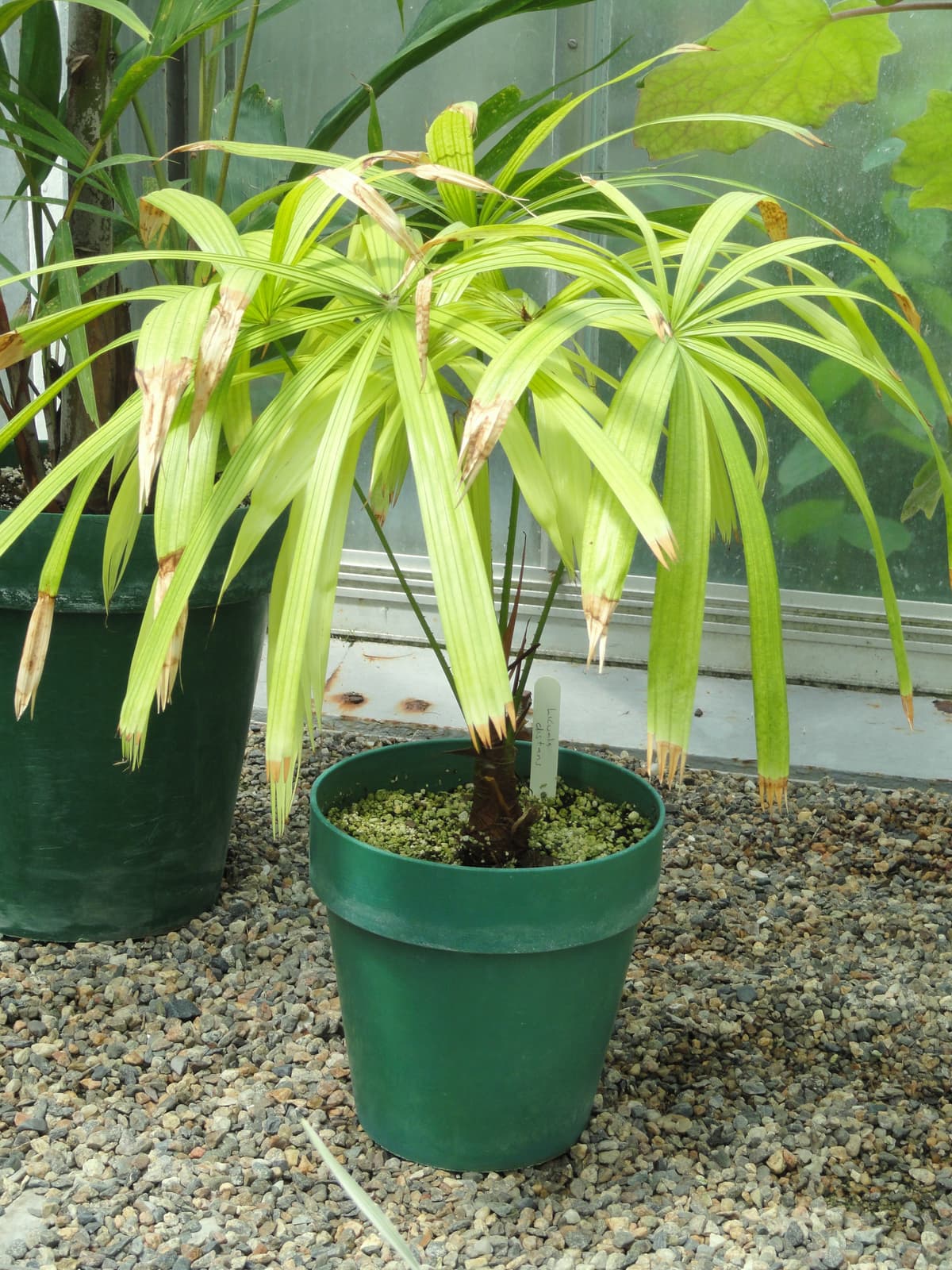
Botanical specimen of Licuala Distans.
Sources & Conservation
Curated- Licuala distans Ridl. | Plants of the World Online (POWO), Kew Science · accessed 2026-08
- Licuala distans — The IUCN Red List of Threatened Species (Barker 2025, e.T191349A1976771) · accessed 2026-08
- Licuala distans Ridl. — International Plant Names Index (IPNI) · accessed 2026-08
- Licuala distans Ridl. — GBIF Backbone Taxonomy / occurrence records · accessed 2026-08
- Licuala distans Ridl., J. Fed. Malay States Mus. 10: 123 (1920) — PALMweb · accessed 2026-08
- Licuala distans — Palmpedia, Palm Grower's Guide · accessed 2026-08
- Barfod, A.S., Burholt, T. & Borchsenius, F. (2003). Contrasting pollination modes in three species of Licuala (Arecaceae: Coryphoideae). Telopea 10(1): 207-223 (Royal Botanic Gardens Sydney)