Paradise Palm
Licuala Mattanensis • Mapu Palm
Paradise Palm in Motion
The Essence
"Licuala mattanensis is a small, solitary fan palm of lowland Borneo, described by Odoardo Beccari from Sarawak material he collected in 1865; the type and an isotype are held at Kew (K000207560 and K000207561). Old wild plants develop a slender trunk to about 3 m. Two varieties are accepted, var. mattanensis and var. paucisecta, and the horticultural trade sells the latter under the cultivar name 'Mapu'. The species is grown almost entirely for its foliage: the mottled, tessellated 'Mapu' and 'Tigrina' forms are by far the most cultivated, described by Monaco Nature Encyclopedia as standing among the most ornamental palms but also among the most difficult to cultivate. Documentation is thin. There is no English Wikipedia article, iNaturalist holds only 18 observations, and the species has no IUCN Red List assessment, GBIF's Red List service returning NOT_EVALUATED. L. G. Saw's 2012 revision of Licuala in Borneo (Kew Bulletin 67: 577-654) is the standard modern treatment, but its text is paywalled and no conservation category for this species could be retrieved."
Licuala is a latinisation of a vernacular name recorded as "leko wala". Citing Genera Palmarum (Dransfield et al. 2008), the French Wikipedia article reports the name as used for Licuala spinosa at Makassar in Sulawesi, while Monaco Nature Encyclopedia gives the same root but attributes it to the Maluku Islands. The epithet mattanensis indicates the place of origin, Mount Mattang (Matang) in Sarawak, which is consistent with GBIF herbarium records collected at the base of that mountain.
Beccari published the species in Malesia 3: 86, but the date is not settled between Kew-linked databases: PALMweb and GBIF both cite 1889, while IPNI's record for the same name gives 1886, with the collation "Malesia 3: 86, t. 7". Type and isotype material was collected by Beccari in Sarawak in 1865. The second variety, var. paucisecta Becc., was published later, in Webbia 5: 51 (1921). GBIF also records living plants of the species in the Mixed Planting Garden at Semenggoh Nature Reserve, Kuching.
Natural Habitat
Lowland Bornean rainforest, in shade. Herbarium labels in GBIF are unusually specific and point to two recurring settings: kerangas (heath forest), frequently on wet or swampy ground, including logged-over kerangas, swampy valley bottoms and swamp edges; and limestone terrain, with collections from the foot of limestone hills, flat limestone in secondary jungle, and a steep valley between two limestone hills. Other labels read "Near stream in primary lowland forest", "Lower slope, primary forest" and "Disturbed primary forest, on small hill". Recorded elevations on those specimens are low: 9, 20, 40 and 50 m. POWO classifies the species as a shrub growing primarily in the wet tropical biome, and NParks Singapore gives its native habitat as terrestrial primary rainforest in a tropical climate zone. All 23 georeferenced GBIF records are from Malaysia, with localities in Sarawak: Bau and Jambusan, Matang Forest Reserve, Semenggoh Nature Reserve, Padawan, the Lundu-Pueh road, and the Sematan area.
Curated Specimens
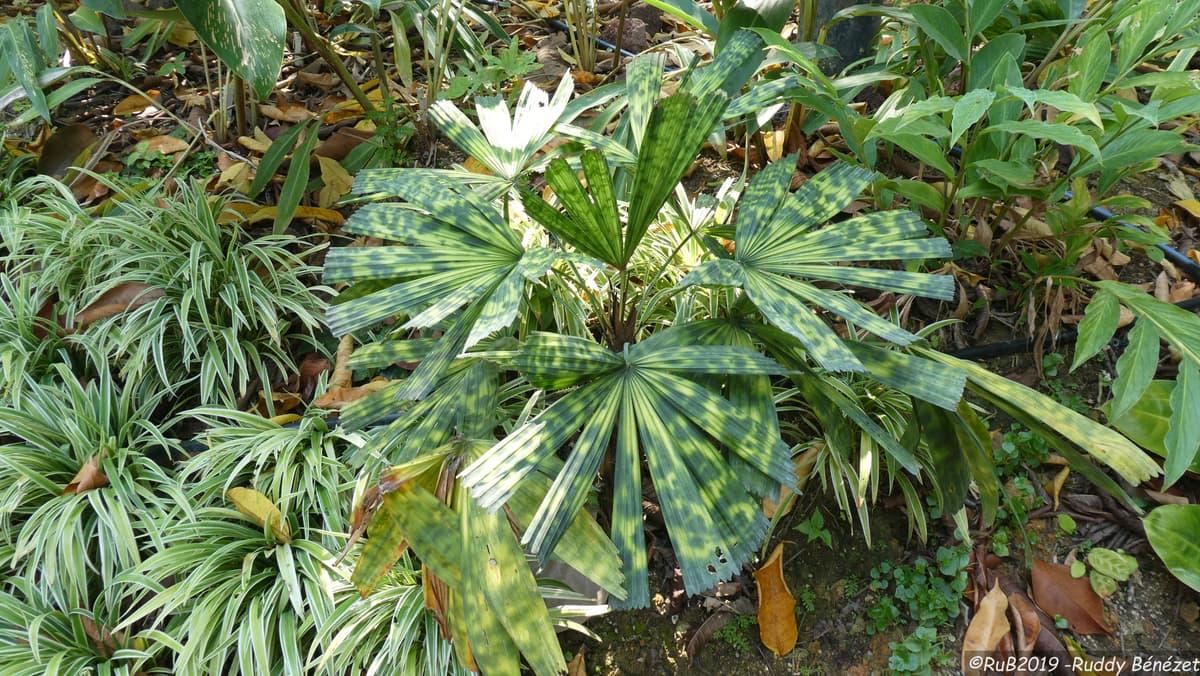
Botanical specimen of Licuala Mattanensis.

Botanical specimen of Licuala Mattanensis.

Botanical specimen of Licuala Mattanensis.
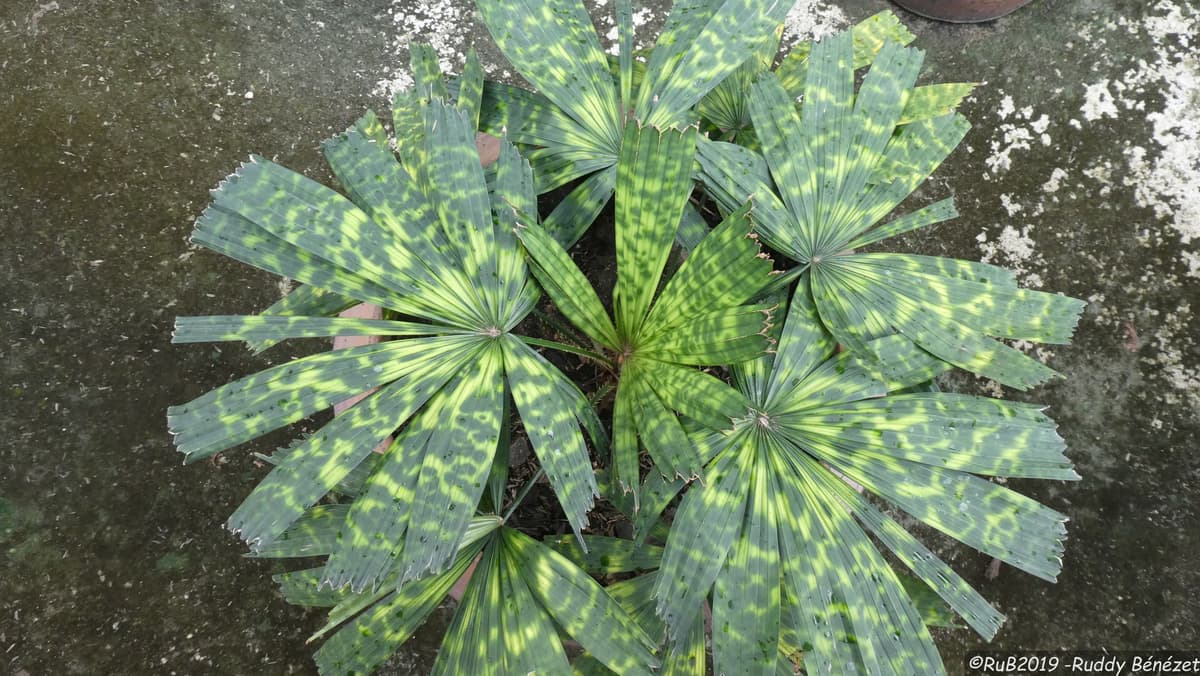
Botanical specimen of Licuala Mattanensis.