Swamp fan palm
Licuala Paludosa • Mangrove fan palm • Golden licuala
Swamp fan palm in Motion
The Essence
"Licuala paludosa is a clustering fan palm of Southeast Asian swamp forests, ranging from the Andaman Islands, Myanmar, Thailand, Cambodia and Vietnam south through Peninsular Malaysia to Sumatra and Borneo. True to its name — paludosa comes from the Latin for swamp — it grows on land inundated with water for six or more months a year, above all in peat-swamp forest. Its slender stems form a dense clump, each carrying circular fan leaves up to 1.5 m across on long petioles armed on their lower half with small black thorns. In a striking form from Thailand's coastal swamp forests the leafsheaths and petioles are vividly orange; described in 1997 as a separate species, Licuala aurantiaca — the "Golden Licuala" — it is now treated as a synonym of L. paludosa, yet remains much sought after ornamentally, its colour strongest in sun-grown plants and fading to yellow-green in shade. Locally the leaves are used to wrap ketupat, the traditional Southeast Asian rice dumpling, and to make hats, small baskets and raincoats, while the stems are employed in building local dwellings. Since it naturally stands in water for much of the year, cultivated plants demand constant moisture — a potted specimen is best kept with its saucer permanently full of water. The IUCN Red List assessed it in 2023 as Least Concern, though the Useful Tropical Plants database flags the conversion of large areas of Borneo's peat-swamp forests as a great threat to the species."
The genus name Licuala is a Latinization of "lkowalà", a name used by the natives of the Maluku Islands, while the epithet paludosa comes from the Latin paludis, "of the swamp", referring to its flooded habitat.
William Griffith described the species in the Calcutta Journal of Natural History in 1845. The orange-stemmed form of Thai coastal swamp forest was named Licuala aurantiaca by Hodel in 1997 — the "Golden Licuala" — but is now a synonym of L. paludosa, as are Licuala oxleyi, L. amplifrons and L. paniculata.
Natural Habitat
A true swamp palm, growing in swamp forest — especially peat-swamp forest — on land inundated with water for six or more months a year, and also recorded from lowland and kerangas (heath) forests in Borneo. It occurs from sea level to about 900 m; POWO classes it as a shrub or tree of the wet tropical biome.
Curated Specimens
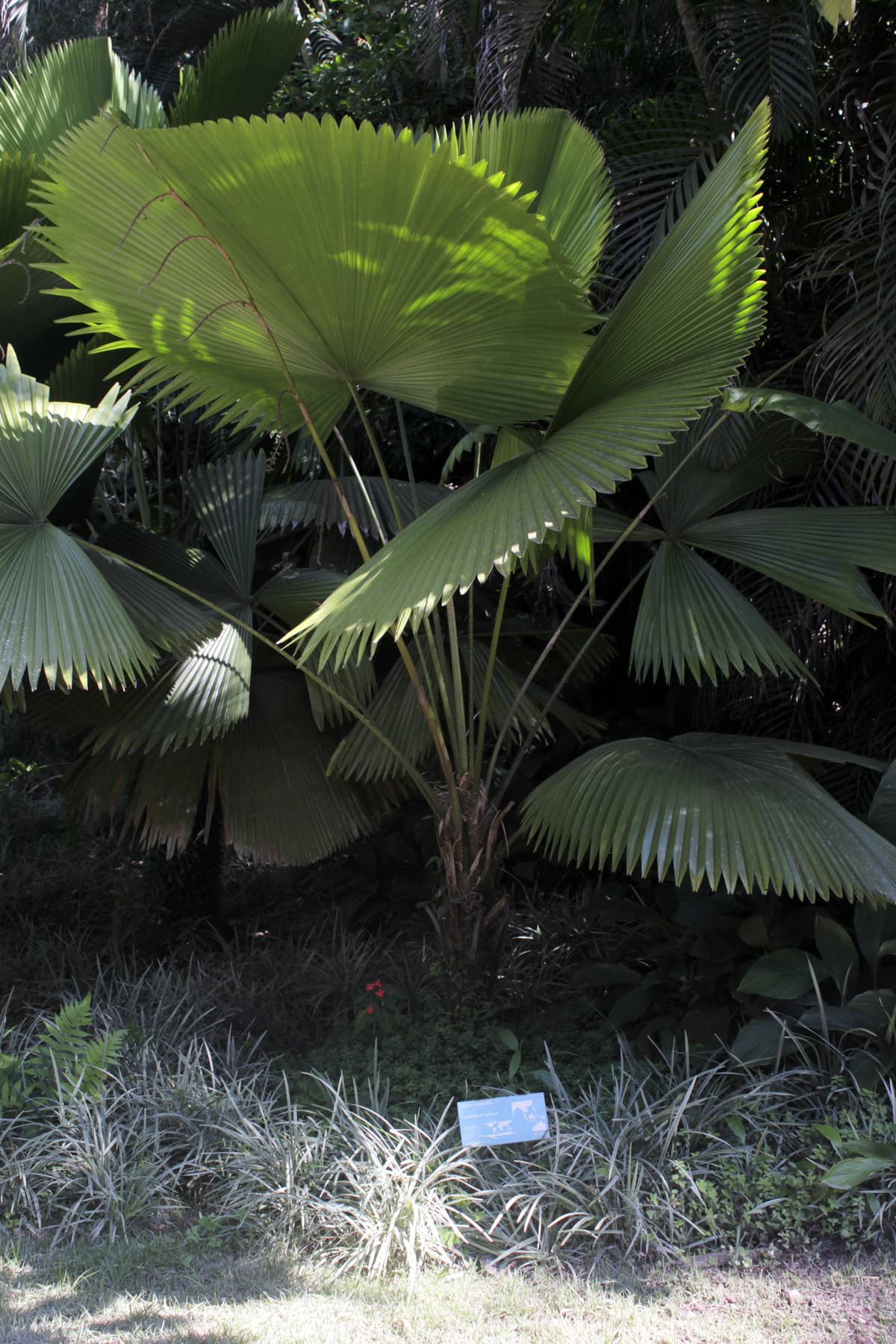
Botanical specimen of Licuala Paludosa.
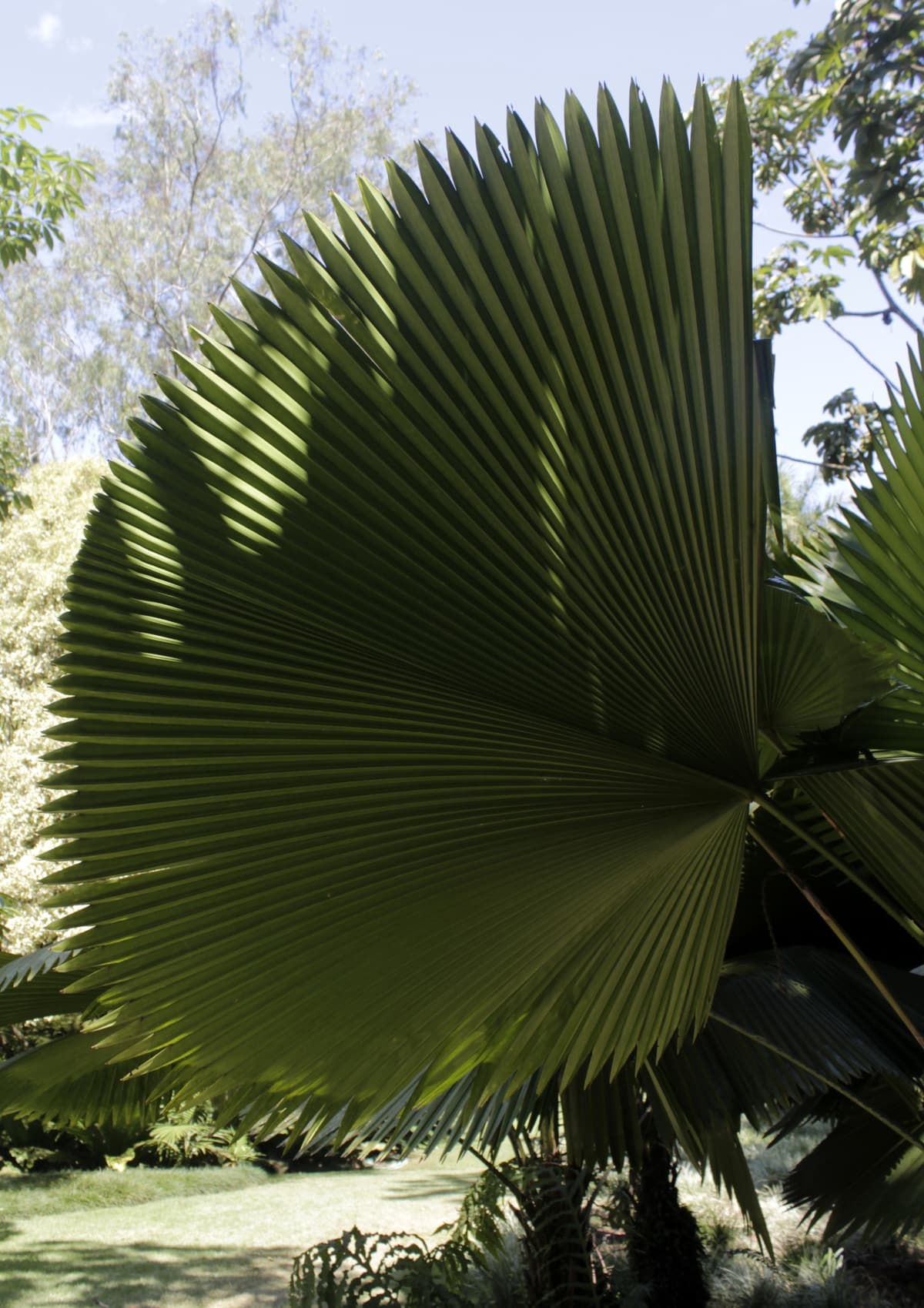
Botanical specimen of Licuala Paludosa.
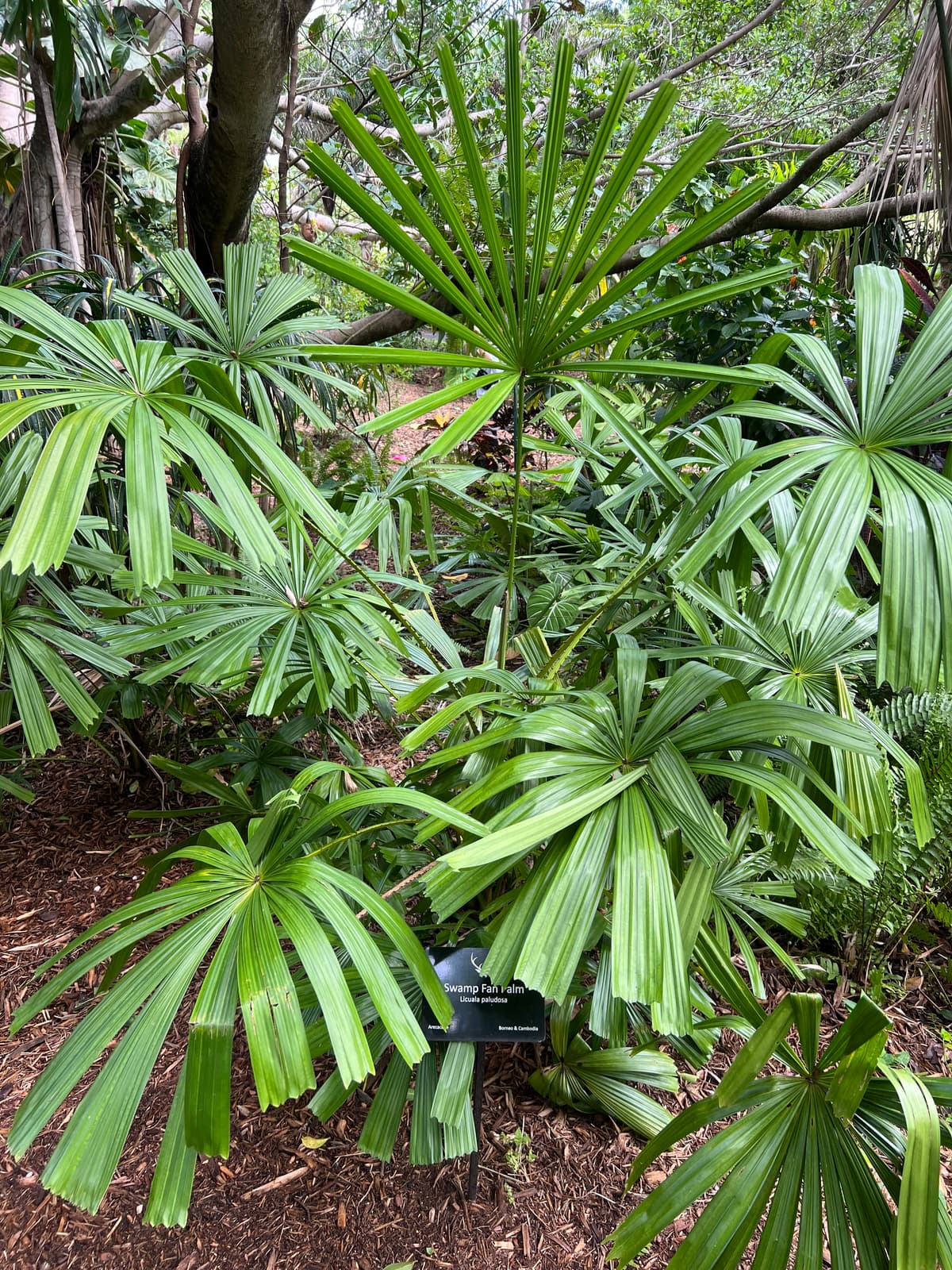
Botanical specimen of Licuala Paludosa.
Biology & Morphology
"Clustering fan palm whose thin stems, about 5 cm in diameter, form dense clumps up to about 6 m tall and 9 m broad (stems reported to reach 7 m); each stem carries a crown of 9–10 circular, flat leaves up to 1.5 m across, divided to the base into 7–20 bright-green segments with truncated, toothed tips. The erect inflorescences project beyond the leaves, and the globose to ovoid, single-seeded fruit, up to about 1 cm across, ripens orange-red to red."
Morphology
Multi-stemmed clumping architecture with slender, clustering canes exhibiting high tensile strength.
Adventitious root system spreading radially to maximize hydraulic intake in competitive soil matrices.
Distinctive solitary/clumping habit and dwarf stature providing a unique architectural profile.
Foliage
Vibrant green canopy featuring fan-shaped palmate leaves with deep costapalmate structure and rigid petiole attachments.
Specialized green tissues exhibiting slow metabolic expansion rates.
Reproduction
Complex inflorescence branching typical of the Licuala clade, exhibiting seasonal reproductive synchrony.
Nutrient-dense drupes encased in a fibrous pericarp, optimized for protection and dispersal.
Dormant embryonic tissues with high endosperm density, characteristic of resilient Licuala specimens.
Ecology
Active rhizosphere communication with mycorrhizal fungal networks, enhancing phosphorus and micronutrient uptake.
Interlocked with local entomological vectors, primarily Meliponini bees or specialized coleoptera.
Gravity-mediated and animal-vectored dispersal mechanisms ensuring regional genetic distribution.
Germination & Propagation
Germination Timeline
Hydration soak.
Incubation in moist media.
Sprout emergence.
Seeds germinate in about 2 months on a warm bed (Monaco Nature Encyclopedia); no other pre-treatment is documented. Clumps can also be propagated by division of the tufts.
Cultivation & Care
Light
Grown in sun or shade; sun exposure governs the colour of the orange-stemmed forms — petioles turn vivid orange in sun-grown plants, while shaded specimens show yellow to yellow-green tones.
Water
Needs abundant, constant water and ambient humidity above 70%; potted plants should be kept with the saucer permanently full of water.
Soil
Peaty, humus-rich soil kept very moist to wet, matching its native waterlogged peat-swamp soils.
Strictly warm-climate: Palmpedia lists cold-hardiness zone 10b, and Monaco Nature Encyclopedia states it can be cultivated only in tropical or warm-subtropical climates, with winter temperatures around 16 °C.
Pests, Diseases & Care
Pests
Rhynchophorus ferrugineus (Red Palm Weevil)
CRITICALLethal internal boring; often undetected until crown collapse.
Acoustic monitoring and early-stage trunk infusion with fipronil.
Chrysomphalus aonidum (Florida Red Scale)
MODERATEYellow spotting and premature leaf drop in high-humidity zones.
Introduction of Aphytis holoxanthus (parasitic wasp).
Diseases
Ganoderma zonatum (Butt Rot)
LETHALRadial wood decay and structural instability at the base.
No chemical cure; immediate isolation and removal.
Phytophthora palmivora (Bud Rot)
CRITICALNecrosis of the spear leaf and decay of the meristem.
Fosetyl-Al application and optimizing canopy ventilation.
Nutritional Deficiencies
Interveinal chlorosis (Younger fronds)
Chelated Fe-EDDHA Soil Pulse
Marginal chlorosis (Older fronds)
Mg-Sulfate (Kieserite) saturation
Frizzletop / Distorted spear
Systemic Mn-Sulfate application
Care Tips
Biosurveillance pulse synchronized for Asia regional vectors.
Apply prophylactic fungicidal drench in the nocturnal phase.
Improve canopy ventilation to disrupt fungal sporulation cycles.
Sources & Conservation
Curated- Licuala paludosa Griff. | Plants of the World Online | Kew Science · accessed 2026-08
- IUCN Red List: Licuala paludosa (assessed 2023, IUCN SSC Global Tree Specialist Group & BGCI) · accessed 2026-08
- GBIF: Licuala paludosa Griff. (taxon key 2736350; IUCN category via GBIF IUCN checklist) · accessed 2026-08
- Licuala paludosa - Palmpedia - Palm Grower's Guide · accessed 2026-08
- Licuala paludosa - Monaco Nature Encyclopedia · accessed 2026-08
- Licuala paludosa - Useful Tropical Plants Database · accessed 2026-08