Big-leaf palm
Marojejya Darianii • Ravimbe
The Essence
"Marojejya darianii is a solitary, monoecious swamp palm endemic to northeastern Madagascar, one of only two species in a genus confined to that island. Its trunk reaches 8-15 m tall and 15-35 cm thick, hidden at first by old leaf bases and later bare, pale grey-brown and covered in warty lumps, with short spine-like adventitious roots on the short internodes. The crown holds 20-30 stiffly erect, undivided leaves that rise straight from a bright green sheath with two large rounded auricles, with no petiole at all; PACSOA compares the effect to a shuttlecock. Sources disagree on leaf size: secondary accounts such as Wikipedia credit the species with the largest simple leaves of any known tree, up to 9.1 m long and 1.2 m wide, while the 1995 monograph account gives blades of 3.5-5 m long by 1-1.2 m wide. The original 1984 description was itself drawn up only from fragments and photographs. Known from about 80 mature individuals at five sites between 200 and 600 m elevation, the species is assessed as Endangered (criteria B2ab(iii); D) by the IUCN and listed on CITES Appendix II. Agriculture, logging and the gathering of plants are the recorded threats, and it is used internationally in the horticultural trade; it has been among the most sought-after Malagasy palms since its discovery in 1983, with large quantities of seed exported from the type locality and juvenile plants reported in private collections in Queensland. Dransfield and Beentje called it "undoubtedly a difficult palm to grow for most of us", though a PACSOA contributor considers that reputation undeserved where its conditions are adequately met, reporting that plants are slow to establish and then grow strongly, each new leaf up to 15 cm longer than the last. No traditional or economic use is recorded for it."
The genus name Marojejya, erected by Humbert in 1955, refers to the Marojejy Massif in northeast Madagascar, where the first species of the genus was collected and described. The epithet darianii honours Mardy Darian, the Californian palm enthusiast whose persistence located this species and who supplied the fragments and photographs on which Dransfield and Uhl based their 1984 description. The Malagasy vernacular name Ravimbe is Betsimisaraka for "big leaf".
Reports of a huge entire-leaved palm in the hills near Maroantsetra began circulating in the early 1980s. Mardy Darian, helped by Jean Gerard and Dominique Halleux, tracked it down in 1983, and John Dransfield and Natalie Uhl described it the following year in Principes under the title "A Magnificent New Palm from Madagascar", working only from the material Darian sent; the authors later noted that those fragments gave no sense of the plant's size and beauty as it grows in the wild. For years it was known from that single unprotected site, and the 1995 monograph rated it Critical. Five localities are now recorded, and the current IUCN assessment - dated 17 December 2010 and published in 2012 - places it at Endangered, a change from Critically Endangered that some secondary text still has not caught up with.
Natural Habitat
A palm of rainforest swamps in valley bottoms. The site described in the 1995 monograph is a small upland peat swamp in the hills above Sahavary, near Maroantsetra, at 400-450 m. Across all five known localities the IUCN assessment gives the habitat as forest and inland wetland, terrestrial, with an elevation range of 200-600 m; POWO places the species in the wet tropical biome. Palmpedia records occurrences between Ampasimanolotra and the Masoala Peninsula, and carries field photographs from the Analalava reserve at Foulpointe.
Curated Specimens
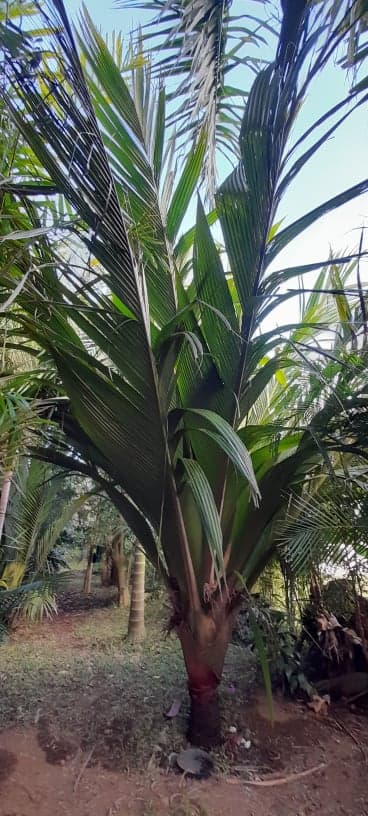
Botanical specimen of Marojejya Darianii.
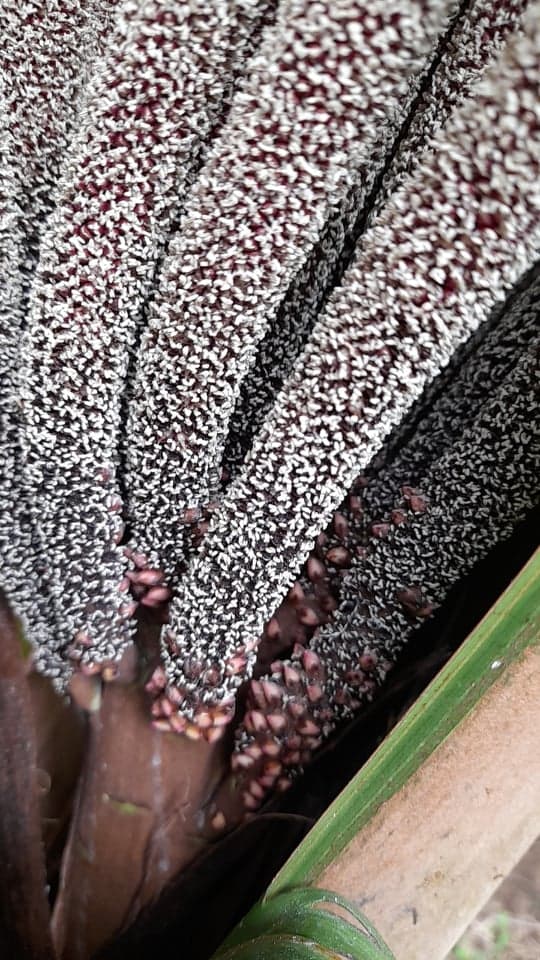
Botanical specimen of Marojejya Darianii.
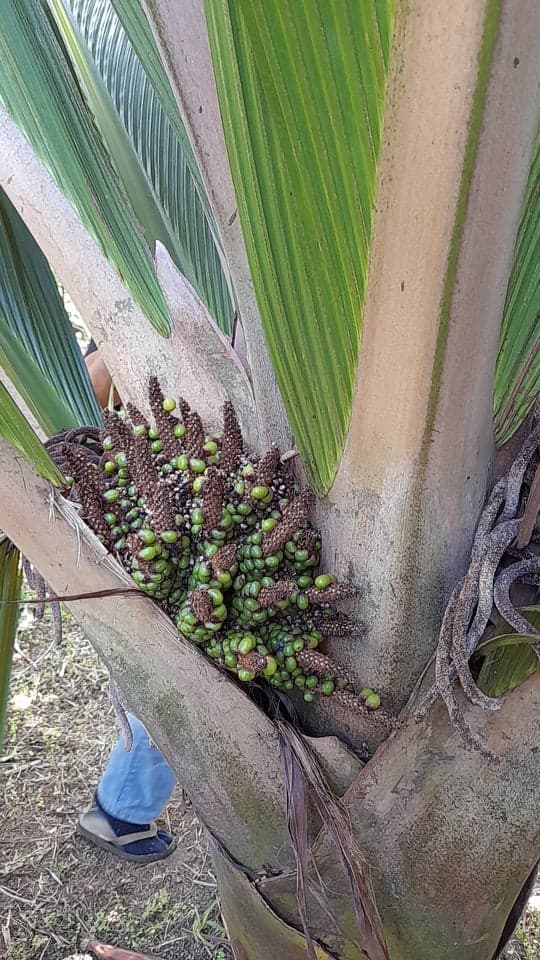
Botanical specimen of Marojejya Darianii.
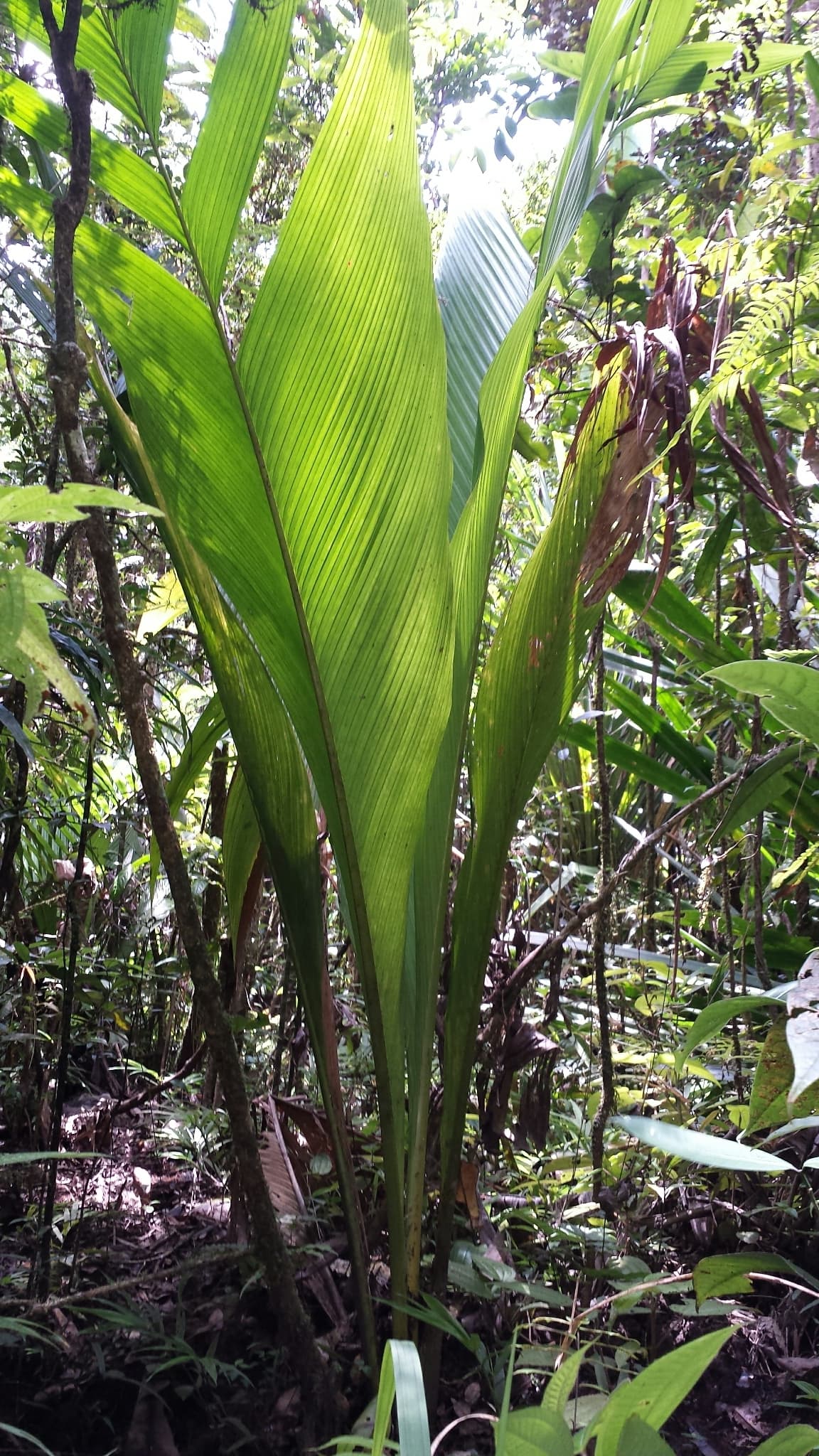
Botanical specimen of Marojejya Darianii.
Biology & Morphology
"Solitary, monoecious tree palm with a warty grey-brown trunk 8-15 m tall and 15-35 cm in diameter, a crown of 20-30 stiffly erect, petiole-less, entire bifid leaves with blades 3.5-5 m long and 1-1.2 m wide, separate staminate and pistillate inflorescences carrying densely packed catkin-like rachillae, and obovoid fruit 20-25 mm long that ripen from pink through green to red over a fibrous endocarp."
Morphology
Symmetrical columnar trunk with characteristic leaf-scar patterning and lignified outer cortex.
Adventitious root system spreading radially to maximize hydraulic intake in competitive soil matrices.
Distinctive unknown habit and medium stature providing a unique architectural profile.
Foliage
Vibrant green canopy featuring characteristic frond architecture optimized for photon interception and transpiration efficiency.
Specialized green tissues exhibiting moderate metabolic expansion rates.
Reproduction
Complex inflorescence branching typical of the Marojejya clade, exhibiting seasonal reproductive synchrony.
Nutrient-dense drupes encased in a fibrous pericarp, optimized for protection and dispersal.
Dormant embryonic tissues with high endosperm density, characteristic of resilient Marojejya specimens.
Ecology
Active rhizosphere communication with mycorrhizal fungal networks, enhancing phosphorus and micronutrient uptake.
Interlocked with local entomological vectors, primarily Meliponini bees or specialized coleoptera.
Gravity-mediated and animal-vectored dispersal mechanisms ensuring regional genetic distribution.
Germination & Propagation
Germination Timeline
Hydration soak.
Incubation in moist media.
Sprout emergence.
No germination protocol from a botanical or monograph source was located, so these figures are grower experience rather than published data. Seed quality matters: one grower got 8 of 25 seeds (about 32%) to germinate, and three of those subsequently died with larvae emerging from the seed.
Cultivation & Care
Light
Best in shade or partial shade while small; a grower quoted on Palmpedia reports that larger plants can take a fair amount of sun though they always look their best in partial shade, and recommends planting under canopy or in a small clearing shaded by taller palms or trees for most of the day. PACSOA takes a more permissive view, stating it can handle full sun from an early age as long as water is kept up to it. Both accounts agree that light tolerance and water supply are coupled.
Water
A swamp dweller that wants abundant, consistent moisture; PACSOA notes it very much likes wet conditions. The grower quoted on Palmpedia reports that the more rain it receives the better it grows and looks, and that any canopy above it should let rain fall straight through rather than intercept it. The PACSOA specimen photographed grows in the Panaewa rainforest at Hilo, Hawaii, which receives about 200 inches (roughly 5 m) of rain a year.
Soil
Despite its peat-swamp origins, growers on PalmTalk stress that cultivated plants need sharp drainage, reporting the species is very prone to root rot and that well-drained soil is the key. No soil description from a botanical monograph was found beyond the habitat itself, which is peat swamp in a rainforest valley bottom.
No authoritative USDA-zone or minimum-temperature rating has been published for this species, and Palmpedia's survivability index field is blank. The only cold-tolerance statement located is an unverified grower observation on the PACSOA wiki that the palm grows better in south-east Queensland than in the wetter, more tropical north, speculating that it may like the cooler winters there and be frost resistant. That single claim sits awkwardly with the species' lowland tropical swamp origin and should not be treated as a hardiness rating. A grower quoted on Palmpedia reported losing the most sun-exposed of five plants after a spell of dry, hot weather, indicating little tolerance of heat and drought stress.
Pests, Diseases & Care
Pests
Strategus aloeus (Ox Beetle)
HIGHAdults bore into the base of young palms, causing structural instability.
Soil drenching and manual inspection of the root flare.
Coraliomela brunnea (Leaf Miner)
LOWNecrotic galleries in young leaves, particularly in spiny species.
Targeted contact insecticides during peak emergence.
Diseases
Phytophthora palmivora (Bud Rot)
CRITICALNecrosis of the spear leaf and decay of the meristem.
Fosetyl-Al application and optimizing canopy ventilation.
Thielaviopsis punctulata (Black Scorch)
HIGHBlackening and dwarfing of newly emerging fronds.
Wound protection and application of thiophanate-methyl.
Nutritional Deficiencies
Interveinal chlorosis (Younger fronds)
Chelated Fe-EDDHA Soil Pulse
Marginal chlorosis (Older fronds)
Mg-Sulfate (Kieserite) saturation
Frizzletop / Distorted spear
Systemic Mn-Sulfate application
Care Tips
Biosurveillance pulse synchronized for Madagascar regional vectors.
Apply prophylactic fungicidal drench in the nocturnal phase.
Improve canopy ventilation to disrupt fungal sporulation cycles.
Sources & Conservation
Curated- Marojejya darianii J.Dransf. & N.W.Uhl | Plants of the World Online (POWO), Kew · accessed 2026-08
- Marojejya darianii J. Dransf. & N.W.Uhl, Principes 28: 151 (1984) | PALMweb (Dransfield & Beentje, The Palms of Madagascar, 1995) · accessed 2026-08
- Marojejya Humbert, Mem. Inst. Sci. Madagascar 6: 92 (1955) | PALMweb genus page (etymology, from Genera Palmarum 2008) · accessed 2026-08
- Marojejya darianii | The IUCN Red List of Threatened Species 2012: e.T38605A2880647 (Rakotoarinivo & Dransfield) · accessed 2026-08
- Comprehensive Red List Assessment Reveals Exceptionally High Extinction Risk to Madagascar Palms (Rakotoarinivo, Dransfield, Bachman, Moat & Baker, PLoS ONE 2014) · accessed 2026-08
- Marojejya darianii - Palmpedia, Palm Grower's Guide · accessed 2026-08
- Marojejya darianii - PACSOA Wiki (Palm & Cycad Societies of Australia) · accessed 2026-08
- Marojejya darianii - Wikipedia · accessed 2026-08
- Marojejya darianii J.Dransf. & N.W.Uhl - GBIF Backbone Taxonomy (key 2735645) · accessed 2026-08
- Marojejya darianii germination - PalmTalk forum (grower reports) · accessed 2026-08