Sindro palm
Orania Longisquama • Sindro • Sindroa • Anivona • Ovobolafotsy • Vakapasy
The Essence
"Orania longisquama is one of only three Malagasy members of Orania, a genus with an oddly disjunct distribution: PALMweb describes 28 species in all, 25 of them in Malesia - from southern Thailand through the Malay Peninsula, Sumatra, Java, Borneo, the Philippines, Sulawesi and the Moluccas to New Guinea, where diversity is greatest - and only three confined to Madagascar. POWO gives this species' range as north-western and eastern Madagascar, against north-eastern Madagascar for O. ravaka and north-eastern and south-eastern Madagascar for O. trispatha, and the IUCN assessment calls it a widespread palm. It is a large solitary pinnate-leaved palm of lowland rainforest, quite variable in size, described by Palmpedia as ranging from a compact, small palm to a canopy tree, with a base-swollen trunk 7 to 20 m tall and extremely hard, yellowish brown wood. From a distance it resembles Ravenea madagascariensis, but its praemorse, raggedly bitten-off leaflet tips separate the two at once. Unusually for a palm, the heart is not eaten: across the genus the cabbage is reputedly poisonous and avoided by local people, although Henk Beentje drank some fruit sap with no ill effects and the liquid endosperm is said to taste sweet. The wood is used for house walls, whole trunks for house building and the leaves for thatching, and seed is harvested for the international horticultural trade. The IUCN assessed the species as Least Concern on 17 December 2010, published in the 2012 Red List, estimating more than 1,000 mature trees and noting populations protected in Manongarivo, Masoala, Mananara Avaratra, Analalava and Manombo; habitat loss through clearance for shifting agriculture and logging is the main threat, though the assessors did not think it was having a significant impact at the time."
The epithet longisquama means long scales, referring to the red-brown ramenta on the leaflets. The genus name Orania commemorates F.G.L. Willem van Nassau, Prince of Orange and Crown Prince of the Netherlands (1792-1849).
The basionym is Sindroa longisquama Jum., published in Annales du Musee Colonial de Marseille ser. 5, 1(1): 11 (1933), in which Jumelle placed the palm in a Madagascan genus of its own, Sindroa; the IUCN Red List still carries Sindroa as the species' common name. Dransfield and Uhl transferred it to Orania in Principes 28(4): 164 (1984), sinking the endemic genus. The combination is accepted by POWO, IPNI (914314-1) and GBIF (taxon key 5293557). Before the current Least Concern assessment the species had been listed in 1998 as Lower Risk/near threatened and as Rare.
Natural Habitat
Lowland rainforest at the foot of slopes, on mid slopes or along ridge crests, recorded from 10 to 700 m in the IUCN assessment; the Keim and Dransfield 2012 monograph, quoted by Palmpedia, gives lowland to highland tropical rain forest at 50-550 m, mainly on the eastern side of the island facing the Indian Ocean. POWO places the species in the wet tropical biome. The IUCN records it as endemic to the north-west and east of Madagascar, occurring between Manongarivo, Masoala and Taolagnaro, with an estimated extent of occurrence of 151,841 km2, an estimated area of occupancy of 2,345 km2 and 15 known locations, and notes that individuals are able to persist in secondary vegetation.
Curated Specimens
Botanical specimen of Orania Longisquama.
Botanical specimen of Orania Longisquama.
Botanical specimen of Orania Longisquama.
Botanical specimen of Orania Longisquama.
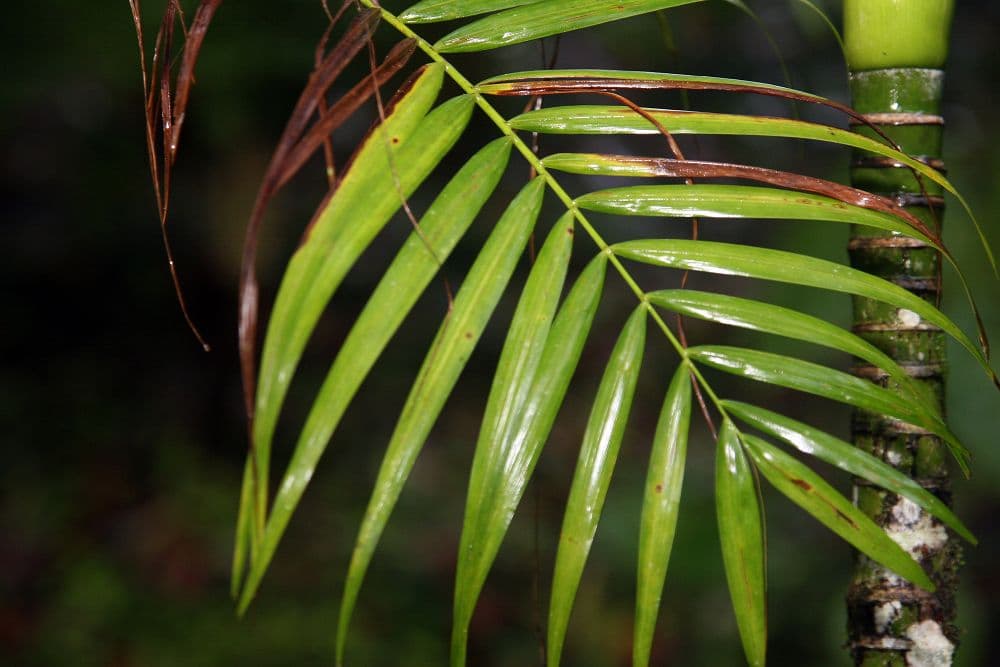
Botanical specimen of Orania Longisquama.
Sources & Conservation
Curated- Plants of the World Online (Kew): Orania longisquama (Jum.) J.Dransf. & N.W.Uhl - accepted, native to NW. & E. Madagascar, wet tropical biome · accessed 2026-09
- IUCN Red List: Rakotoarinivo, M. & Dransfield, J. 2012. Orania longisquama (Sindroa), e.T38622A2881133 - Least Concern, assessed 17 December 2010 · accessed 2026-09
- Palmpedia: Orania longisquama (quoting Keim & Dransfield 2012 monograph and Dransfield & Beentje 1995, The Palms of Madagascar) · accessed 2026-09
- PALMweb: Orania Zipp. - genus treatment from Keim & Dransfield 2012, A monograph of the genus Orania, Kew Bulletin 67: 127-190 · accessed 2026-09
- International Plant Names Index: Orania longisquama (Jum.) J.Dransf. & N.W.Uhl, Principes 28(4): 164 (1984), basionym Sindroa longisquama Jum. (1933) · accessed 2026-09
- GBIF: Orania longisquama (accepted, taxon key 5293557; verified via api.gbif.org) · accessed 2026-09