Monkeytail Shadowpalm
Geonoma Interrupta • Súrtuba • Chontilla • Chontillo • Chocho blanco • Cortadera • Koko makak • Aile à ravet • Géonoma macaque • Turúji • Ewenparen
The Essence
"Geonoma interrupta is, in Geoff Stein's words on Palmpedia, "one of the most widespread of the genus" — Geonoma being one of the largest palm genera in the Neotropics — and also one of the biggest species in it: "Also one of the largest Geonomas, up to 30' tall." It is an understorey palm of rain forest, averaging 3.7 m tall (to 8 m), with usually solitary stems about 3.7 cm thick whose internodes Henderson describes as "yellowish and smooth". The leaves are irregularly pinnate rather than split into regular leaflets, and Palmpedia notes that the stem "may divide above soil elevation (aerial branching)". The taxonomy has been unsettled. Plants of the World Online accepts six subspecies (interrupta, magnifica, purdieana, rivalis, platybothros and ramosissima); Henderson's 2011 revision recognised four, separated on pistillate flower persistence, bract length and pinna number combined with geographic discontinuity. Henderson placed the species in the "G. interrupta clade" — defined by "its lack of a distal lip of the flower pit and flower pits hairy internally", alongside G. euspatha, G. frontinensis, G. pinnatifrons and G. simplicifrons — and observed that "These species have had a checkered taxonomic history". It is separated from the very similar G. pinnatifrons by flower pits "densely hairy internally distally only". For an understorey palm it is unusually well documented ethnobotanically. Palmweb's use records compile reports of the Quichua of Ecuador making a beverage from the seeds and thatching houses with the leaves; the Huaorani using whole leaves for thatch, for packing and "as a napkin at feasts", and reporting that agoutis and small birds eat the fruits; the Shuar and Achuar thatching with the leaves, with the Shuar also using the stems as labour tools; the Siona using the stem to clean shotguns; and the Tacana of Bolivia thatching with the leaves. Useful Tropical Plants adds that the tender young flower clusters and the leaves are cooked and eaten and the stems made into tool handles, and that the apical bud is taken as a palm heart — a harvest it warns "leads to the death of the tree because it is unable to make side shoots"."
Geonoma comes from the Greek geonomos, "colonist". Genera Palmarum, quoted on Palmweb, glosses the name as "presumably referring to the clustering, spreading habit of many species", and Palmpedia's genus entry likewise reads it as "referring to the palm's habit of growing in colonies". The epithet interrupta is Latin for "interrupted", but none of the sources consulted explains what feature Ruiz and Pavón intended it to describe.
The species was published as the basionym Martinezia interrupta Ruiz & Pav. (Syst. Veg. Fl. Peruv. Chil.: 296, 1798) and transferred to Geonoma by Carl Friedrich Philipp von Martius in Historia Naturalis Palmarum 2: 8 (1823). Its circumscription has shifted considerably since. POWO's accepted native range runs from central Mexico to Bolivia — Belize, Bolivia, Colombia, Costa Rica, Ecuador, Guatemala, Honduras, Mexico, Nicaragua, Panamá, Peru and Venezuela — and excludes Brazil and the Caribbean; Useful Tropical Plants gives a wider circumscription including both, the IUCN assessment additionally lists Dominica and Trinidad and Tobago, and Palmpedia carries photographs captioned from Martinique and Guadeloupe. Within the narrower treatment, subsp. interrupta itself is far more restricted, occurring "From 1°05'N-14°25'S and 70°58-79°30'W in Ecuador, Peru, and Bolivia" (Henderson 2011).
Natural Habitat
An understorey palm of lowland to premontane rain forest, growing "in both well-drained soils on slopes and also in wet and poorly drained soil, usually at elevations to 1,000 metres, occasionally to 1,400 metres" (Useful Tropical Plants). Henderson's revision gives the typical subspecies a mean elevation of 533 m, ranging from 50 to 1,160 m, "in lowland to montane rainforest". POWO records that it "grows primarily in the wet tropical biome". One subspecies, subsp. rivalis, occurs in the Andes of Colombia, where the plants "are reported to be rheophytes" — growing in or beside fast-flowing streams.
Curated Specimens
Botanical specimen of Geonoma Interrupta.
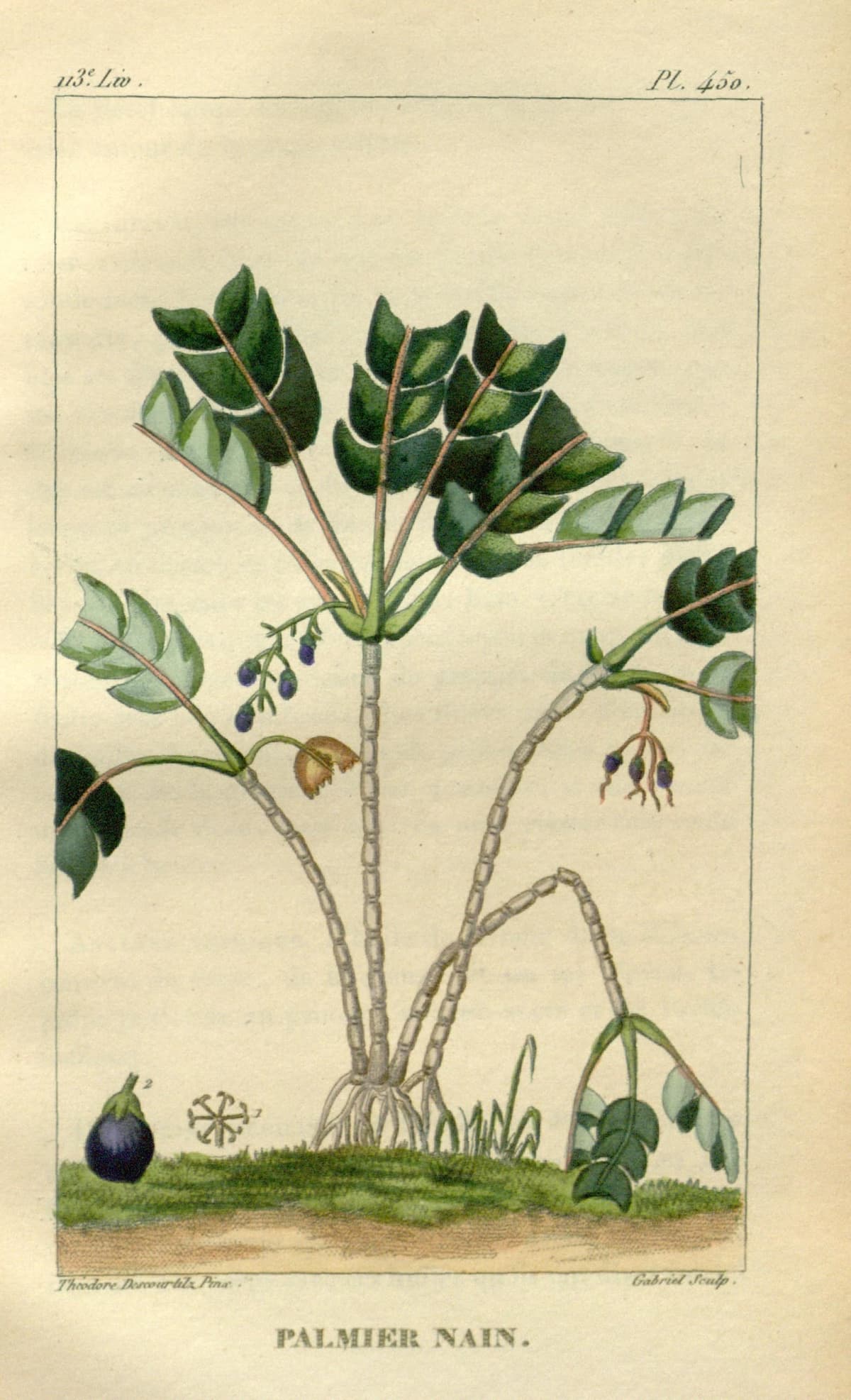
Botanical specimen of Geonoma Interrupta.