D'Orbigny's Shadowpalm
Geonoma Orbignyana • Géonoma de d'Orbigny
D'Orbigny's Shadowpalm in Motion
The Essence
"Geonoma orbignyana is a slender understorey palm of Andean and Central American montane rain forest, described in the ecological literature as a common understorey palm. Plants average about 2 m tall (0.5-7.0 m), on a thin stem only around 1.2 cm in diameter, solitary or clustered, carrying roughly ten leaves that may be undivided, irregularly pinnate, or sometimes regularly pinnate. Plants of the World Online gives the native range as Central America to Bolivia and accepts two subspecies, subsp. hoffmanniana and subsp. orbignyana. It is also a notoriously difficult taxon. Henderson's 2011 revision of Geonoma places it in the high-elevation Andean G. undata clade alongside G. lehmannii, G. talamancana, G. trigona and G. undata, and reports that G. lehmannii, G. orbignyana and G. undata are difficult to distinguish from one another and extremely complex internally. Henderson treats G. jussieuana as a synonym of subsp. orbignyana, and within that subspecies recognises a series of named regional morphotypes - lindeniana in the Venezuelan Andes, pumila in the Sierra Nevada de Santa Marta, linearifolia in the central Eastern Cordillera, plicata in the Central and Western Cordilleras and wilsonii in Caqueta - while flagging several Eastern Cordillera specimens as possible hybrids with the weberbaueri morphotype of G. undata subsp. undata. He also notes a distributional gap in eastern Panama separating Central American from South American specimens. The IUCN Red List lists the species as Least Concern, assessed in 2018 and published in 2023."
Genera Palmarum glosses the genus name Geonomos as "colonist", presumably referring to the clustering, spreading habit of many species. The epithet orbignyana commemorates the French naturalist Alcide d'Orbigny: Martius published the species in d'Orbigny's own Voyage dans l'Amerique Meridionale 7(3): 22 (1843), and Henderson (2011) notes that the type specimen came from a Bolivian population. Catalogue of Life, via GBIF, carries the vernacular names d'Orbigny's Shadowpalm (English) and Geonoma de d'Orbigny (French). Palmpedia renders the pronunciation as geo-NO-mah ohr-big-nee-AHN-ah.
The leaves have been harvested as cut foliage in Colombia for more than 30 years, making this a non-timber forest product of genuine economic interest. Rodriguez-Buritica, Orjuela & Galeano (2005) monitored more than 1,600 palms between June 1999 and March 2000 and found that the species grows at 1.98 +/- 0.047 leaves per year, has a long lifespan, and belonged to a growing population (lambda = 1.074, CI 1.046-1.099), with survival transitions accounting for 77% of population growth. They describe it as a promising non-timber forest product, but recommend that harvesting regimes consider recovery time and forest dynamics: without those considerations mortality could increase in all classes, compromising population persistence. Palmweb's use records report the stem used for walking sticks in Ecuador (Borchsenius, Borgtoft-Pedersen & Balslev 1998) and the fruit eaten as human food (Aguirre et al. 2003); POWO records that the species has social uses and uses for food.
Natural Habitat
Understorey of montane rain forest, usually on slopes, at elevations of 1,200-3,150 m - the figure given by both Palmpedia and the IUCN assessment, which records exactly these lower and upper elevation limits. POWO classifies the species as a shrub or tree growing primarily in the wet tropical biome. Henderson (2011) gives mean elevations by subspecies: 2,008 m (range 1,400-3,000 m) for subsp. hoffmanniana in Nicaragua, Costa Rica and Panama, and 1,966 m (775-2,850 m) for subsp. orbignyana in the Andes of Venezuela, Colombia, Ecuador, Peru and Bolivia. Genera Palmarum notes that all Geonoma are understorey rain-forest palms, occurring at low to high elevations and including some of the highest elevations recorded for palms in South America. Fieldwork in Colombia found G. orbignyana at high local densities of 108-311 palms per 100 m2, and the authors hypothesised that it behaves as an opportunistic species taking advantage of forest gaps (Rodriguez-Buritica et al. 2005).
Curated Specimens
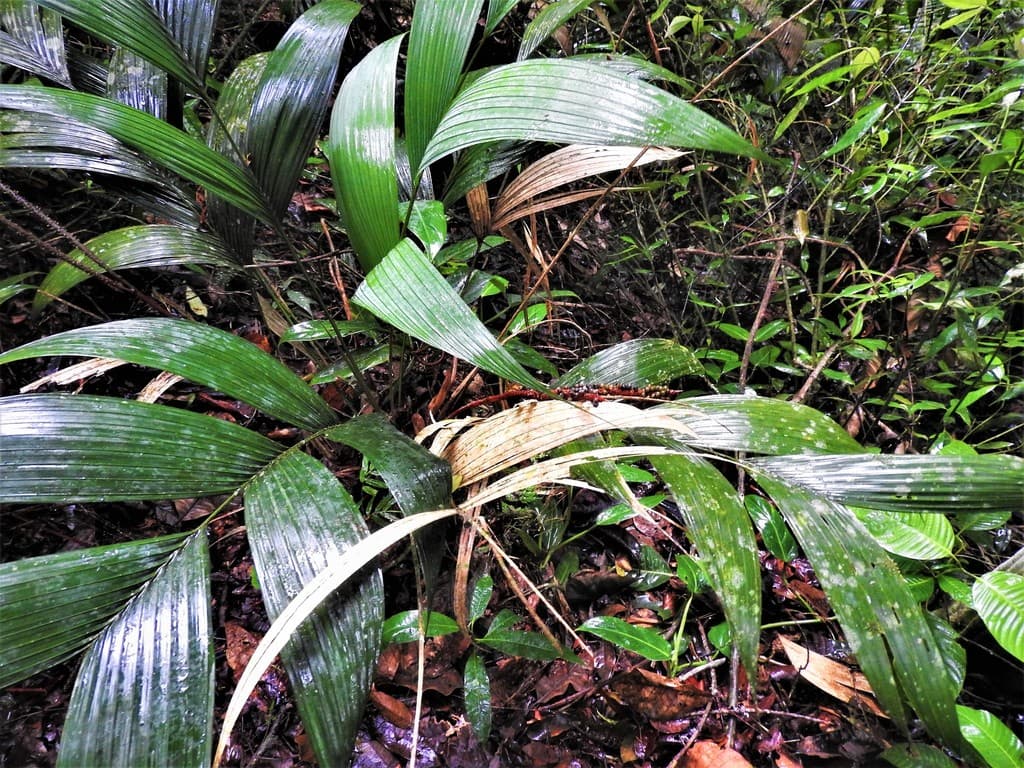
Botanical specimen of Geonoma Orbignyana.
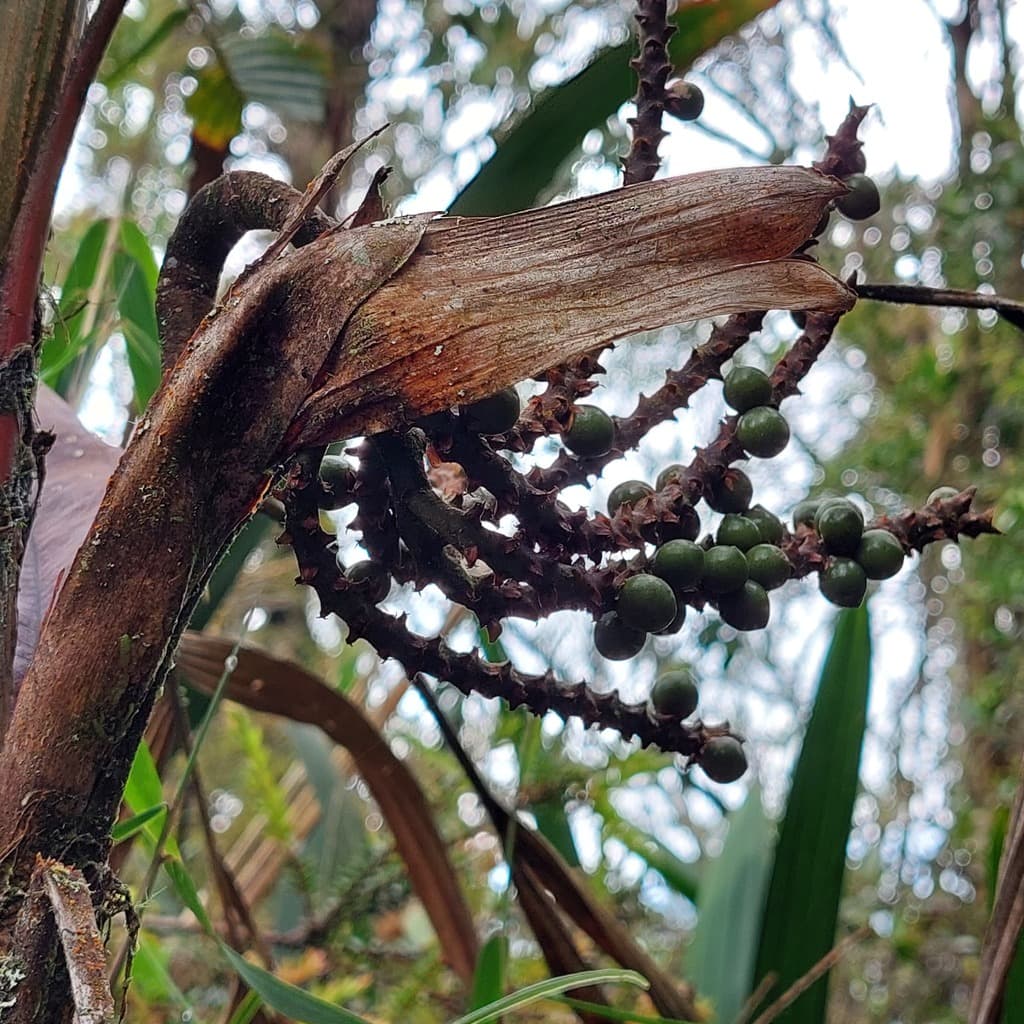
Botanical specimen of Geonoma Orbignyana.
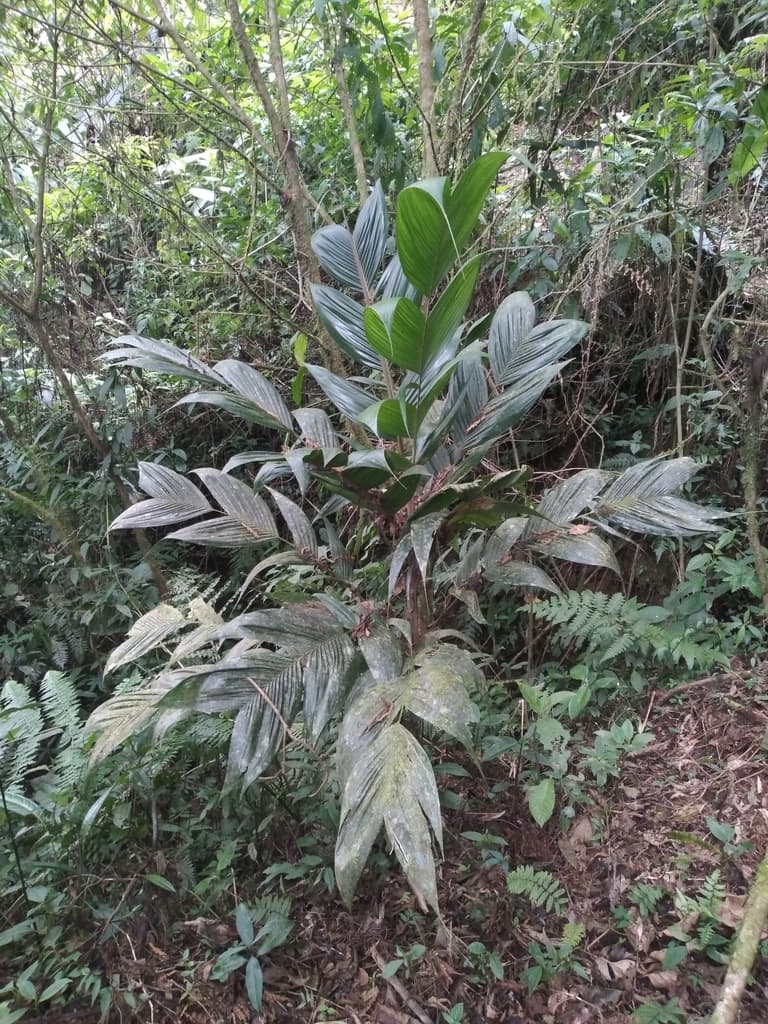
Botanical specimen of Geonoma Orbignyana.
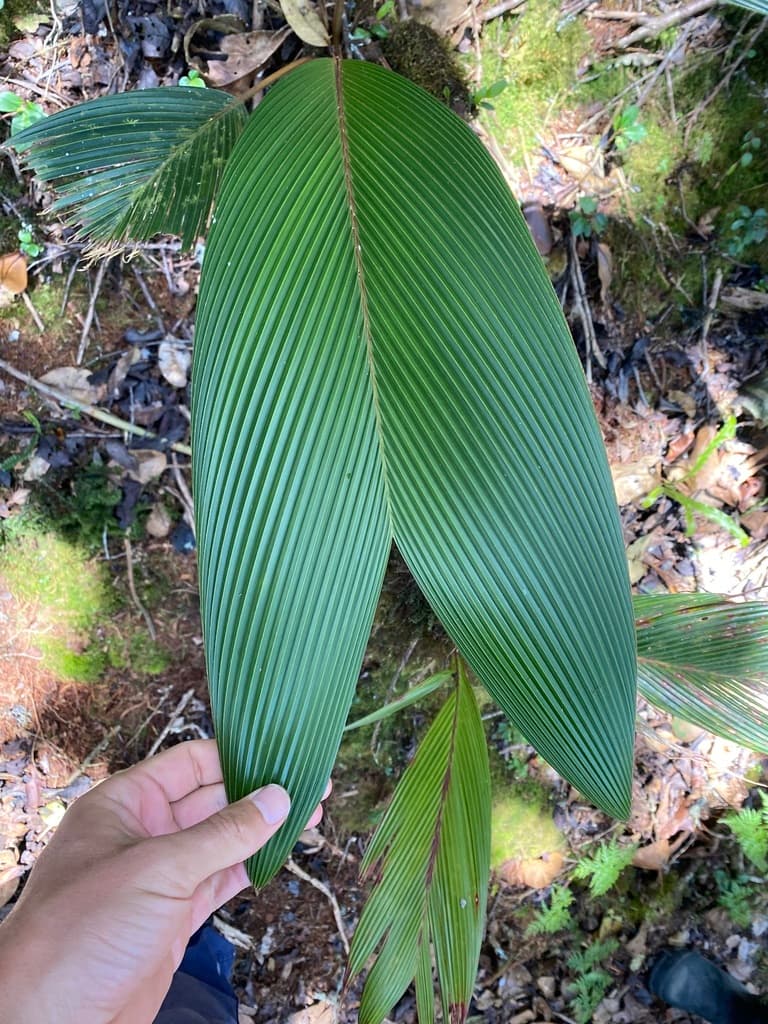
Botanical specimen of Geonoma Orbignyana.
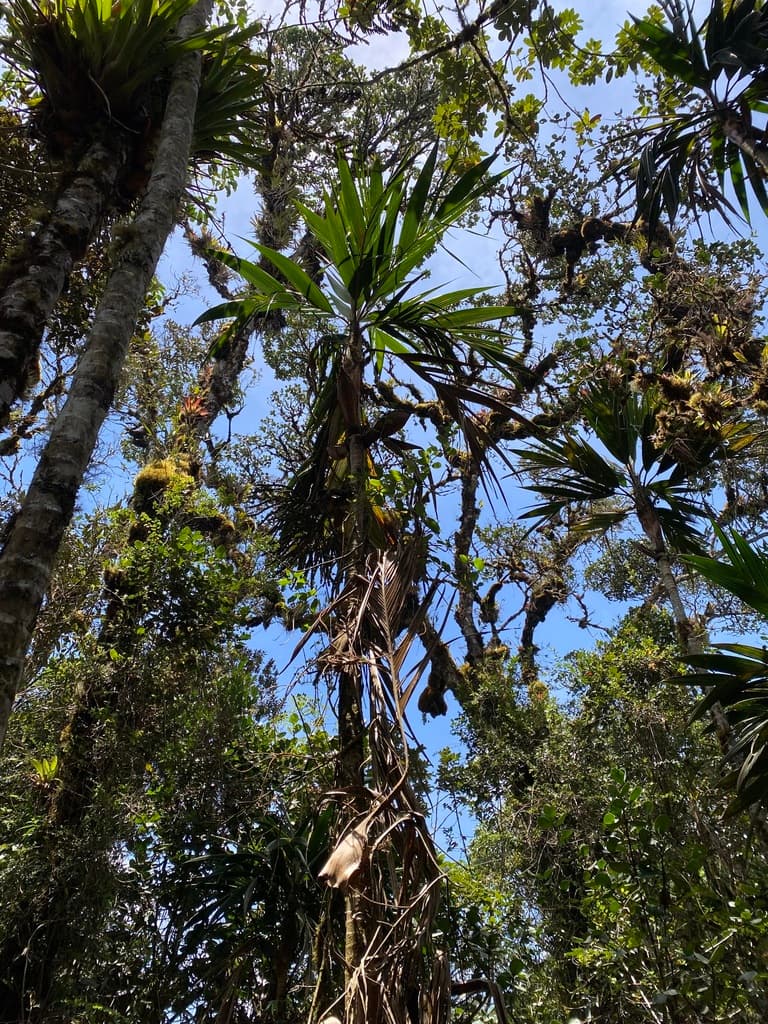
Botanical specimen of Geonoma Orbignyana.
Sources & Conservation
Curated- Geonoma orbignyana Mart. | Plants of the World Online | Kew Science · accessed 2026-08
- Geonoma orbignyana Mart., Voy. Amér. Mér. 7(3): 22 (1843) | PALMweb · accessed 2026-08
- Geonoma orbignyana subsp. orbignyana | PALMweb (Henderson 2011 distribution, elevation and morphotype discussion) · accessed 2026-08
- Geonoma orbignyana subsp. hoffmanniana (H.Wendl. ex Spruce) A.J.Hend. | PALMweb (Henderson 2011 distribution and elevation)