Chontilla
Geonoma Stricta • Caña brava • Hoja ancha • Pepas negras • Tauna kaspi • Tuksina chunta • Boyego tinwe
The Essence
"Geonoma stricta is a small, slender understorey palm of lowland Neotropical rainforest, and one of the most taxonomically troublesome palms in the Americas. Andrew Henderson called it "an extremely complicated species": earlier authors treated it either as a single species with several varieties (Henderson 1995) or as several distinct species (Wessels Boer 1968), and fifteen other published names — among them Geonoma pycnostachys, G. piscicauda, G. trailii, G. wittiana, G. bella and G. uleana — are now treated as synonyms of it. Henderson's 2011 genus revision, combining quantitative and qualitative characters with geography, settled on one species with nine subspecies: antioquiensis, arundinacea, bracteata, divaricata, pendula, pliniana, quibdoensis, stricta and submontana. The most widespread of these, subsp. arundinacea, is itself variable enough that Henderson divided it into eight informal morphotypes and suspected introgression and hybridisation among them. Its range is wide but not continuous, falling into four separate areas: the Pacific coast of Colombia (Chocó), the Central Cordillera of Colombia (Antioquia), the central and western Amazon with adjacent sub-Andean regions, and the Guianas with adjacent Amapá in Brazil. GBIF holds about 11,300 occurrence records. Ethnobotanical use is well documented. Leaves serve as thatch, for covering baskets of forest produce and for wrapping; stems become walking sticks, meat skewers, fishing harpoons and stilts; the palm heart is chewed to protect the teeth from rotting; and the seeds are used in blowguns to shoot small birds. An Ecuadorian ethnobotanical inventory also records scraped stem tissue packed into shotgun cartridges alongside the shot, and dried leaves smoked before a hunt to bring good results. PALMweb's account of subsp. arundinacea adds stems used by the Urarina of Peru as mosquito-net supports and for fishing spears. No English common name exists — Palmpedia and Trebrown both record "none known" — though GBIF carries local Ecuadorian vernaculars."
Geonoma comes from the Greek geonomos, "colonist", supposedly referring to the clustering, spreading habit of many species in the genus. The epithet stricta is botanical Latin strictus: "drawn close together, congested; very upright or erect, very straight and rigid".
Described by Poiteau as Gynestum strictum and transferred to Geonoma by Kunth in Enumeratio Plantarum 3: 232 (1841).
Natural Habitat
An understorey palm of lowland rainforest on well-drained soils, generally up to about 700 m and occasionally to 1,000 m. Subspecies differ markedly in elevation: subsp. arundinacea averages 416 m (75-1,850 m) in lowland or montane rainforest, subsp. antioquiensis 852 m (700-1,075 m), subsp. quibdoensis just 96 m (50-150 m), and subsp. pliniana 53 m (5-100 m) in coastal terra firme forest.
Curated Specimens
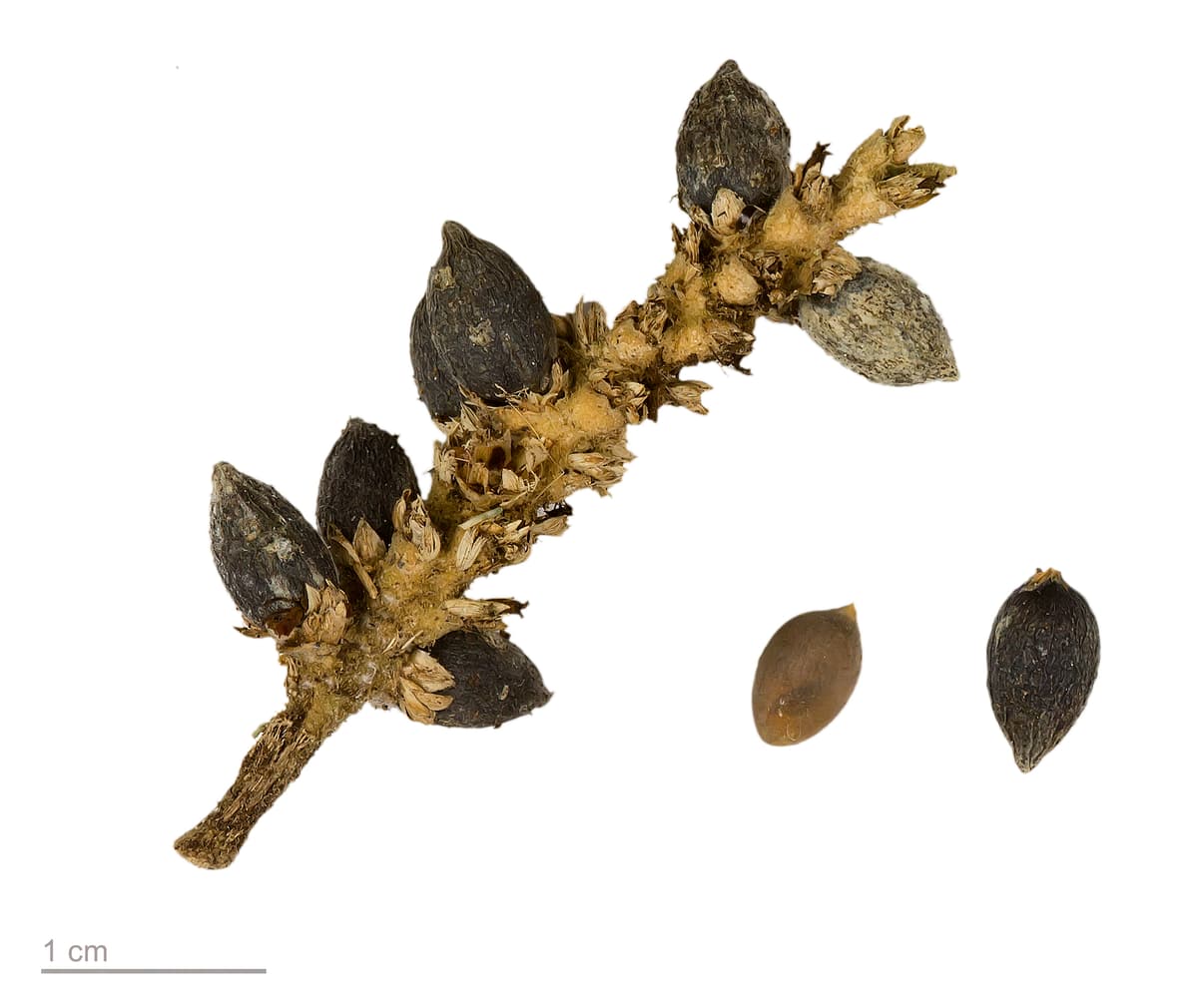
Botanical specimen of Geonoma Stricta.
Sources & Conservation
Curated- Geonoma stricta (Poit.) Kunth | Plants of the World Online, Kew · accessed 2026-08
- Geonoma stricta - Palmpedia, Palm Grower's Guide (Henderson 2011 / Palmweb text) · accessed 2026-08
- Geonoma stricta subsp. arundinacea (Mart.) A.J.Hend. | PALMweb · accessed 2026-08
- Geonoma Willd. (genus account, Genera Palmarum) | PALMweb · accessed 2026-08
- Geonoma stricta - Useful Tropical Plants · accessed 2026-08
- Geonoma stricta (Poit.) Kunth - GBIF Backbone Taxonomy (taxon 2734102; vernacular names, use descriptions, IUCN category) · accessed 2026-08
- Geonoma stricta - The IUCN Red List of Threatened Species 2024 (Least Concern, e.T67536848A67537109; BGCI & IUCN SSC Global Tree Specialist Group) · accessed 2026-08
- Geonoma stricta subsp. stricta - Trebrown Nurseries (cold hardiness zone) · accessed 2026-08
- strictus - A Grammatical Dictionary of Botanical Latin, Missouri Botanical Garden · accessed 2026-08