Bentham's Fan Palm
Livistona Benthamii • Cabbage Palm
Bentham's Fan Palm in Motion
The Essence
"Livistona benthamii is a solitary fan palm of the seasonally flooded lowlands of northern Australia and southern New Guinea, and one of the few Livistona species adapted to genuinely swampy ground: it grows in swamp forest, on alluvial flats, in gallery forest, and even on the leeward side of mangroves. Frederick Manson Bailey described it in 1902 from a collection made at Somerset on Cape York Peninsula by Frank L. Jardine; Livistona holtzei and Livistona melanocarpa are treated as synonyms. Its most useful field character is the trunk, which stays clothed in persistent petiole stubs because the leaves break off at about the middle of the petiole instead of shedding cleanly. Published measurements differ - Palmweb gives a stem to 18 m tall and 13-20 cm dbh, while Monaco Nature Encyclopedia reports 16-20 m with a base of 30-40 cm narrowing to 14-18 cm higher up - so the figures below are given with their sources. Plants are functionally male or female. The apical bud is edible, though taking it kills the palm. In cultivation it is grown for its ornamental form, including roadside planting, and is described as cyclone resistant and attractive to birds and butterflies; a cultivated specimen can be seen on the Freshwater Lake Walk at the Flecker Botanic Gardens in Cairns."
The genus name Livistona was dedicated to Patrick Murray, Baron of Livingston, whose collection and garden passed in 1670 to the botanic garden that became the present Royal Botanic Garden Edinburgh. The epithet benthamii honours the English botanist George Bentham (1800-1884), author of Flora Australiensis. The species was described by Frederick Manson Bailey: Livistona benthamii F.M.Bailey, Queensl. Fl. 5: 1683 (1902).
The apical bud, the "cabbage", is edible. The CSIRO Australian Tropical Rainforest Plants key records that the central growing tip is eaten raw or lightly roasted, and Territory Native Plants notes that the cabbage is still occasionally eaten. Harvesting it kills the plant.
Natural Habitat
A lowland wetland palm. It grows in swamp forests, on alluvial flats, on the leeward side of mangroves, and in moist to wet areas in monsoonal thickets and gallery forests at low elevations, 0-100 m. Wikipedia describes it as a solitary palm of open forest near areas that are annually inundated. Flowering runs September to January and fruiting November to April. POWO gives the native range as New Guinea, the Northern Territory and Queensland; Palmweb breaks this down as the Northern Territory from the Daly River across the Top End to east Arnhem Land, Queensland from Moa Island in Torres Strait through Cape York to the McIlwraith Range, and, in New Guinea, the Western and Central Provinces of Papua New Guinea and the Merauke Division of Indonesian Papua.
Curated Specimens
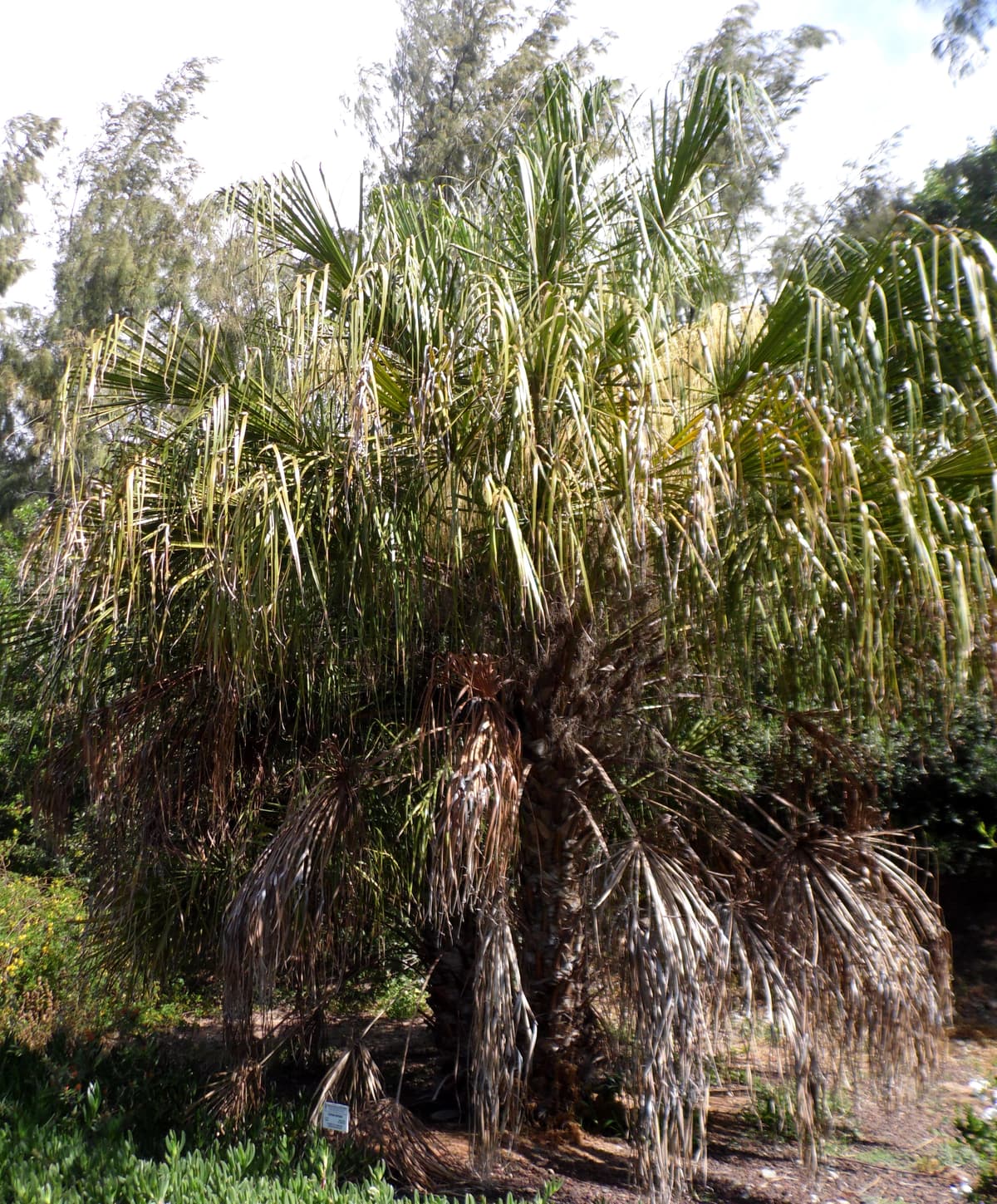
Botanical specimen of Livistona Benthamii.
Biology & Morphology
"Solitary single-stemmed fan palm whose trunk retains long persistent petiole stubs, with a globose crown of 30-50 costapalmate leaves 90-160 cm long divided into 50-80 segments on spiny petioles 120-200 cm long, inflorescences 120-210 cm long branched to two orders and carrying small cream to pale yellow flowers, and globose to obovoid or pyriform pruinose purple-black fruit 9-13 mm long and 9-11 mm across with an ovoid seed 8-9 mm long. Plants are functionally dioecious."
Morphology
Solitary, erect trunk with prominent vascular reinforcement and dense fibrous layering.
Adventitious root system spreading radially to maximize hydraulic intake in competitive soil matrices.
Distinctive solitary habit and large stature providing a unique architectural profile.
Foliage
Vibrant green canopy featuring fan-shaped palmate leaves with deep costapalmate structure and rigid petiole attachments.
Specialized green tissues exhibiting moderate metabolic expansion rates.
Reproduction
Complex inflorescence branching typical of the Livistona clade, exhibiting seasonal reproductive synchrony.
Nutrient-dense drupes encased in a fibrous pericarp, optimized for protection and dispersal.
Dormant embryonic tissues with high endosperm density, characteristic of resilient Livistona specimens.
Ecology
Active rhizosphere communication with mycorrhizal fungal networks, enhancing phosphorus and micronutrient uptake.
Interlocked with local entomological vectors, primarily Meliponini bees or specialized coleoptera.
Gravity-mediated and animal-vectored dispersal mechanisms ensuring regional genetic distribution.
Germination & Propagation
Germination Timeline
Hydration soak.
Incubation in moist media.
Sprout emergence.
Propagated by seed. The soaking-and-temperature protocol above comes from a single source (Monaco Nature Encyclopedia); no second source was found to corroborate it.
Cultivation & Care
Light
Partial shade during the juvenile phase, then full sun once established; NParks Singapore simply lists full sun. The Malaga parks profile instead describes it as preferring semi-shade and usable as an indoor plant while young, and Territory Native Plants notes it is suitable for understorey planting.
Water
Keep the substrate almost constantly humid; NParks lists water preference as moderate. Consistent with its swamp-forest habitat, it tolerates seasonal flooding and moist, humid conditions.
Soil
Slightly acidic to slightly alkaline soils, preferably rich in organic matter and kept almost constantly humid.
Essentially a tropical to subtropical palm, from monsoonal lowland habitats at 0-100 m. Only one retrieved source gives a cold figure: Monaco Nature Encyclopedia states that adult plants tolerate temperatures down to about -3 C. No authoritative USDA zone rating was found in the sources consulted. Territory Native Plants describes the species as cyclone resistant and attractive to birds and butterflies, and NParks lists it as suitable for roadside planting.
Pests, Diseases & Care
Pests
Rhynchophorus ferrugineus (Red Palm Weevil)
CRITICALLethal internal boring; often undetected until crown collapse.
Acoustic monitoring and early-stage trunk infusion with fipronil.
Oryctes rhinoceros (Asiatic Rhinoceros Beetle)
HIGHSevere damage to young spear leaves and apical bud.
Pheromone lures and integration of viral control (Oryctes nudivirus).
Diseases
Colletotrichum spp. (Anthracnose)
MODERATEBlack necrotic spots on leaflets under high humidity.
Copper-based fungicides and reduction of overhead irrigation.
Ganoderma zonatum (Butt Rot)
LETHALRadial wood decay and structural instability at the base.
No chemical cure; immediate isolation and removal.
Nutritional Deficiencies
Interveinal chlorosis (Younger fronds)
Chelated Fe-EDDHA Soil Pulse
Marginal chlorosis (Older fronds)
Mg-Sulfate (Kieserite) saturation
Frizzletop / Distorted spear
Systemic Mn-Sulfate application
Care Tips
Biosurveillance pulse synchronized for Asia regional vectors.
Apply prophylactic fungicidal drench in the nocturnal phase.
Improve canopy ventilation to disrupt fungal sporulation cycles.
Sources & Conservation
Curated- Livistona benthamii F.M.Bailey, Queensl. Fl. 5: 1683 (1902) — PALMweb · accessed 2026-08
- Livistona benthamii — Australian Tropical Rainforest Plants (CSIRO, Lucid key) · accessed 2026-08
- Livistona benthamii F.M.Bailey — Plants of the World Online (POWO), Kew Science · accessed 2026-08
- Livistona benthamii — Wikipedia · accessed 2026-08
- Livistona benthamii — NParks Singapore Flora & Fauna Web · accessed 2026-08
- Livistona benthamii — Monaco Nature Encyclopedia · accessed 2026-08
- GBIF species search: Livistona benthamii (accepted name, authorship, family) · accessed 2026-08
- Livistona benthamii — Ayuntamiento de Málaga, Parques y Jardines species profile · accessed 2026-08
- Livistona benthamii (Bentham's Fan/Cabbage Palm) — Territory Native Plants (NT, Australia) · accessed 2026-08