Kona palm
Masoala Kona • Kona • Kogne
Kona palm in Motion
The Essence
"Masoala kona is one of only three species in Masoala, a palm genus endemic to Madagascar, and it is among the rarest palms on the island. Fewer than 60 trees are known in the wild, scattered across just three widely separated locations in the southeast between Vondrozo and Ifanadiana, giving an extent of occurrence of about 693 km2 and an area of occupancy of only about 36 km2. None of the occurrence sites lies in a protected area and the population is decreasing, with shifting agriculture and logging the main threats; the IUCN assessment - made in December 2010 and published in 2012 - calls for urgent conservation action and warns that the species could very quickly become Critically Endangered if the sites remain unprotected. What sets the palm apart is its foliage: the largest leaflets reach 165-250 cm long and are attached to the rachis for up to 1.5 m, and its leaves are credited with the longest leaf segments of any plant, up to 2.5 m (8.2 ft). The hard-wooded trunk carries a crown of erect leaves whose litter-accumulating sheaths are covered in dense red-brown tomentum. Locally, a leaf stuck in a bamboo pole is thought by some to ward off thunder-clouds; the IUCN assessment records no use and trade information."
The genus name Masoala refers to the Masoala Peninsula of northeastern Madagascar, where M. madagascariensis is native. The epithet kona is taken from the local name for the palm, and both kona and kogne are recorded as vernacular names used by the Tanala people.
Described as new by Henk Beentje in Dransfield & Beentje, Palms of Madagascar (1995), page 425. The protologue notes that the leaf resembles that of Marojejya insignis while the inflorescence is clearly congeneric with the much larger M. madagascariensis. The fruit is known only from empty specimens.
Natural Habitat
Mid-altitude low-canopy rainforest between 300 and 700 m, on steep to gentle slopes, near ridge crests, or in swampy valley bottoms on sandy or quartz soils; POWO places the species in the wet tropical biome.
Curated Specimens
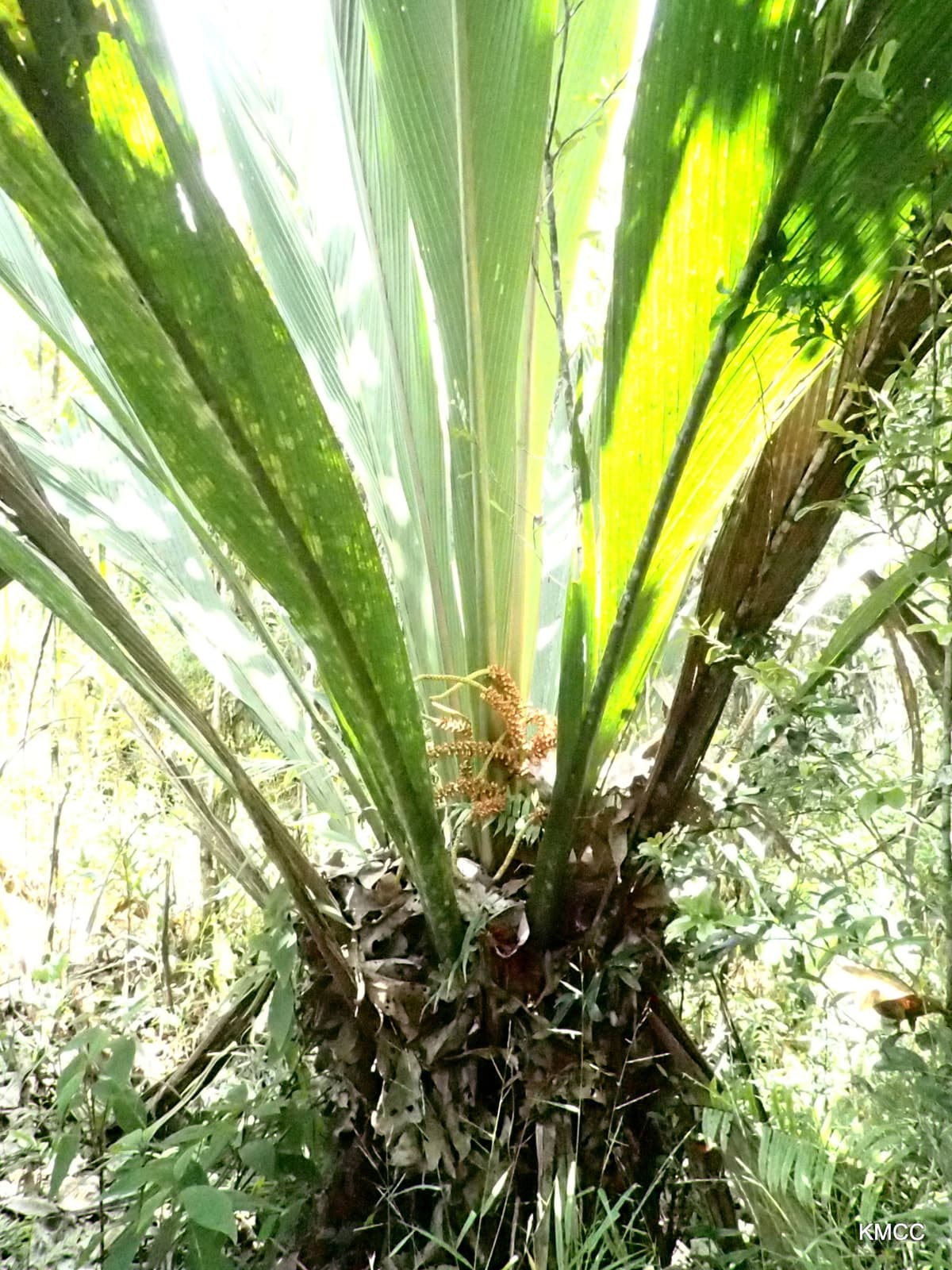
Botanical specimen of Masoala Kona.
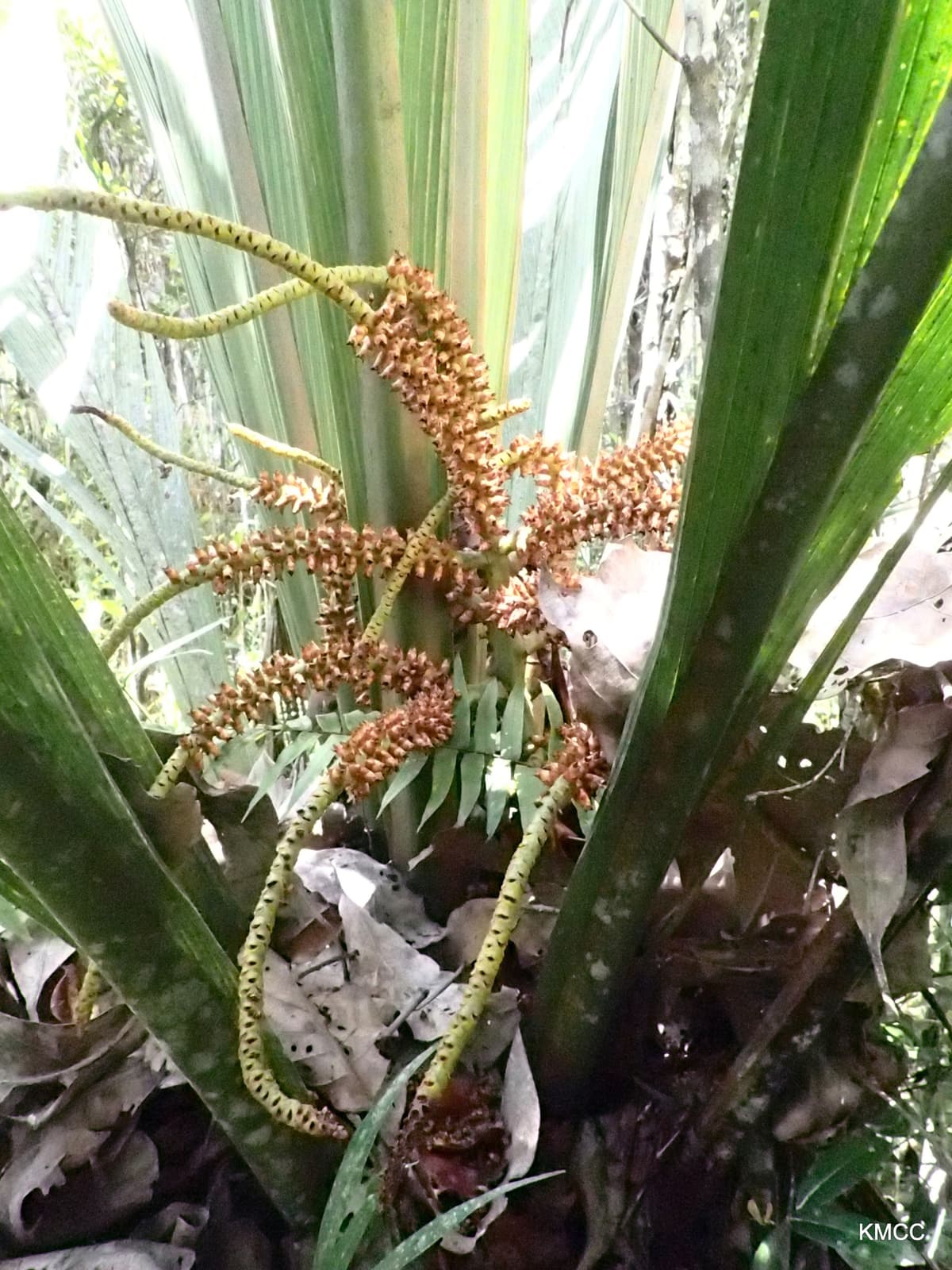
Botanical specimen of Masoala Kona.
Biology & Morphology
"Solitary palm with a trunk 1.2-9 m tall (about 35 cm across while clothed in persistent leaf bases, 13-20 cm bare) carrying 13-17 erect living leaves plus 5-15 marcescent dead ones, the rachis 2.8-4.5 m long with 6-15 leaflets per side and huge proximal multi-fold leaflets 165-250 x 13-24 cm; the erect interfoliar inflorescence is 0.7-1.2 m long, branched to 1-2 orders and protogynous, with yellow staminate flowers, and the ellipsoid fruit measures 25-40 x 12-14 mm."
Morphology
Symmetrical columnar trunk with characteristic leaf-scar patterning and lignified outer cortex.
Adventitious root system spreading radially to maximize hydraulic intake in competitive soil matrices.
Distinctive unknown habit and medium stature providing a unique architectural profile.
Foliage
Vibrant green canopy featuring characteristic frond architecture optimized for photon interception and transpiration efficiency.
Specialized green tissues exhibiting moderate metabolic expansion rates.
Reproduction
Complex inflorescence branching typical of the Masoala clade, exhibiting seasonal reproductive synchrony.
Nutrient-dense drupes encased in a fibrous pericarp, optimized for protection and dispersal.
Dormant embryonic tissues with high endosperm density, characteristic of resilient Masoala specimens.
Ecology
Active rhizosphere communication with mycorrhizal fungal networks, enhancing phosphorus and micronutrient uptake.
Interlocked with local entomological vectors, primarily Meliponini bees or specialized coleoptera.
Gravity-mediated and animal-vectored dispersal mechanisms ensuring regional genetic distribution.
Germination & Propagation
Germination Timeline
Hydration soak.
Incubation in moist media.
Sprout emergence.
No germination guidance was found in the sources consulted; the fruit is known only from empty specimens, and the protologue records only that the eophyll (first seedling leaf) is deeply bifid.
Cultivation & Care
Light
Full Sun to Partial Shade
Water
No cultivation watering guidance was found in the sources consulted. In the wild it grows in rainforest, including swampy valley bottoms.
Soil
No cultivation soil guidance was found in the sources consulted. In habitat the species grows on sandy or quartz soils.
Palmpedia lists cold hardiness zone 9b+; no other cold-hardiness information was found in the sources consulted, and this is a wet-tropical Madagascar rainforest palm. Despite fewer than 60 known wild trees, it is present in a few cultivated collections: Palmpedia's photo gallery documents plants at Harry P. Leu Gardens (Orlando), Nong Nooch Botanical Garden (Thailand), Florida nurseries and Hawaii gardens.
Pests, Diseases & Care
Pests
Strategus aloeus (Ox Beetle)
HIGHAdults bore into the base of young palms, causing structural instability.
Soil drenching and manual inspection of the root flare.
Rhynchophorus palmarum (South American Palm Weevil)
CRITICALLarvae tunnel through the apical meristem, leading to crown collapse.
Pheromone trapping and systemic insecticide injection.
Diseases
Thielaviopsis punctulata (Black Scorch)
HIGHBlackening and dwarfing of newly emerging fronds.
Wound protection and application of thiophanate-methyl.
Colletotrichum spp. (Anthracnose)
MODERATEBlack necrotic spots on leaflets under high humidity.
Copper-based fungicides and reduction of overhead irrigation.
Nutritional Deficiencies
Interveinal chlorosis (Younger fronds)
Chelated Fe-EDDHA Soil Pulse
Marginal chlorosis (Older fronds)
Mg-Sulfate (Kieserite) saturation
Frizzletop / Distorted spear
Systemic Mn-Sulfate application
Care Tips
Biosurveillance pulse synchronized for Madagascar regional vectors.
Apply prophylactic fungicidal drench in the nocturnal phase.
Improve canopy ventilation to disrupt fungal sporulation cycles.
Sources & Conservation
Curated- Masoala kona Beentje — Plants of the World Online (POWO), Kew · accessed 2026-09
- Masoala Jum. (genus, 3 accepted species) — Plants of the World Online (POWO), Kew · accessed 2026-09
- Rakotoarinivo, M. & Dransfield, J. 2012. Masoala kona. The IUCN Red List of Threatened Species 2012: e.T38607A2880873 · accessed 2026-09
- Masoala kona — Palmpedia (quoting Dransfield & Beentje 1995, Palms of Madagascar / Palmweb) · accessed 2026-09
- Masoala kona — Wikipedia · accessed 2026-09
- Masoala kona Beentje — GBIF Backbone Taxonomy (species 5293758) · accessed 2026-09