Tucumã
Astrocaryum Aculeatum • Tucumã-do-Amazonas • Tucumã-açu • Tucum • Acaiúra • Acuiuru • Coco-tucumã • Tucumã-do-mato • Tucumã-piririca • Jabarana
Tucumã in Motion
The Essence
"Astrocaryum aculeatum is a large, solitary, fiercely spiny palm of northern South America and Trinidad, and the source of the tucumã — an economically important non-timber forest product of the Brazilian Amazon. Its unbranched trunk, armed with long black spines, can reach about 25 m although it is usually much shorter, and it carries a crown of 6–15 erect leaves up to 6 m long. The orange fruits, 5–6 cm in diameter and around 70 g, hold a slightly sweet pulp over a woody endocarp. That pulp is exceptionally rich in provitamin A — 808 µg vitamin A RAE and 5,191 µg beta-carotene per 100 g, alongside 22.15 g fat and 9.6 g dietary fibre — and it is eaten fresh, in sandwiches, and processed into a juice used as a base for sweet and savoury sauces. Oil is pressed from both pulp and kernel for cooking and for skin care; the pulp oil is 25.6% saturated and 74.4% unsaturated fatty acids, and goes into soaps, body lotions and hair products. Leaf fibre is worked into hammocks and ropes that resist salt water, and the hard seed shell is carved into jewellery — the tucum ring is worn in the Catholic church in Brazil as a symbol of commitment to social justice, peace-building and ecology. Palmweb records ethnobotanical use across Amazonia among Nukak, Miraña, Tikuna, Chacobo and Muinane peoples, for fibre, food, oil, construction, bows and arrows, and medicine. Despite all this the palm is still described as only incipiently domesticated: supply comes from extractive harvest rather than plantations and reaches the market irregularly in both quantity and quality, and the seed's notoriously slow, erratic germination is a genuine obstacle to propagation. The name is contested, and the two camps mean different plants. Under strict typification Astrocaryum aculeatum belongs to the palm long known as A. gynacanthum, and Astrocaryum tucuma is the correct name for the tucumã; a 2008 proposal to conserve A. aculeatum for the tucumã was rejected, and in 2024 Lima and de Almeida Jr. published a further proposal in TAXON to conserve A. gynacanthum against A. aculeatum. Kew's data — POWO, as served through ColPlanta — accordingly treats A. aculeatum G.Mey. as a synonym of Astrocaryum tucuma Mart. and flags the name "nom. rej. prop.", whereas the GBIF backbone, World Flora Online, the IUCN Red List, Palmweb, Wikipedia and the Brazilian agronomic literature all still use A. aculeatum for the tucumã. This page describes the tucumã — the plant almost everyone means by the name."
Astrocaryum comes from the Greek astron, star, and karyon, nut, referring to the star-like pattern of fibres around the endocarp pores. The epithet aculeatum is botanical Latin for prickly or beset with prickles, from aculeus, a sting or prickle — an apt name for a trunk armed with long black spines. The vernacular name tucumã derives from tuku'mã in the Tupi language.
Described by Georg Friedrich Wilhelm Meyer in Primitiae Florae Essequeboensis: 266 (1818), based on material from the Essequibo region of Guyana.
Natural Habitat
A palm of non-flooded, terra firme upland ground, recorded in rainforest and in Amazonian dry-land forest. It is most frequent in deforested areas and in ground that has undergone human disturbance, and is rarely found in lowland rain forest — effectively a light-demanding coloniser of clearings and anthropized land. Seed dispersal is mainly by gravity, with seed concentrated within about 3.5 m of the canopy projection, and secondary dispersal by agoutis (Dasyprocta azarae) and acouchis (Myoprocta sp.), which deposit seed close to the mother plant; seed is also moved by people and along rivers. The species is protogynous: pistillate flowers open in the evening and remain viable about 24 hours, while staminate flowers open later and last only about six hours. It is predominantly outcrossing — no selfed offspring were detected in a harvested Amazonian population — and its flowers are visited for pollen by bees (Trigona sp., Apis mellifera) and beetles (Nitidulidae: Mystrops sp.; Curculionidae: Terires minusculus).
Curated Specimens
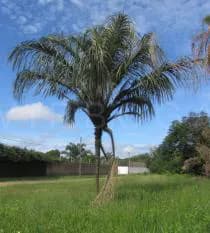
Botanical specimen of Astrocaryum Aculeatum.