Wine palm
Attalea Butyracea • American oil palm • Yagua palm • Corozo • Palma real • Shapaja • Jaci palm • Rooster-tail palm • Coquito • Canambo
Wine palm in Motion
The Essence
"Attalea butyracea is one of the most useful and conspicuous palms of the lowland Neotropics, ranging from southern Mexico to Bolivia and Trinidad-Tobago, mostly below 300 m elevation. A massive, solitary canopy palm, it carries a 'shuttlecock' crown of huge arching leaves atop a trunk that can reach 25 m. People use nearly every part: the sap is fermented into an alcoholic drink — hence 'wine palm' — and the buttery, oil-rich seeds yield an edible oil, behind both the name 'American oil palm' and the epithet butyracea. The leaves make a prized thatch lasting four years or more; the mildly sweet, nutty fruits are eaten raw and fed to cattle and pigs; the palm heart is eaten, beetle larvae are harvested from decaying trunks, and the roots are used in folk extracts for hepatitis. The species also has a notorious medical-ecology role: in Colombia its crowns are the wild biotope most often found infested by triatomine bugs, among them Rhodnius prolixus, one of the main vectors of Chagas disease — a floodplain-forest study in Casanare, Colombia found 88.9% of palms infested, at about 12.6 bugs per palm, and palms near houses are a documented risk factor for infected bugs migrating into homes."
The genus name Attalea recalls Attalus III (ca. 170–133 BC), king of Pergamon and a scholar of medicine and botany; the epithet butyracea is the Latin adjective for 'buttery' or 'oily', referring to the oil-rich seeds.
The species was first described as Cocos butyracea by Mutis ex Linnaeus f. in Supplementum Plantarum (1782); the current combination Attalea butyracea (Mutis ex L.f.) Wess.Boer was published in Pittieria in 1988. Its long synonymy — Cocos butyracea, Scheelea butyracea, Attalea gomphococca, A. humboldtiana, A. wallisii and others — reflects repeated reclassification between Cocos, Scheelea and Attalea.
Natural Habitat
Wet tropical biome: woodlands and forests — most commonly on edges and in areas of disturbance — as well as grassland and wet savannah, frequently on flat ground alongside streams, from the coastal plains to about 1,000 m (mostly below 300 m). It often grows gregariously: in Ecuador it occurs east of the Andes, often in relatively large stands in flood-plain forest, and one floodplain-forest study site in Casanare, Colombia held about 1,265 palms per hectare. It also grows in humid forest along riverbanks and even in semi-arid degraded areas at low altitudes, where it is often the dominant species.
Curated Specimens
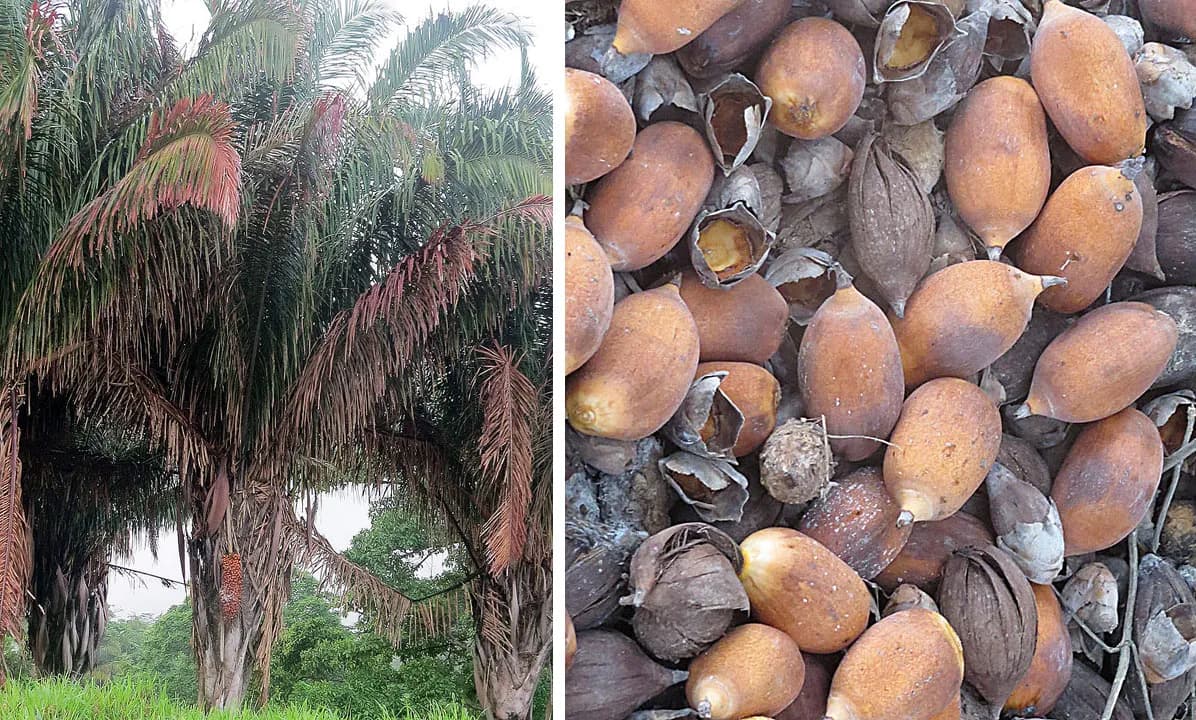
Botanical specimen of Attalea Butyracea.