Carossier palm
Attalea Crassispatha • Carossier • Carroussier • Côrossié • Petit coco • Kawosie • Ti koko • Kowos • Kokowos • Kolowosh • Kowos etranjè
Carossier palm in Motion
The Essence
"Attalea crassispatha is endemic to the southern (Tiburon) peninsula of south-western Haiti, and is the only member of subtribe Attaleinae native to the Greater Antilles. It is the most isolated disjunct in its genus: every other Attalea is Central or South American, and the only other species reaching the insular Caribbean, A. maripa and A. osmantha, occur in Trinidad and Tobago at the extreme southern end. The IUCN/SSC Palm Specialist Group account describes it as restricted to four localities within two major watersheds, the Cavaillon and the Côtes-de-Fer, from sea level to 450 m; the 2018 IUCN assessment instead names the four localities as Fond des Nègres, Aquin (Fond des Blancs), Cavaillon and Bonne Fin, gives an area of occupancy under 250 km2, and records an elevation range of 50 to 504 m. A 2009 molecular phylogeny by Alan Meerow and colleagues placed it in a clade containing the "Scheelea clade" and the two "Orbignya clades", but as sister to both groups. GBIF held only 46 occurrence records for the species when checked in August 2026, 38 of them from Haiti. The palm has been described as one of the rarest in the Americas, and Haiti National Trust calls it the most endangered endemic palm in Haiti and one of the world's most threatened palm species. The 2018 IUCN assessment lists it as Critically Endangered under criteria C2a(i); D, with fewer than 50 mature individuals known (the assessment's population field gives 40 to 50), a declining trend, and subpopulations of one to six individuals; about half the population grows in courtyard gardens, and most of it is senescent. Field surveys in 2017 located 24 plants in the wild, consistent with a count of 25 in 1994, while Useful Tropical Plants reports fewer than 30 individuals found in 1996 in two adjacent river valleys. Haiti National Trust reports that the last study of the wild population, in 2001, found only 19 known reproductive adults, 5 of them adult males, scattered across three geographically separated subpopulations, and that the remnant suffers from inbreeding depression. The species is long-lived, reaching sexual maturity at around 40 years; individuals bear male-only flowers within 20 years but do not produce female flowers until roughly 30 to 40 years. IUCN identifies lightning strikes and tropical cyclones uprooting old trees as the largest cause of death, alongside conversion of the range to agricultural and urban land, reduced rainfall and more severe hurricanes under climate change, and possible interference with fruiting by the Hispaniolan Woodpecker, which nests inside the woody inflorescence bract. The Palm Specialist Group adds habitat destruction, changes in forest cover, soil structure and moisture, fire regime and the abundance of native seed dispersers, livestock grazing on fruits and seedlings, people harvesting immature seeds as snacks, and periodic hurricanes, one mature individual having been toppled by Hurricane Georges in 1998. Where it survives, the palm is useful. The seeds are edible, their flavour reported as similar to coconut but richer in fats and denser, and children eat the soft immature endosperm; IUCN records the seeds being eaten locally both raw and cooked in sweet cakes, the fruit fed to pigs, the large woody bract used as a bowl, the trunk used for hanging corn to dry, and candles lit at the base of the tree during cultural and religious ceremonies. The nuts are a good source of cooking oil, which is why Timyan and Reep called it the rare and endemic oil palm of Haiti. The leaves are used for thatch and weaving when the commoner fan palms Sabal causiarum and Coccothrinax argentea are unavailable, and the stem is used for lumber and traditional building. Because it is long-lived and survives hurricanes, farmers use the palm as a boundary marker between fields. Conservation work runs on two tracks. A large ex situ population grows at Fairchild Tropical Botanic Garden in Miami, probably the largest collection of the species anywhere, and seeds were distributed to botanic gardens in 12 countries in 1991; microsatellite work published in Webbia in 2023 found that the Fairchild genotypes did not capture most of the already limited genetic diversity of the wild plants, among which three major genetic groups were detected. In Haiti, seedlings were planted on the grounds of public buildings and private residences in 1990, families with the palm on their land were paid to preserve it, and the Fondation Botanique d'Haïti ran a project on the species' distribution, ecology and conservation status with support from Fauna & Flora International. IUCN notes plantings in cemeteries and on the grounds of hospitals and monasteries, and in gardens in Port-au-Prince and Pétionville, but records that the species occurs in no protected area. A four-year in situ project by Haiti National Trust with Fondation Capital Bank was announced in August 2024. The Palm Specialist Group notes that the species persists and can reproduce in anthropomorphic habitats, if given an opportunity."
The genus name Attalea commemorates Attalus III (ca. 170 B.C.–133 B.C.), king of Pergamon and a scholar of botany and medicine. The epithet crassispatha combines the Latin adjective crassus, big or thick, with spatha, and refers to the inflorescence's bract, matching the thick, woody, furrowed peduncular bract described by the IUCN/SSC Palm Specialist Group. The accepted combination Attalea crassispatha (Mart.) Burret was published in Kongl. Svenska Vetensk. Acad. Handl., ser. 3, 6(7): 23 (1929); the basionym is Maximiliana crassispatha Mart., and homotypic synonyms include Bornoa crassispatha (Mart.) O.F.Cook and Orbignya crassispatha (Mart.) Glassman. Bornoa was named by O. F. Cook for Louis Borno, a former President of Haiti; Wikipedia states that Cook did not validly publish the name, although POWO lists Bornoa crassispatha with a place of publication in Natl. Hort. Mag. 18: 266 (1939).
Charles Plumier visited Hispaniola in 1689 and published a description of the palm in 1703; Haiti National Trust reproduces Plumier's 1703 drawing, made on expeditions of 1689–1693. Carl Friedrich Philipp von Martius later used Plumier's notes and drawings for the formal Linnaean description, placing the palm in Maximiliana; POWO dates that basionym to d'Orbigny's Voyage dans l'Amérique Méridionale, 1844. Max Burret transferred it to Attalea in 1929. O. F. Cook proposed the genus Bornoa for it in 1939, Liberty Hyde Bailey kept it in Attalea, and S. F. Glassman thought it close to Orbignya and possibly a new genus; recent work has favoured maintaining these taxa in the single genus Attalea.
Natural Habitat
Sources disagree on the climate label. POWO records the species as growing primarily in the wet tropical biome, and the 2018 IUCN assessment states that it is often found on slopes and ravines in humid regions and that its natural habitat is subtropical humid forest. Against this, the IUCN/SSC Palm Specialist Group account states that its natural habitat is seasonally dry forest, of which much of the forest cover is now absent, and Monaco Nature Encyclopedia likewise describes dry forest from sea level to about 450 m. Useful Tropical Plants records the habitat as limestone soil slopes in disturbed areas at low elevations, and as scattered stands in rocky areas. Very little natural vegetation survives in Haiti, and the palm is now found in three anthropogenic habitats: field gardens, courtyard gardens and shrub forest. Timyan and Reep considered courtyard gardens, cultivated with perennial crops on more fertile soils, to have the highest potential for survival and regeneration, and found only one case of natural regeneration in a field garden. Most adult palms now occur as isolated individuals, and aspects of their biotic interactions are unknown, though IUCN notes that two birds endemic to Hispaniola, the Hispaniolan Woodpecker and the Palmchat, live in the canopy.
Curated Specimens
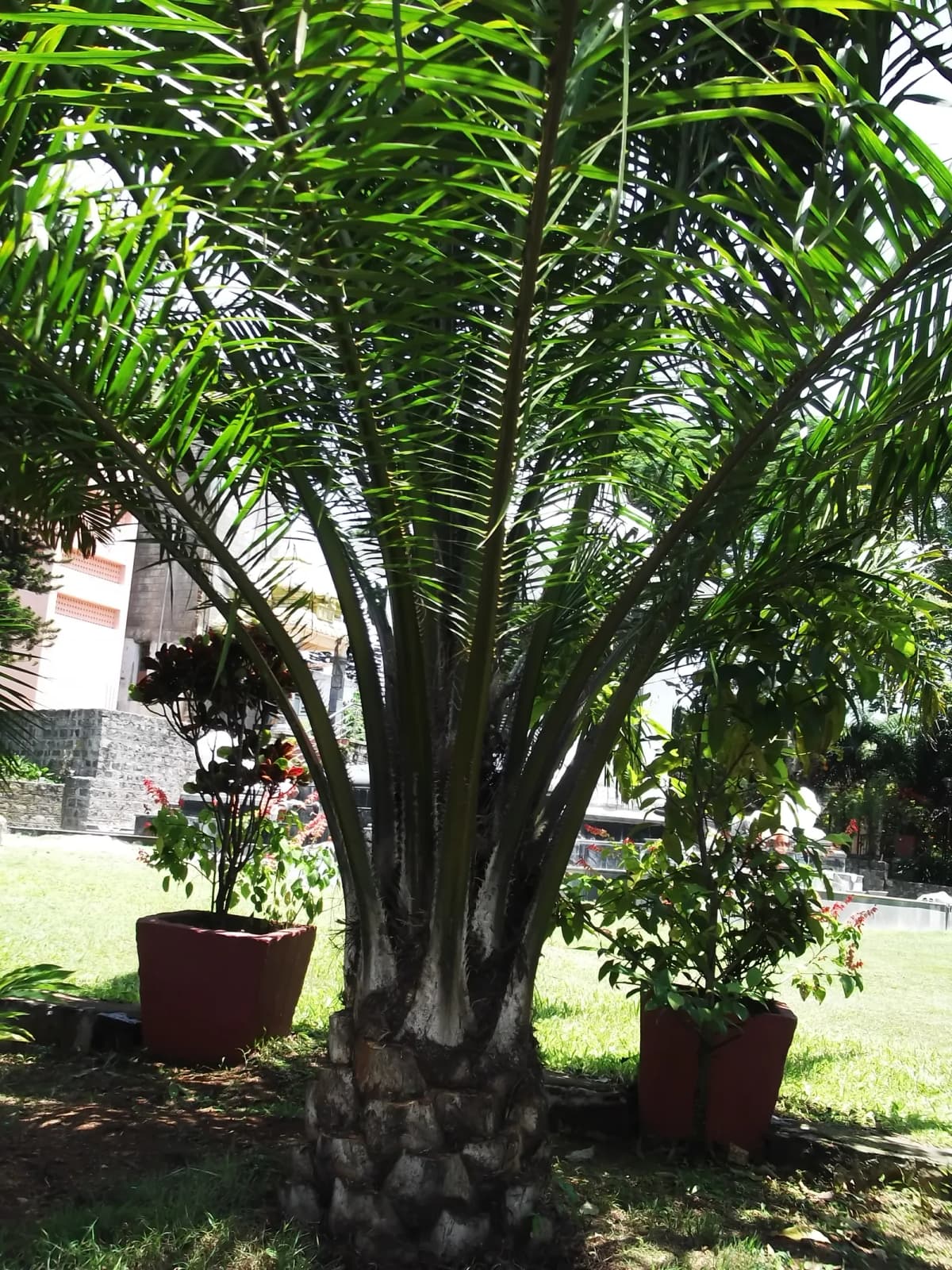
Botanical specimen of Attalea Crassispatha.
Sources & Conservation
Curated- Attalea crassispatha (Mart.) Burret | Plants of the World Online | Kew Science · accessed 2026-08
- Attalea crassispatha - Wikipedia · accessed 2026-08
- Attalea crassispatha - The IUCN Red List of Threatened Species (Timyan & Cinea 2018, e.T38198A2868173) · accessed 2026-08
- Attalea crassispatha (Mart.) Burret - IUCN/SSC Palm Specialist Group flagship species account by Scott Zona (Fairchild Virtual Herbarium, archived copy; the live site is offline) · accessed 2026-08
- Attalea crassispatha - Palmpedia, Palm Grower's Guide · accessed 2026-08
- Attalea crassispatha (Mart.) Burret - GBIF Backbone Taxonomy (occurrence and distribution data) · accessed 2026-08
- The Critically Endangered Haitian endemic palm Attalea crassispatha (Arecaceae) and its living collections in Fairchild Tropical Botanic Garden - Webbia 78(1), 2023