Babassu
Attalea Compta • Indaiá • Daiá • Catolé • Inajá
The Essence
"Attalea compta is a solitary palm endemic to the Brazilian Cerrado. Flora e Funga do Brasil confirms it for just three states — Goiás, Minas Gerais and São Paulo, with Espírito Santo listed only as a possible occurrence — while the IUCN assessment adds the Distrito Federal and names municipalities from Brasília and Pirenópolis to Januária, Araraquara and Pirassununga; POWO gives the range more broadly as central Brazil south to Paraná. Scarce in records but not scarce in the field: the assessment describes it as quite frequent in the wild, forming large populations around Chapada dos Veadeiros, Cocalzinho, Pirenópolis and the Federal District (Fercal), and rates it Least Concern, noting that no threats to its survival in the wild have been documented. Its significance is largely ethnobotanical. In a study of palm use in Central-Western Brazil it ranked second in cultural importance among the palms surveyed, behind only buriti (Mauritia flexuosa), under the local names indaiá, daiá and babaçu; fruit (mesocarp, endocarp and seed), leaf and peduncular bract were all put to use, across food, handicraft, construction, medicinal, fuel and ritual categories. Among the Kalunga of Engenho II, in Cavalcante, Goiás, the seeds are eaten and pressed for oil, the leaves roof rural buildings, the palm heart is cooked in traditional dishes during religious festivals, and oil from the endocarp is used against toothache. Where the species begins and ends is still argued. POWO, Flora e Funga do Brasil and the IUCN all accept A. compta, but Portuguese Wikipedia treats the name as a synonym of Attalea oleifera, and Palmpedia groups it in an "Attalea oleifera complex" alongside A. burretiana, A. oleifera, A. pindobassu, A. salvadorensis and A. seabrensis. It remains thinly recorded: GBIF holds only 84 occurrence records, and Palmpedia's page under the name Attalea compta carries no description or cultivation text at all."
The genus Attalea was named for Attalus III Philometor, king of Pergamon, known for his interest in medicinal plants. The epithet compta is the Latin comptus, meaning adorned, decked or ornamented, and also arranged, combed or taken care of. Carl Friedrich Philipp von Martius published the species in Historia Naturalis Palmarum 2: 137, t. 41, 97 (1826).
Martius published Attalea compta in 1826, and Flora e Funga do Brasil also cites the plate in Flora Brasiliensis (vol. 3, part 2, tab. 99). Its circumscription has shifted since. POWO accepts the species with three heterotypic synonyms — Attalea brasiliensis Glassman, Attalea camposportoana Burret and Attalea monogyna Glaz. ex Burret — following Henderson's 2020 revision of the genus, while Flora e Funga do Brasil lists only A. brasiliensis as a synonym and states outright that it does not agree with Henderson's sinking of A. camposportoana into A. compta. Portuguese Wikipedia goes the other way and redirects the name to Attalea oleifera. The palm also appears in babassu-complex hybridisation research: Balick, Anderson and de Medeiros-Costa described the natural hybrid ×Attabignya minarum, Attalea compta × Orbignya oleifera, from the Rio São Francisco valley of Minas Gerais in Brittonia in 1987, reporting it as quite common in the area studied and as the first record of hybridisation between Orbignya and Attalea. Conservation status moved with the taxonomy: under the name Attalea brasiliensis, CNCFlora assessed the taxon as Endangered in 2012 on a then-perceived extent of occurrence of 2,014.3 km² and area of occupancy of 12 km², whereas the 2022 reassessment under the broader circumscription returned Least Concern. The published area figures are not consistent between fields of the same source: the IUCN data fields give an extent of occurrence of 232,066 km² and an area of occupancy of 60 km², the assessment's own justification text quotes 782,674 km², and the parallel CNCFlora page gives 272,650 km² and 64 km².
Natural Habitat
A palm of the Cerrado, the Brazilian savanna. POWO notes that it "grows primarily in the seasonally dry tropical biome"; Flora e Funga do Brasil records it as terrestrial in Cerrado (lato sensu) and in riverine or gallery forest, and the IUCN assessment assigns three habitat classes — dry savanna, subtropical/tropical dry forest and subtropical/tropical moist lowland forest. The assessment reports it as quite frequent in the wild in the Chapada dos Veadeiros, Cocalzinho and Pirenópolis regions and in the Federal District (Fercal), always forming large populations. Collections record flowering from December to March and fruit in March.
Curated Specimens
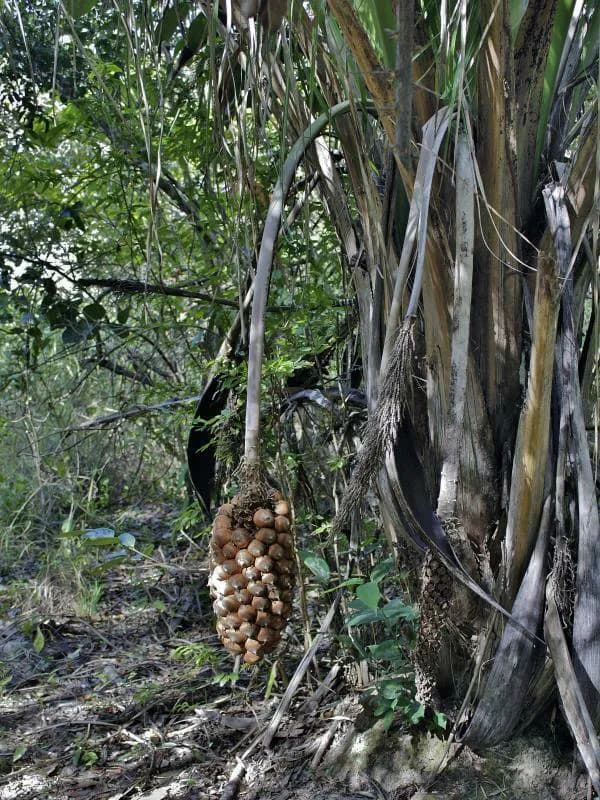
Botanical specimen of Attalea Compta.
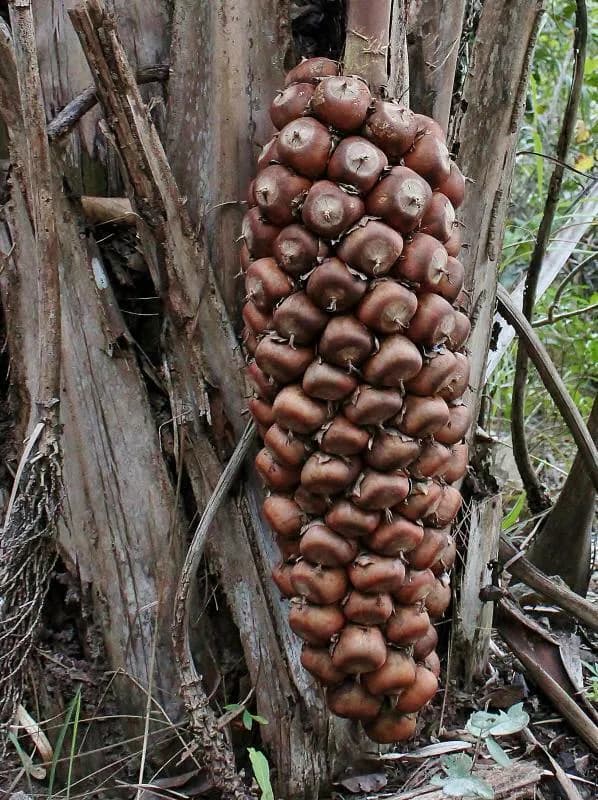
Botanical specimen of Attalea Compta.
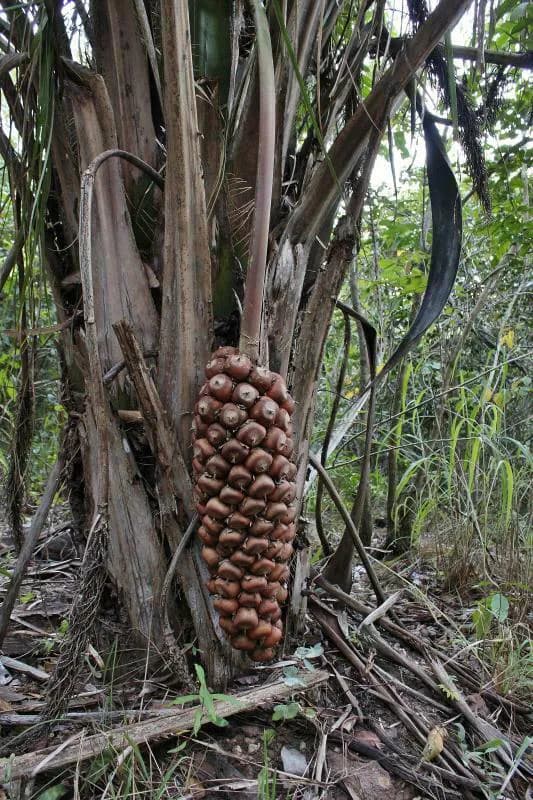
Botanical specimen of Attalea Compta.
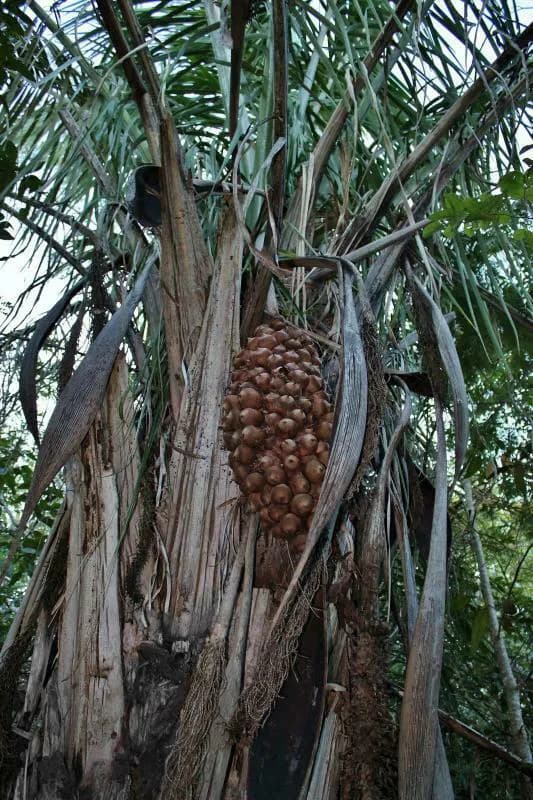
Botanical specimen of Attalea Compta.
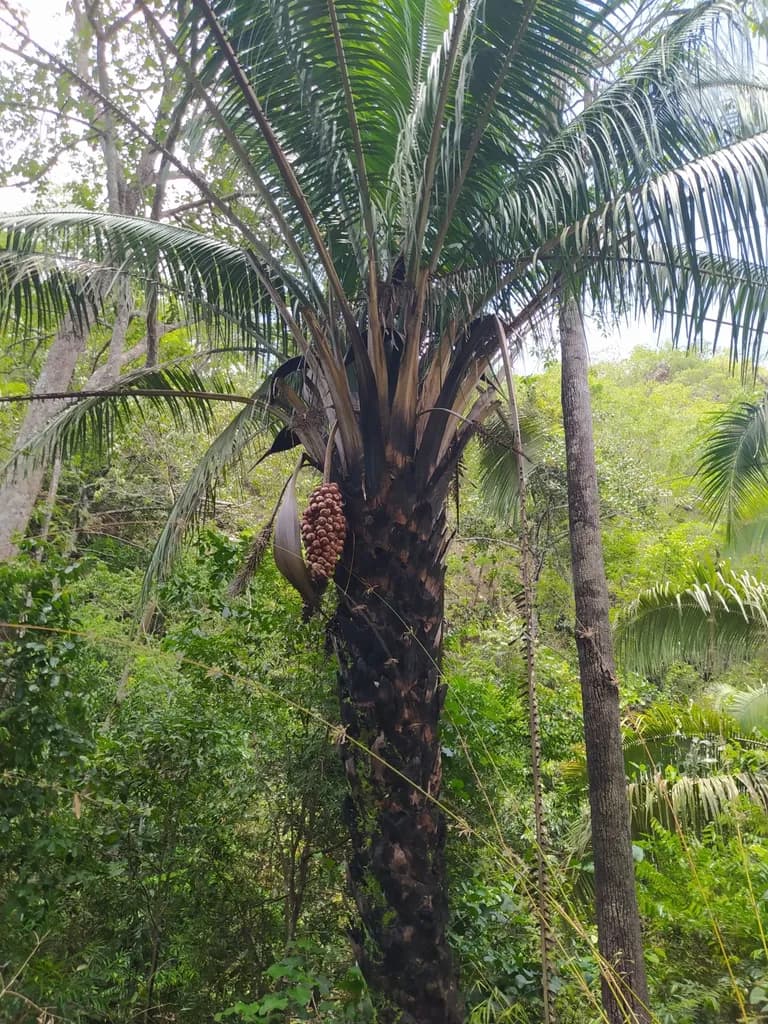
Botanical specimen of Attalea Compta.
Sources & Conservation
Curated- Attalea compta Mart. | Plants of the World Online, Kew Science (POWO) · accessed 2026-08
- Attalea compta Mart. | International Plant Names Index (IPNI) record 319683-2 · accessed 2026-08
- Attalea compta Mart. — The IUCN Red List of Threatened Species 2026: e.T237203678A237203686 (Least Concern, assessed 2022) · accessed 2026-08
- Attalea compta Mart. — Flora e Funga do Brasil, Jardim Botânico do Rio de Janeiro (FB33988) · accessed 2026-08
- CNCFlora • Attalea compta Mart. — Lista Vermelha da Flora Brasileira (Bicalho & Amorim 2022, LC) · accessed 2026-08
- CNCFlora • Attalea brasiliensis Glassman — 2012 assessment (EN), synonym of A. compta