Babassu palm
Attalea Speciosa • Babassu • Babaçu • American oil palm • Cusi • Auaçu • Uauaçu • Bauaçu • Guaguaço
Babassu palm in Motion
The Essence
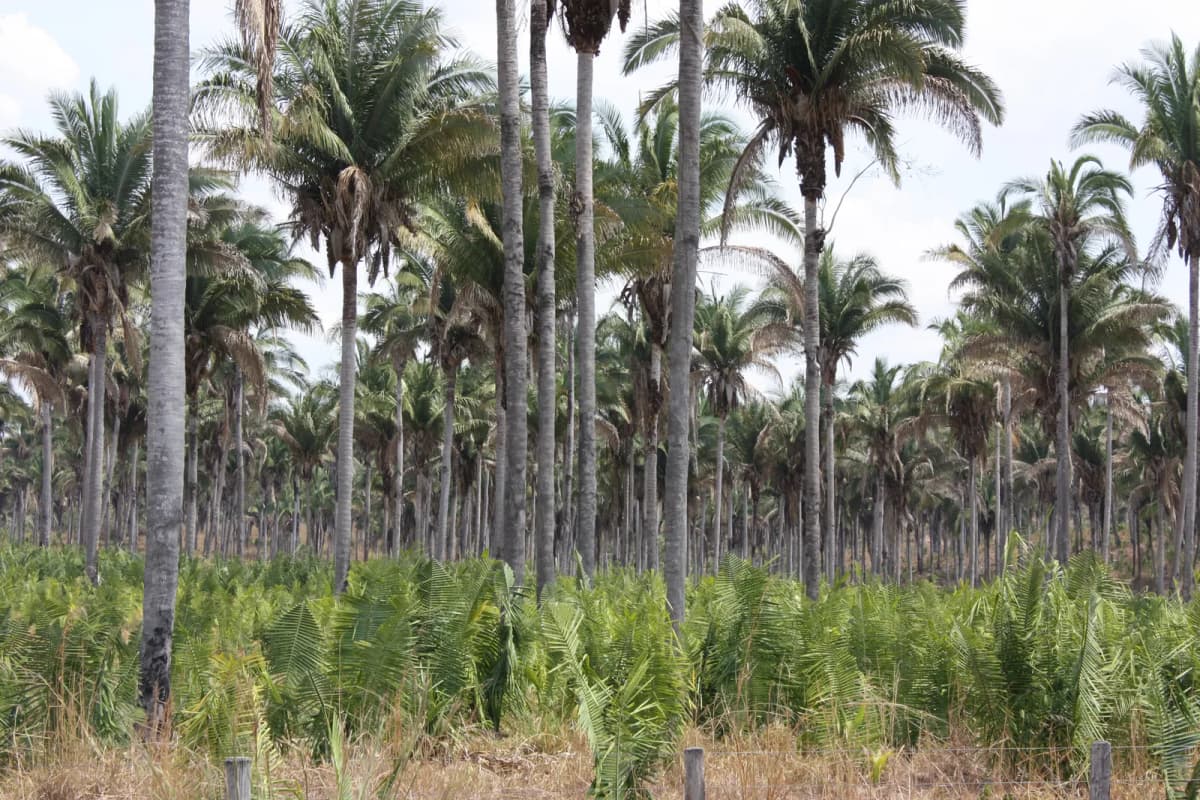
"Attalea speciosa, the babassu palm, is one of the most economically important wild palms of the Americas. Native from southern Suriname to Bolivia and across much of Brazil, it is the dominant tree of an entire ecoregion named for it — the Maranhão Babaçu forests, at the transition between Amazon rainforest, Cerrado and Caatinga. Babassu profits from disturbance rather than retreating before it: a germination habit that buries the growing point safely underground lets it survive clearing and human disturbance, and on cut-over and abandoned pasture it forms near-monodominant secondary forests known as babaçuais — stands once estimated at nearly 200,000 km² — to the point of ranking as a weed on land cleared for grazing. Its metre-long fruiting bunches can weigh 40–90 kg and carry 100–600 woody, oblong 'coconuts', each 8–15 cm long, whose kernels contain 60–70% oil: babassu oil goes into cooking oil, margarine, soap and cosmetics, the shells are burned into smokeless charcoal, and traditional communities of Maranhão grind the fruit into a flour sold as a nutritional supplement. Kernel harvesting has supported hundreds of thousands of rural households — as many as 450,000 by a 1985 estimate — with the nuts traditionally cracked by hand by the quebradeiras, the region's famous babassu coconut breaker women. In February 2008 babassu oil, blended with coconut oil and jet fuel, powered one of the four engines of a Virgin Atlantic Boeing 747 in the first biofuel test flight by a commercial airline. Long treated under the synonym Orbignya phalerata, the species was described by Martius in his Historia Naturalis Palmarum in 1826."
Attalea honours Attalus III Philometor, king of Pergamon, remembered for his interest in medicinal plants; the epithet speciosa is Latin for 'showy, beautiful'. Carl F. P. von Martius described the species in his Historia Naturalis Palmarum (1826), and it was long known under the synonym Orbignya phalerata. The Portuguese common name babaçu comes, via Nheengatu babasú, from Old Tupi ybagûasu — 'big fruit'.
Wild babassu underpins one of Brazil's great extractive economies. A 1985 study in Economic Botany estimated that as many as 450,000 subsistence-level households relied on the sale of babassu kernels to a regional vegetable-oil industry, from palm stands covering nearly 200,000 km² centred on Maranhão, Piauí and Goiás. Collecting and breaking the nuts — done by hand with a stone and a small axe — is traditionally the work of women, the quebradeiras de coco babaçu of Maranhão, Tocantins, Pará and Piauí, whose movement has become a symbol of traditional communities' land rights. In February 2008, babassu oil blended with coconut oil and jet fuel powered one of the four engines of a Virgin Atlantic Boeing 747 from London to Amsterdam in the first biofuel test flight by a commercial airline.
Natural Habitat
Attalea speciosa grows in the wet tropical biome, in lowland country up to about 500 m elevation, under 1,200–2,500 mm of annual rainfall with a 4–6 month dry season. Its stands are concentrated in the southern portion of the Amazon Basin, and in Brazil the palm occurs in Amazon rainforest, in gallery forests of the Cerrado and into the Atlantic Forest; the Maranhão Babaçu forests, where it dominates, form a transition between Amazon equatorial forest, Cerrado savanna and Caatinga shrubland. It regenerates vigorously where the original vegetation has been disturbed, forming dense thickets and near-monospecific stands (babaçuais) on cleared and abandoned land, and is considered an invasive weed on land cleared for pasture.
Curated Specimens
Botanical specimen of Attalea Speciosa.