Slender Joey Palm
Johannesteijsmannia Lanceolata • Slender Joey • Narrow-leaved Umbrella Palm • Chica
The Essence
"Johannesteijsmannia lanceolata, the Slender Joey Palm, is regarded as the rarest of the four Johannesteijsmannia species — a genus of magnificent rainforest fan palms, all four of which occur in Peninsular Malaysia. It is a solitary, stemless understorey palm endemic to Peninsular Malaysia, best known from a very small area of the Sungai Lalang watershed in Selangor, with Malaysian records extending to Pahang and Negeri Sembilan. Its erect, pleated, lance-shaped leaves are the narrowest in the genus: up to 3.5 m tall, with an undivided blade to 2.4 m long but only about 30 cm wide, glossy above and brown-scurfy beneath. Flowering to ripe fruit takes about 14–15 months, and the species produces few seeds compared with its relatives, so seed is scarce. Malaysia assesses it as Endangered under IUCN Red List criteria (ver. 3.1): it is an endemic with a very restricted extent of occurrence, and the largest subpopulation holds fewer than 250 mature individuals — though the species has not yet been evaluated for the global IUCN Red List. Export of the genus from Malaysia is banned under the Customs (Prohibition of Export) Order 1998, and collecting wild plants or seed requires a permit and is discouraged. Local indigenous communities, who know the palm as chica, use the tough leaves for roof thatch — a practice now rare and reserved mainly for kenduri celebration feasts — and the species is also traded locally as an ornamental. It remains rare in cultivation, found in only a few botanic gardens and private collections, among them the Singapore Botanic Gardens and Nong Nooch Tropical Botanical Garden in Thailand."
The genus name honours Johannes Elias Teijsmann (1808–1882), a Dutch gardener and botanist. The epithet lanceolata is from the Latin for "lance-shaped", referring to the narrow, lance-head-like outline of the leaf.
John Dransfield described the species in 1972 in his revision of the genus, published in the Gardens' Bulletin Singapore (26: 78). The original 1972 account records it in the Sungei Lalang Virgin Jungle Reserve in Selangor, growing with J. magnifica on the steep banks of a forest river. Its endangered status has since made it a subject of conservation-genetics research: Ang and colleagues published 31 microsatellite markers for the species in the American Journal of Botany in 2011, developed to study its genetic diversity and mating system.
Natural Habitat
A solitary palm of the wet-tropical rainforest understorey, recorded in hill dipterocarp forest at low elevations. In the Sungei Lalang Virgin Jungle Reserve it grows on the steep banks of a forest river in a deep, humid valley alongside Johannesteijsmannia magnifica, favouring well-drained soils and avoiding the low, swampy ground at the bends in the river. It thrives in river valleys, but only on well-drained sites, and scattered individuals also persist in logged forest near rivers.
Curated Specimens
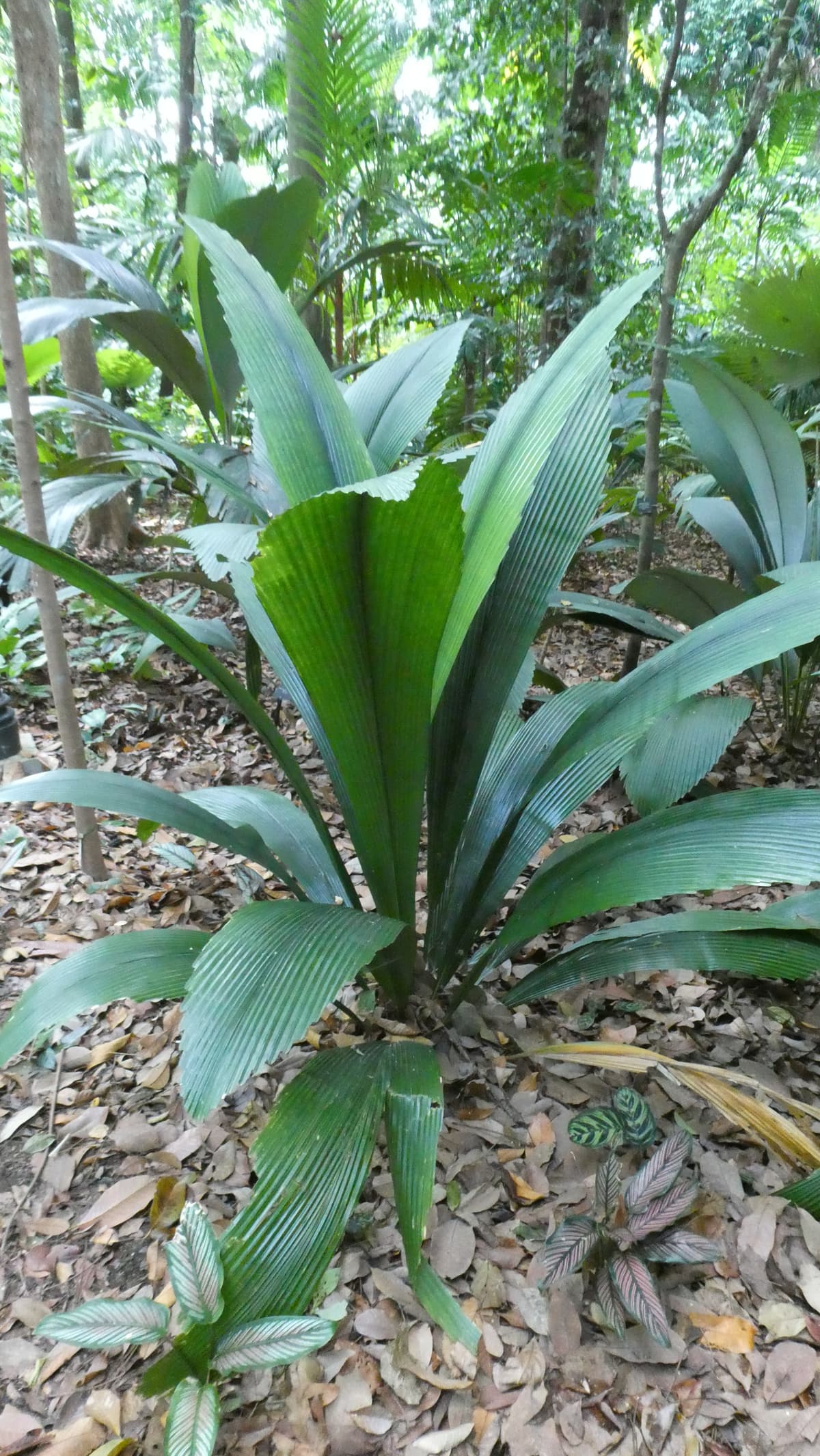
Botanical specimen of Johannesteijsmannia Lanceolata.
Sources & Conservation
Curated- Johannesteijsmannia lanceolata J.Dransf. — Plants of the World Online, Kew (data retrieved via POWO API) · accessed 2026-08
- Johannesteijsmannia lanceolata — Wikipedia · accessed 2026-08
- Johannesteijsmannia lanceolata — Palmpedia (Palm Grower's Guide), reproducing the description and habitat account of Dransfield's 1972 generic revision via Palmweb · accessed 2026-08
- Johannesteijsmannia lanceolata J.Dransf. — NParks FloraFaunaWeb, Singapore · accessed 2026-08
- Tan Kok Kiat (2020): Johannesteijsmannia lanceolata J. Dransf. — Malaysia Biodiversity Information System (MyBIS) · accessed 2026-08
- Johannesteijsmannia lanceolata J.Dransf. — GBIF (taxon 2731745; IUCN Red List category endpoint: Not Evaluated) · accessed 2026-08
- Johannesteijsmannia lanceolata — Monaco Nature Encyclopedia · accessed 2026-08
- Ang C.C., Lee S.L., Lee C.T., Tnah L.H., Zakaria R.M. & Ng C.C. (2011): Isolation and characterization of microsatellite loci in an endangered palm, Johannesteijsmannia lanceolata (Arecaceae). American Journal of Botany 98(5) — PubMed · accessed 2026-08