Joey on a stick
Johannesteijsmannia Perakensis • Daun payung • Belawan
Joey on a stick in Motion
The Essence
"Most of the fabled umbrella-leaf palms of the genus Johannesteijsmannia hold their enormous, undivided leaves almost straight out of the forest floor, with no visible trunk at all. Johannesteijsmannia perakensis is the exception, and its English nickname captures it perfectly: Joey on a stick. Alone among the four species of the genus, it slowly builds an erect stem to about 4 m tall and 15 cm thick, carrying the whole palm to 4-8 m and lifting its crown of pleated, narrowly diamond-shaped fronds — blades up to 3 m long and 1.6 m wide on spiny, metre-long stalks — like a beacon in the lower canopy. It is found nowhere on Earth except a few forested hill ranges in the Malaysian state of Perak, which gives the palm its name, and the southernmost corner of neighbouring Kedah. There it grows on hill slopes and ridge tops in primary hill dipterocarp rainforest, where it can be locally abundant. Malaysians know it as daun payung, 'umbrella leaf': a single frond makes a serviceable umbrella in a downpour, and the leaves have long been used as thatch for the huts of indigenous communities of Peninsular Malaysia. The young endosperm of the seed is reputedly edible. The palm has some engaging habits. Its funnel of upright leaves traps falling litter between the leaf stalks, gathering its own mulch. Arching sprays of small white flowers emerge among the leaves — fleshy, bisexual and strongly scented, by turns sweet or sour — and are thought to be pollinated by tiny stingless bees. They ripen into curious dirty-brown, globe-shaped fruits up to 5 cm across, armoured all over with corky warts. Seedlings look confusingly like the widespread J. altifrons; the reliable giveaways are the visible trunk, the widely spreading branches of the flower cluster and the knobblier fruit. Science caught up with this palm only in 1972, when palm botanist John Dransfield described it in the Gardens' Bulletin Singapore in his account of the genus. In Malaysia it is regarded as endangered, chiefly through loss of its hill-forest habitat to land conversion, though it has not yet been assessed for the global IUCN Red List; it is also a quiet emblem of local pride, featuring in the logo of Putrajaya Botanical Garden. In cultivation it remains a connoisseur's plant for ever-warm, humid gardens, demanding shade, moisture, shelter from wind — and patience."
The genus name honours Johannes Elias Teijsmann, a 19th-century Dutch gardener and botanist at the Buitenzorg Botanical Garden in Java (today's Bogor Botanic Gardens, Indonesia). The species epithet perakensis means 'from Perak', the Malaysian state to which the palm is largely confined.
Described by John Dransfield in 1972 in the Gardens' Bulletin Singapore (26(1): 72) in his account of the genus Johannesteijsmannia H.E.Moore, a small genus of four rainforest fan palms from the Malay Peninsula, Borneo and northern Sumatra. Uniquely in the genus, J. perakensis develops an erect above-ground trunk; the palm appears in the logo of Putrajaya Botanical Garden in Malaysia.
Natural Habitat
Understorey of primary hill dipterocarp rainforest, on hill slopes and ridge tops, in a few hill ranges of Perak and southernmost Kedah, Peninsular Malaysia, where it can be locally abundant. It favours deep, humid shade on well-drained ground.
Curated Specimens
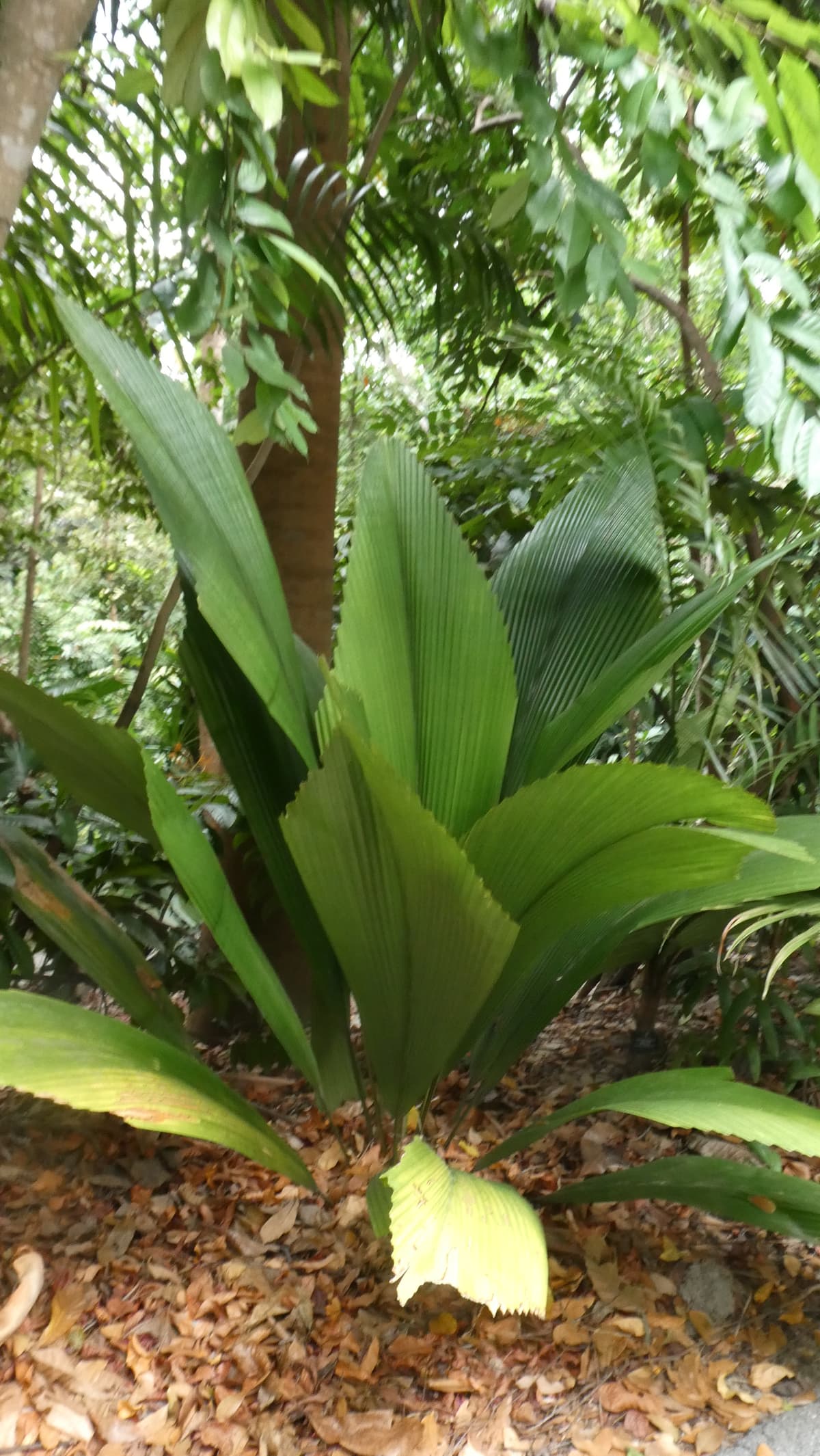
Botanical specimen of Johannesteijsmannia Perakensis.
Sources & Conservation
Curated- Johannesteijsmannia perakensis J.Dransf. — NParks Flora & Fauna Web (Singapore) · accessed 2026-08
- Johannesteijsmannia perakensis — Malaysia Biodiversity Information System (MyBIS) newsletter · accessed 2026-08
- Johannesteijsmannia perakensis J.Dransf. — International Plant Names Index (IPNI) · accessed 2026-08
- Johannesteijsmannia perakensis J.Dransf., Gard. Bull. Singapore 26: 72 (1972) — PALMweb · accessed 2026-08
- Johannesteijsmannia perakensis J.Dransf. — GBIF · accessed 2026-08
- Johannesteijsmannia — Wikipedia · accessed 2026-08