Silver joey palm
Johannesteijsmannia Magnifica • Silver joey • Segalok
Silver joey palm in Motion
The Essence
"Johannesteijsmannia magnifica is one of only four species in a genus defined by enormous undivided leaves, and one of three restricted to Peninsular Malaysia. Kew's Plants of the World Online gives its native range narrowly as Selangor, while other records extend it along the western side of the peninsula into Negeri Sembilan and Perak. Documented sites include Sungai Lalang Forest Reserve, where a gregarious flowering was recorded in May 1968, and Berembun Forest Reserve in Negeri Sembilan, the study population behind most of what is known about its reproduction. The palm is effectively stemless. A single subterranean, prostrate stem up to about 15 cm thick carries leaves that rise straight from the rootstock: simple, leathery, strongly pleated blades, rhomboid to spear-shaped, up to 3 m long (the first metre or so being petiole) and up to 2 m wide, erect at first and then arching. The upper surface is intense green; the underside is densely covered in fine white hairs that give a silvery sheen and the trade name silver joey. Whole plants reach about 3 m tall. Branched inflorescences emerge between the leaves on a curved, tomentose peduncle 50 to 80 cm long and carry cream-white, fleshy, bisexual flowers with a strong fermented sweet-and-sour scent. The fruit is a globose drupe up to about 4 cm across, covered in thick corky pyramidal warts; young fruits are cream to pinkish-white, turning orange-brown as the pericarp breaks up and light brown at maturity. Its breeding biology is unusually well recorded for an obscure palm. Chan and Chua found flowering to be annual, gregarious and synchronous from February to April, fruiting confined to April to October with mature fruit available only from July to October, and a mean of just 82 mature fruits a year for the whole population, a strikingly different strategy from its congeners, which flower sub-annually and fruit continuously. Chan and Saw recorded anthesis in this species peaking between 07:00 and 09:00, within a genus-wide peak of 05:00 to 11:00, with flies, beetles and stingless bees (Trigona) as potential pollinators among visitors that also included thrips and ants. They found its breeding system to be facultative selfing, which allows reproduction in isolated plants or without pollinators. Assessments applying IUCN criteria in the botanical literature rate the species Endangered (Chan, Chua and Saw 2011, cited as such by Chan and Chua 2019), but no assessment for it could be located on the IUCN Red List itself, and it carries neither an IUCN taxon identifier nor a Red List category in Wikidata."
The genus Johannesteijsmannia honours Johannes Elias Teijsmann (1808-1882), the Dutch gardener and botanist at the botanic garden at Buitenzorg, now Bogor, in Java. Harold E. Moore erected the genus in 1961 (Principes 5: 116) as a replacement name for Teysmannia Rchb.f. & Zoll. (Linnaea 28: 657, 1858), an illegitimate later homonym of Teysmannia Miq. (1857) in the Apocynaceae. The epithet magnifica is Latin for magnificent or splendid. John Dransfield described the species in 1972, in Gardens' Bulletin Singapore 26: 75, with type locality given as Malaya.
Orang Asli communities use the fronds for roof thatching (atap), and leaves across the genus, known in Malay as daun payung, are used for thatch and shelters. The palm's appeal has cut both ways: it is a prized collector's plant, and Johannesteijsmannia is traded mainly in the southern parts of North America, Taiwan and Japan, with seed collected illegally from the wild. Wikipedia reports that domestication by a private company, Malesiana Tropicals Sdn. Bhd., has reduced wild seed collection, though Chan and Chua note that reports of wild seed collection for trade persist. Reported threats are deforestation, logging, dam construction, oil palm plantations and highway development. Chan and Chua record the species in cultivation at the Kepong Botanical Gardens of the Forest Research Institute Malaysia, where, receiving more sunlight, rainfall and occasional fertiliser than wild plants, it flowered sub-annually rather than annually.
Natural Habitat
An understorey palm of evergreen tropical lowland dipterocarp forest. The three Johannesteijsmannia populations studied by Chan and Chua, including the J. magnifica population at Berembun, all occur at 120 to 350 m above sea level; NParks gives primary rainforest on steep slopes and ridge-tops at 150 to 500 m and in deep, humid forest river valleys, and Wikipedia gives 120 to 500 m on valley bottoms and hill slopes, including one site on limestone. It prefers unlogged primary forest with high canopy cover and forms dense populations in well-shaded places. Palmweb's treatment of the genus describes plants of the undergrowth of primary rain forest on hillslopes and ridgetops, intolerant of disturbance and highly localised, apparently absent from seemingly suitable forest elsewhere.
Curated Specimens
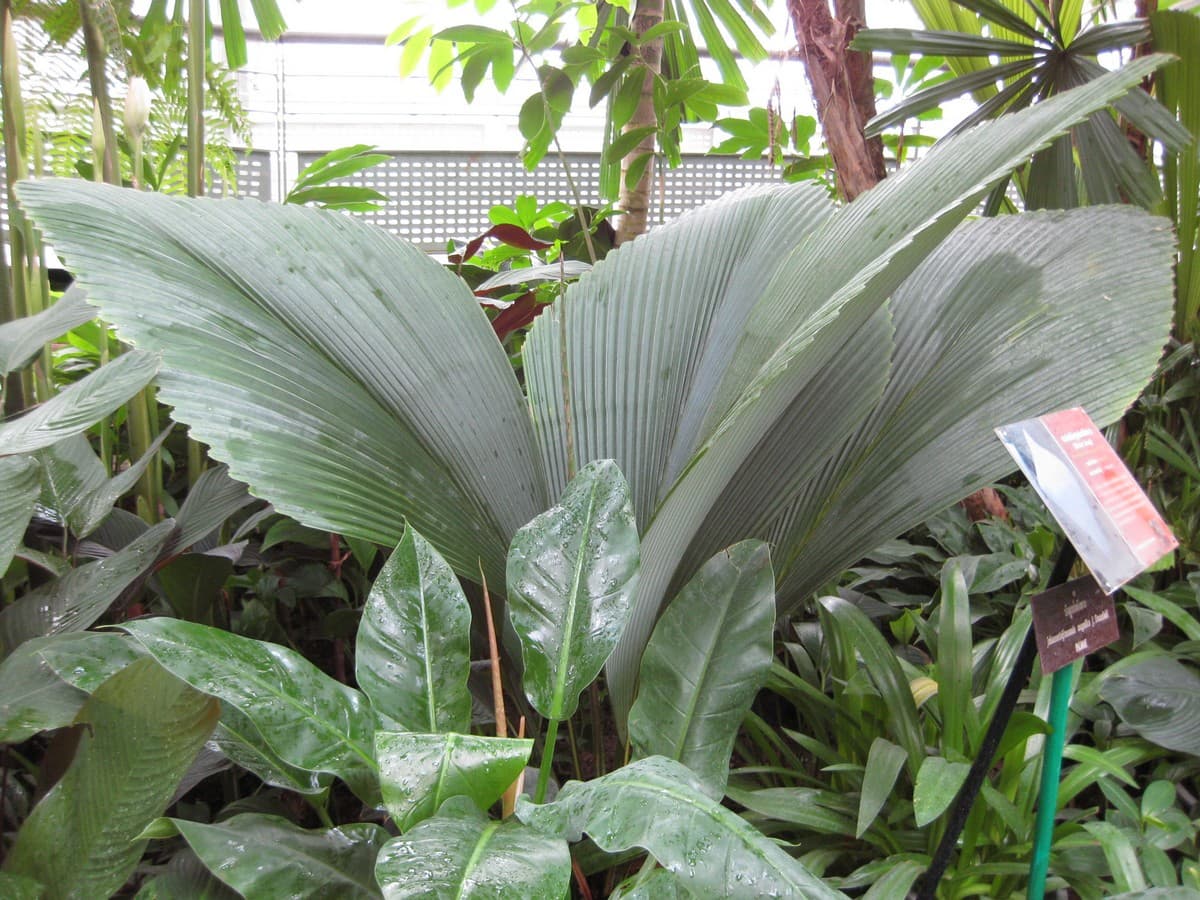
Botanical specimen of Johannesteijsmannia Magnifica.
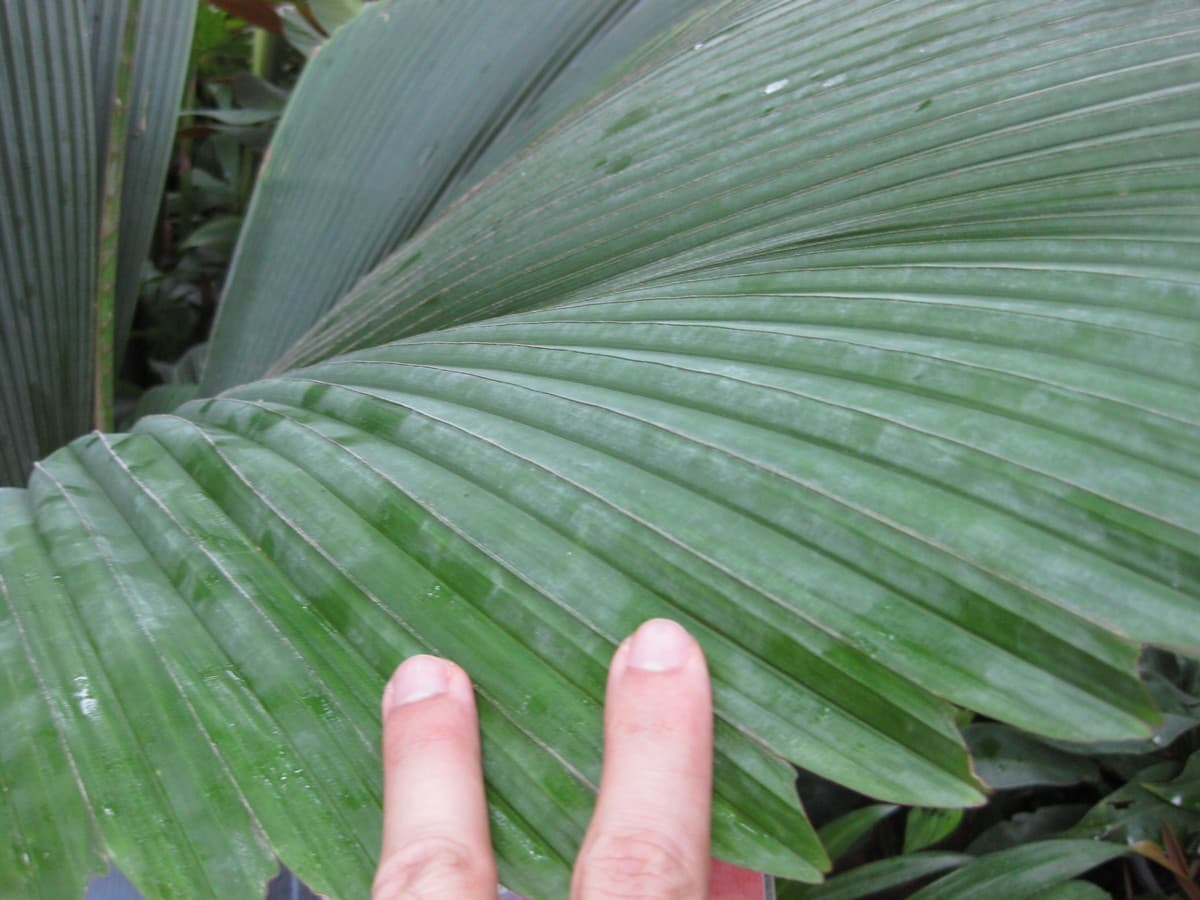
Botanical specimen of Johannesteijsmannia Magnifica.
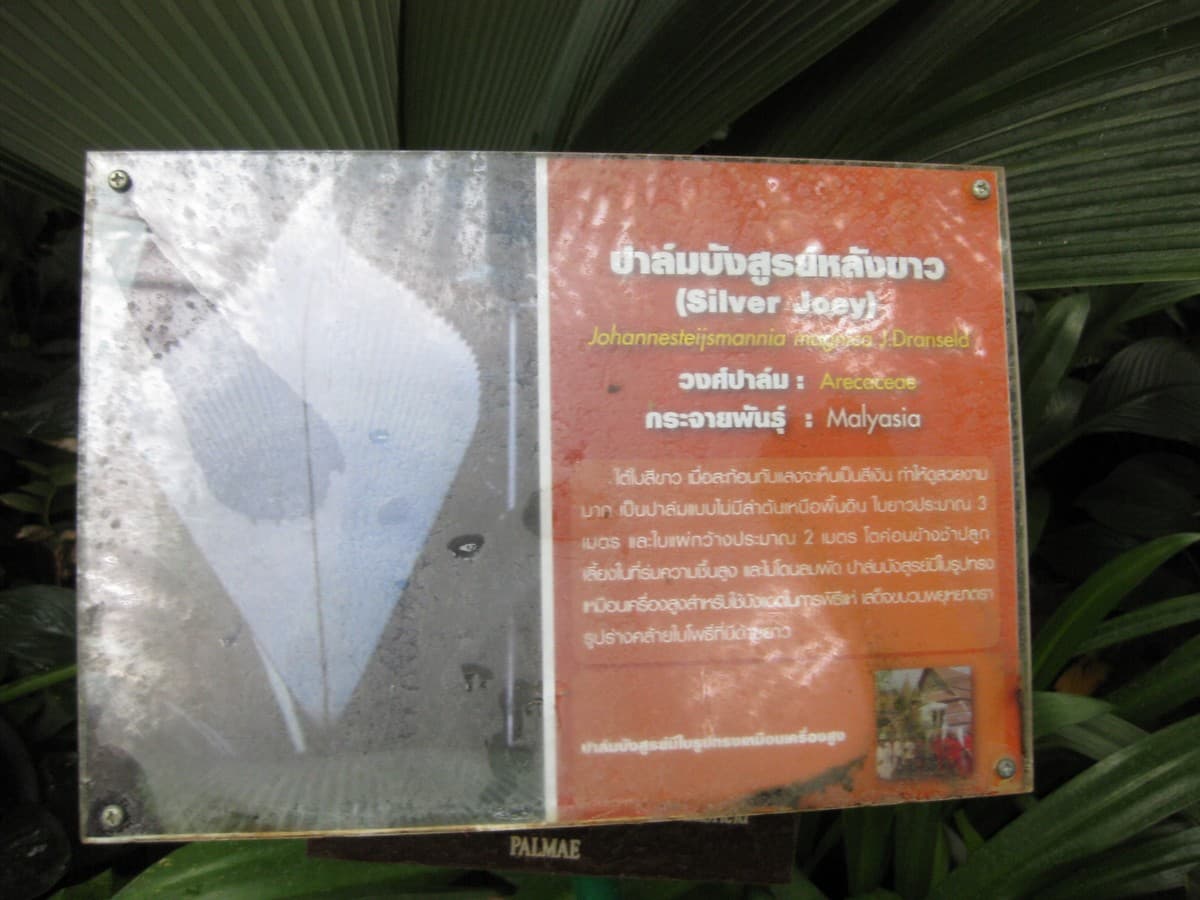
Botanical specimen of Johannesteijsmannia Magnifica.
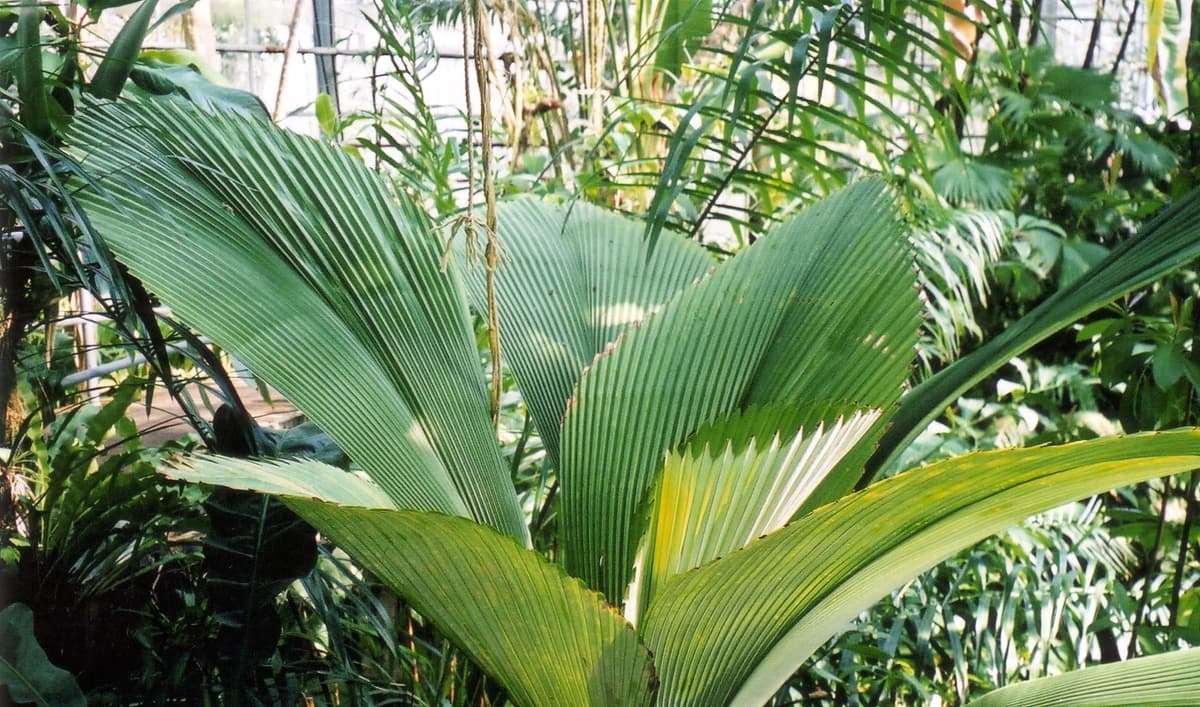
Botanical specimen of Johannesteijsmannia Magnifica.
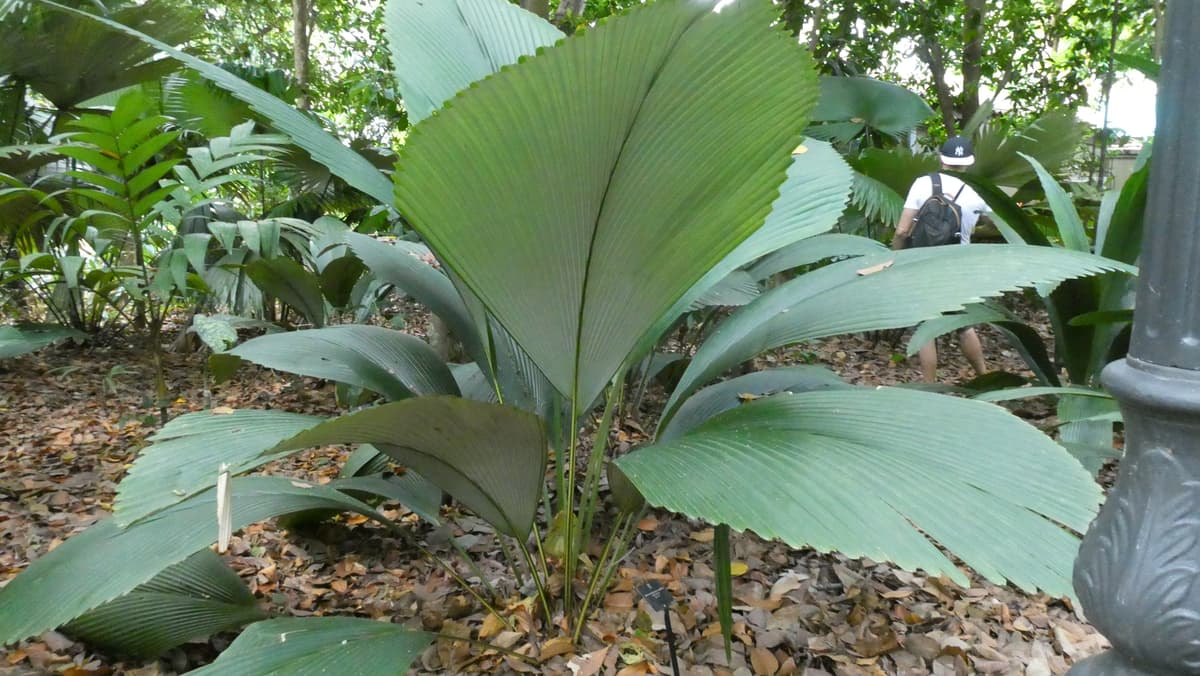
Botanical specimen of Johannesteijsmannia Magnifica.
Sources & Conservation
Curated- Johannesteijsmannia magnifica J.Dransf. | Plants of the World Online | Kew Science · accessed 2026-08
- Johannesteijsmannia magnifica - Wikipedia · accessed 2026-08
- Johannesteijsmannia magnifica J.Dransf. - NParks FloraFaunaWeb (Singapore Botanic Gardens) · accessed 2026-08
- Chan, Y.M. & Chua, L.S.L. (2019). Flowering phenology and seed production of three threatened tropical palms, Johannesteijsmannia spp. (Arecaceae). Gardens' Bulletin Singapore 71(1): 243-260 · accessed 2026-08
- Chan, Y.M. & Saw, L.G. (2011). Notes on the pollination ecology of the palm genus Johannesteijsmannia (Arecaceae). Journal of Pollination Ecology 6(15): 108-117 · accessed 2026-08
- Johannesteijsmannia magnifica - Palmpedia, Palm Grower's Guide · accessed 2026-08
- Johannesteijsmannia magnifica - PACSOA Wiki