Murumuru
Astrocaryum Murumuru • Muru-muru • Palmeira murumura
Murumuru in Motion
The Essence
"Astrocaryum murumuru is one of the most heavily armed palms of Amazonia, described by Carl Friedrich Philipp von Martius in 1824 and carrying an Amazonian vernacular name as its epithet. It is highly variable: some plants are short and effectively stemless, others grow into tall, robust, clustering palms up to 15 m, with hard black spines often over 20 cm long on the stem, sheathing leaf bases, petioles and fruit stalks - armament that complicates fruit harvesting. The turbinate fruits, 60-85 mm long, carry a yellow fleshy mesocarp 6-10 mm thick around a single large seed. When the fruit is ripe the cluster falls to the ground, and rodents eat the yellow flesh, leaving the seeds clean. The kernels are the source of murumuru butter, a mainstream cosmetic fat. It contains lauric, myristic and oleic acids, is odourless and tasteless, resists rancidity, and melts at 33 C - higher than tucuma (30 C) or coconut (22.7 C) - which gives it greater consistency and allows partial substitution for cocoa butter in chocolate. It is used at 0.5-1% in shampoos and at 0.5-8% in conditioners, creams, soaps, lipsticks and deodorants. Roughly 100 kg of dry seeds yields 27-29 kg of kernels, which in turn yield 40-42% oil, about 3.8 litres of oil per palm. Across Amazonia the stems are used for house posts, walls and floors, the leaves for thatch and their fibres for hammocks, the leaf ribs for brooms and fans, and the seeds for carved rings and necklaces; the palm heart is eaten cooked or in beverages, and beetle larvae taken from decaying trunks are collected as food. Its taxonomy is unsettled. Kahn's 2008 treatment restricts the species to the Guianas and the northeastern and central regions of the Amazon basin in Brazil, and makes it the type of Astrocaryum subsection Murumuru alongside A. chonta and A. ulei. Earlier authors used a considerably broader circumscription, publishing names such as A. murumuru var. urostachys and A. murumuru var. ciliatum; POWO today accepts only A. yauaperyense Barb.Rodr. as a synonym of the species."
Astrocaryum combines Greek astron, star, and karyon, nut, referring to the star-like pattern of fibres around the endocarp pores (Genera Palmarum). The epithet repeats the palm's Amazonian vernacular name; murumuru is recorded as its Portuguese common name. Palmpedia gives the pronunciation as ahs-tro-kahr-EE-uhm moor-oo-MOOR-oo.
Martius published the species in Historia Naturalis Palmarum 2: 70 (1824). Astrocaryum yauaperyense Barb.Rodr. is treated as a heterotypic synonym. The species is the type of Astrocaryum subsection Murumuru, which also contains A. chonta and A. ulei. Murumuru butter was highly valued in Europe and the United States during the 1940s and 1950s, when it served as an ingredient in vegetable creams and soaps.
Natural Habitat
A palm of lowland Amazonian rain forest, usually on ground subject to periodic inundation. It grows on islands and in river lowlands throughout the Amazon estuary and its tributaries in dense or semi-open forest, on land under tidal influence in the lower Amazon, and on the margins of the rivers and gapos of the upper Amazon; it is frequently found in the lowlands of Marajo Island. In the Brazilian Amazon it is often one of the dominant trees. POWO records the lifeform as shrub or tree in the wet tropical biome.
Curated Specimens
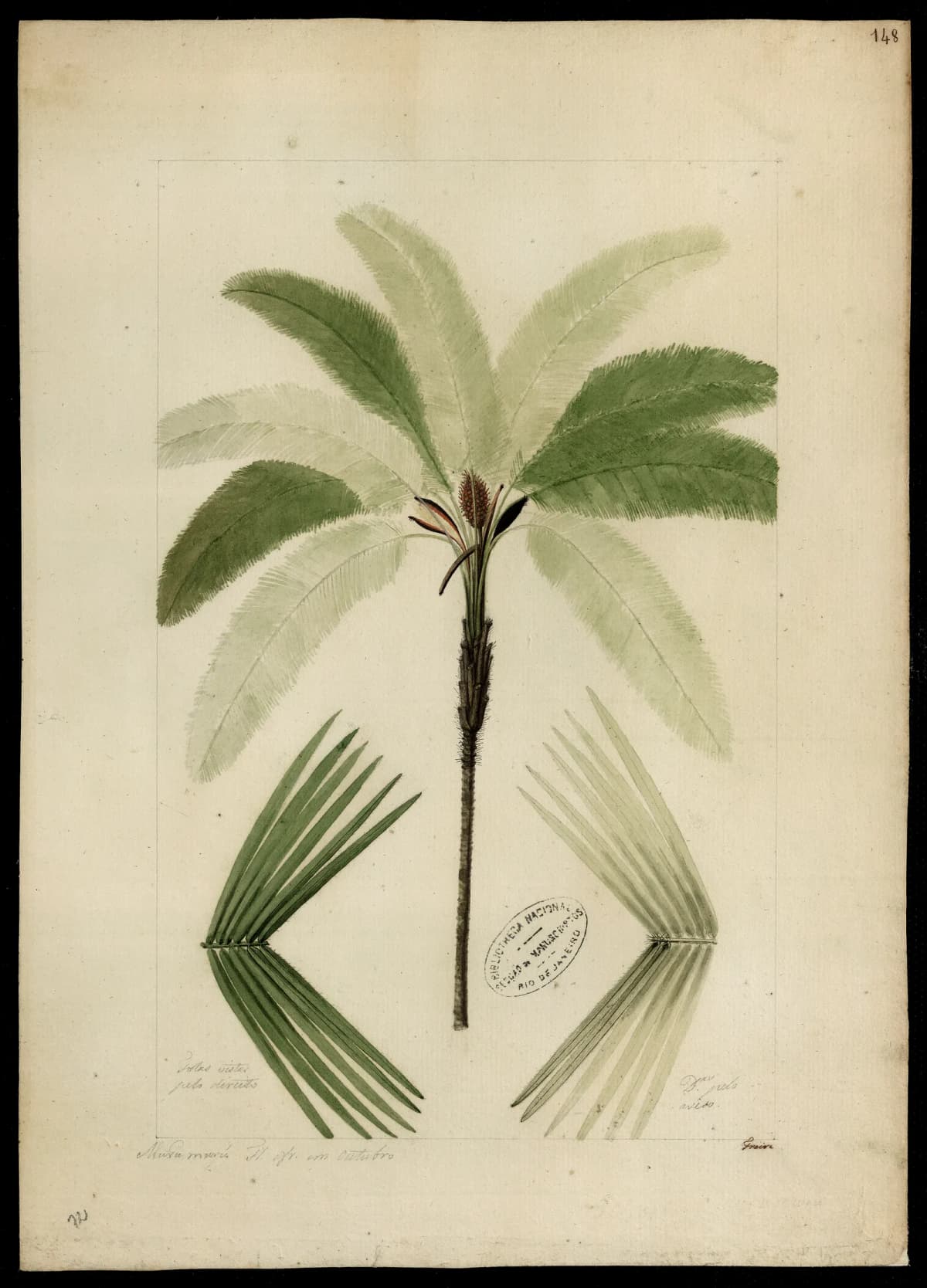
Botanical specimen of Astrocaryum Murumuru.