Black palm
Astrocaryum Standleyanum • Chunga • Mocora palm • Panama star-nut palm • Palma negra • Pejibaye de montaña • Güérregue • Güinul
Black palm in Motion
The Essence
"Astrocaryum standleyanum is a solitary, heavily armed tree palm of the humid lowlands west of the Andes, ranging from Costa Rica through Panama and Colombia to Ecuador. Accounts of its size differ between sources: Palmweb gives a stem to 15 m tall and 30 cm in diameter, Wikipedia and Monaco Nature Encyclopedia cite 15-20 m, and Useful Tropical Plants 6-15 m with a stem 16-22 cm across. The trunk is densely clad in flattened black spines up to 20 cm long. A funnel- or umbrella-shaped crown carries about 15 leaves (11-18 according to Useful Tropical Plants), each 4-5 m long, with roughly 100 pinnae on each side arranged in groups of two to five and spreading in different planes, the central ones to 110 cm long. The erect to arching cream inflorescences reach 150 cm with up to 200 branches, and the obovoid fruits, 5-6 cm long and weighing around 25 g, ripen from greyish green to orange over a seed up to 3 cm wide. Plants push out three to five new leaves a year, each lasting about 4.5 years, and begin reproducing at nine or ten years old. The species is best known as a model system in tropical seed-dispersal ecology. On Barro Colorado Island in Panama, Jansen and colleagues (2012) tracked radio-tagged seeds and showed that Central American agoutis repeatedly steal and re-cache them: just 18% of seeds moved more than 25 m on their first movement, but 35% eventually reached distances over 100 m, and an estimated 14% survived to one year. One seed was cached as many as 36 times, travelled more than 749 m in total, and was dug up and eaten by an agouti 209 days after initial dispersal. Only 16% of caches were recovered by the agouti that made them; the other 84% were stolen by other agoutis, and it is this reciprocal theft that drives seeds across home-range boundaries. The fruit is thought to have been dispersed in the past by now-extinct megafauna such as gomphotheres; the Central American spiny rat scatter-hoards the seeds as well, and most fruits are infested by bruchid beetles."
Astrocaryum combines Greek astron, star, with karyon, nut, referring to the star-like pattern of fibres around the endocarp pores (Palmweb). The epithet standleyanum honours the American botanist Paul Carpenter Standley (1884-1963). L.H. Bailey published the species in Gentes Herbarum 3: 88 (1933).
Astrocaryum standleyanum is one of the most economically important palms in Ecuador. The Wounaan and Emberá peoples, together with Afro-Colombian and Afro-Ecuadorian communities, extract fibre from its leaves: fibres from the opened, mature leaves are used to make mats, while the less robust fibres of the immature leaves are used for basketry, with the material also going into hats, hammocks, fishing nets, bags, jewellery and other accessories. The fibre is washed and sun-dried, then sometimes dyed with extracts of other plants, bleached with sulphur, or buried in mud to darken it; the Emberá prefer to harvest during the full moon, when they believe the fibres are strongest. Finished products reach an international market, with Japan and the United States among the major importers. Other uses include the edible fruit and palm heart, wood for walking sticks, bows and fishing rods, stems for house construction, endocarps carved into beads and ornaments, and occasional processing for oil. Despite a global Least Concern assessment, the palm has been described as decimated in localized areas where its fibre is in demand: much of the time the fronds are cut from standing trees, but sometimes the trees themselves are cut down, a more destructive practice. In parts of Ecuador it is maintained through tropical agroforestry, and it is often conserved in pastures when forest is cleared for agriculture.
Natural Habitat
Grows primarily in the wet tropical biome (POWO/Kew, mirrored by ColPlanta). Palmweb records it to 900 m elevation but usually at lower altitudes, in non-inundated areas, and describes it as common in somewhat seasonal tropical moist forest in western Ecuador. Other sources place it lower still: wet forest up to 500 m (Wikipedia), up to 300 m and more often lower (Monaco Nature Encyclopedia), and lowland rainforest on imperfectly drained soils below 200 m (Useful Tropical Plants; ColPlanta gives 0-200 m for Colombian material). In Colombia it is recorded from the Pacific biogeographic region in Antioquia, Cauca, Chocó, Nariño and Valle del Cauca. It is most common in central Panama, becoming abundant in the tropical forests around the Panama Canal, though in general it is described as not a common plant.
Curated Specimens
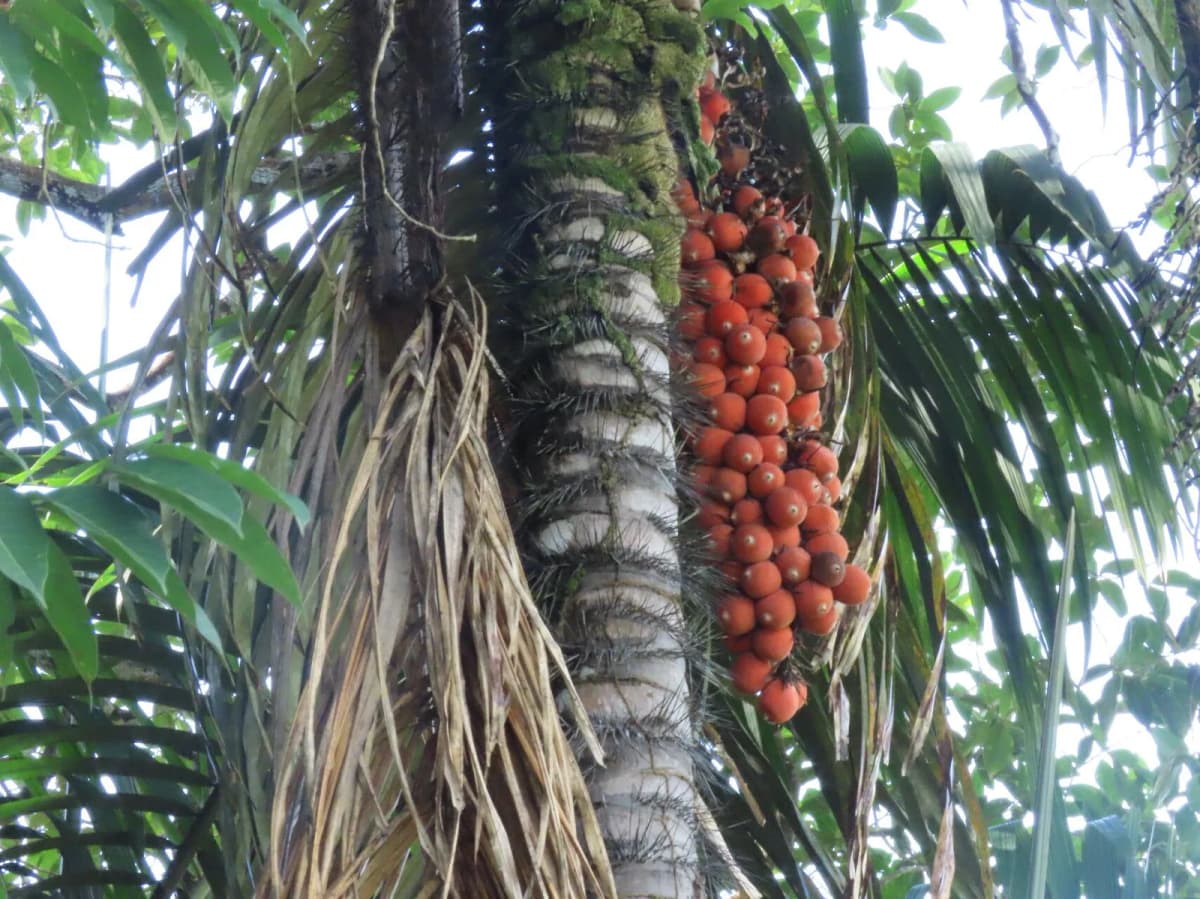
Botanical specimen of Astrocaryum Standleyanum.