Tucuma palm
Astrocaryum Vulgare • Tucum palm • Awarra palm • Tucumã • Tucumã-do-Pará • Awara • Aouara • Wara awara • Chontilla • Tucum-bravo • Tucumanzeiro-do-Pará
The Essence
"Astrocaryum vulgare is a fiercely spiny, usually clustering feather palm of the Guianas and eastern Amazonia, described by Carl Friedrich Philipp von Martius in 1824. Its epithet means "common", and it earns it: the IUCN assessment published in 2022 maps the species across French Guiana, Guyana, Suriname and 21 Brazilian states and federal units, with an extent of occurrence of 3,218,990 km² — over 3 million km² — and calls it widespread and common with a stable population. Unusually for an Amazonian palm, it has gained from forest clearance. It is a pioneer of terra firme, low vegetation cover and open ground rather than undisturbed old growth, regenerates easily from its multiple stems after damage, and can put out new shoots after a fire. The orange fruit is the reason most people know it. In French Guiana the fatty, provitamin-A-rich mesocarp is the base of bouillon d'awara, the traditional Easter dish; in northern Brazil raw tucumã pulp goes into the X-caboquinho sandwich with fried banana and cheese. Wikipedia reports that a mature tree can yield up to 50 kg of fruit a year — around 2.5 kg of pulp oil and 1.5 kg of seed oil — with a cited potential of 4.8 tons of fatty material per hectare. The oil goes into soap, cosmetics and biodiesel. Immature endosperm yields a drink called vino de tucuma, and fermented spathe sap a palm wine. One caution on names: older ethnobotanical text reproduced on Palmweb and Palmpedia calls this species the chambira palm, and Palmweb's common-name list for it also carries canangucha and aguaje — names that belong to the unrelated moriche palm, Mauritia flexuosa. Aggregated vernacular lists for this species are worth reading with care."
Astrocaryum combines Greek astron, star, and karyon, nut, referring to the star-like pattern of fibres around the pores of the endocarp — the explanation given in Genera Palmarum (Dransfield et al. 2008) and quoted on Palmweb, which also gives "Tucuma" as the standard common name for the genus. The epithet vulgare is Latin for common or ordinary, fitting for a palm the IUCN calls widespread and common across the Guianas and eastern Amazonia. Martius published the name in Historia Naturalis Palmarum 2: 74 (1824), a citation repeated by WorldFloraOnline and by Flora e Funga do Brasil.
The epidermis and hypodermis of the sword leaf yield an important fibre, used in manufacturing mats, hats, hammocks and fishing lines and nets — the wording of the IUCN assessment, which draws on Pérez-Arbeláez (1956) via Palmweb; indigenous Amazonian people extract the leaf fibre for cordage, hammocks, belts and woven goods, and Useful Tropical Plants describes it as rot-resistant and reportedly the strongest fibre in the Amazon. Black rings turned from the hard seed shell are a well-known Amazonian craft: Wikipedia records that in the 1800s the ring served as a symbol of marriage for slaves and natives who could not afford gold, and that Catholic missionaries now wear them as a symbol of solidarity with the poor and support in the struggle for equality, social justice and human rights. Schultes (1974), cited by both Palmweb and the IUCN assessment, recorded that Witoto medicine men believe the heavy trunk spines are the favourite and most potent darts shot into the human body by malevolent spirits to cause sickness and misfortune; Palmweb also cites a Yukuna belief that the tree embodies a spirit that turned into an Astrocaryum in order to continue living. Traditional medicinal uses listed by PFAF include a root decoction for furunculosis and syphilis, seed oil as a laxative and for rheumatism, pain and earache, the vitamin-A-rich fruit against xerophthalmia, and the pulp for coughs.
Natural Habitat
Lowland rain forest and forest patches in savanna, on flat to gently rolling terrain that is not subject to periodic inundation, from the lowlands up to about 150 m. Wikipedia calls it a characteristic palm of terra firme — forest that is never flooded — of low vegetation cover and open fields, an aggressive pioneer of secondary forest and pasture that is never found in undisturbed old-growth rainforest. The IUCN assessment records that it commonly inhabits disturbed areas such as abandoned fields at low elevations where the soil is well drained, and classes subtropical/tropical moist lowland forest as habitat of major importance. Flora e Funga do Brasil lists it as a terrestrial palm of anthropic areas and cerrado (lato sensu), within the Amazônia and Cerrado phytogeographic domains, growing in open areas on sandy soils. Seeds are probably dispersed mostly by capuchin monkeys and by scatter-hoarding rodents (agoutis and acouchis).
Curated Specimens
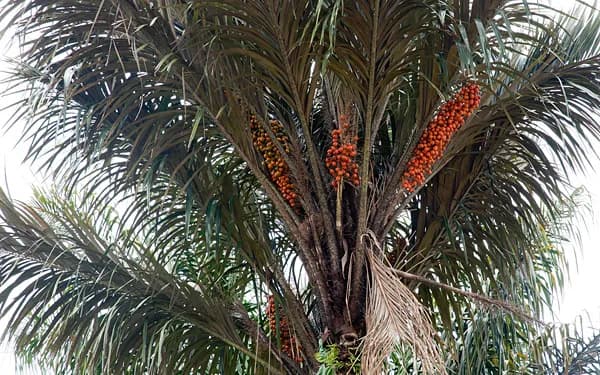
Botanical specimen of Astrocaryum Vulgare.
Sources & Conservation
Curated- Astrocaryum vulgare Mart. — Plants of the World Online (POWO), Royal Botanic Gardens Kew · accessed 2026-08
- Hargreaves, S. 2022. Astrocaryum vulgare. The IUCN Red List of Threatened Species 2022: e.T111453461A161420920 (Least Concern; assessed 23 March 2020; EOO 3,218,990 km²) · accessed 2026-08
- Astrocaryum vulgare Mart. — Palmweb: Palms of the World Online (species page; distribution and ethnobotanical use records citing Schultes 1974, Pérez-Arbeláez 1956, Bernal 1998) · accessed 2026-08
- Astrocaryum G.Mey. — Palmweb genus page (etymology and standard common name quoted from Dransfield et al. 2008, Genera Palmarum, Kew Publishing) · accessed 2026-08